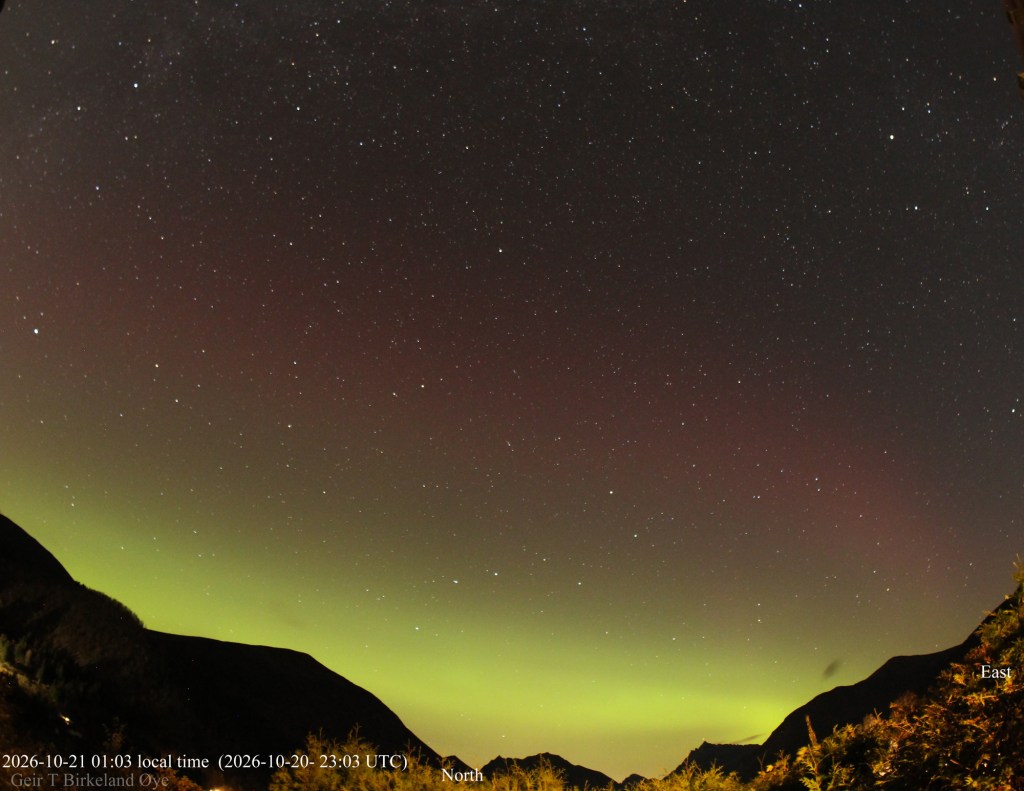
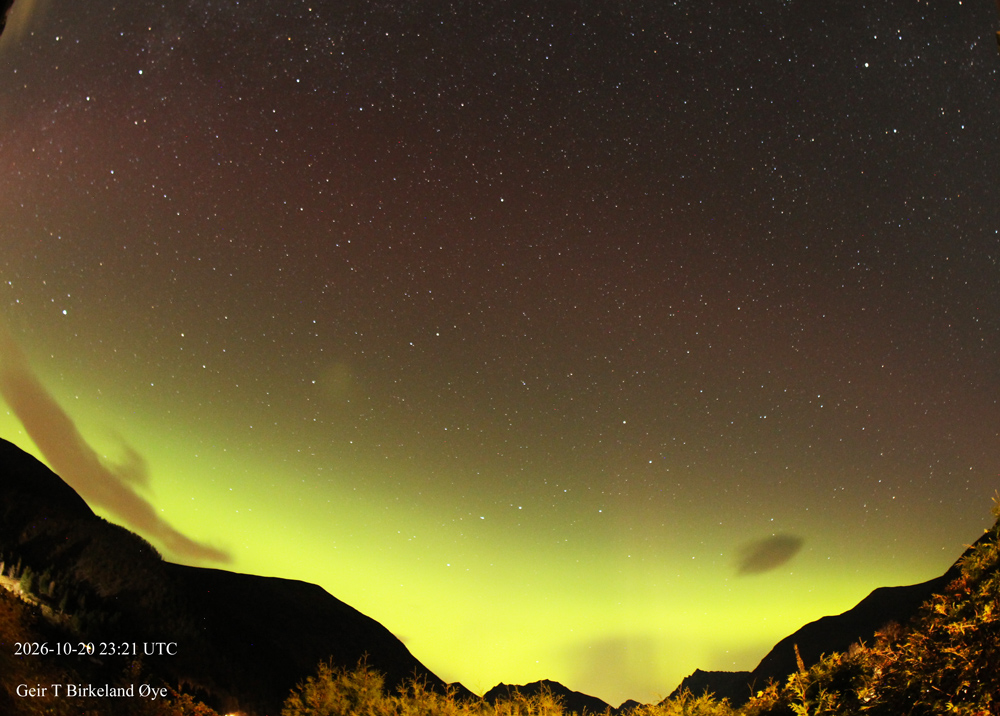
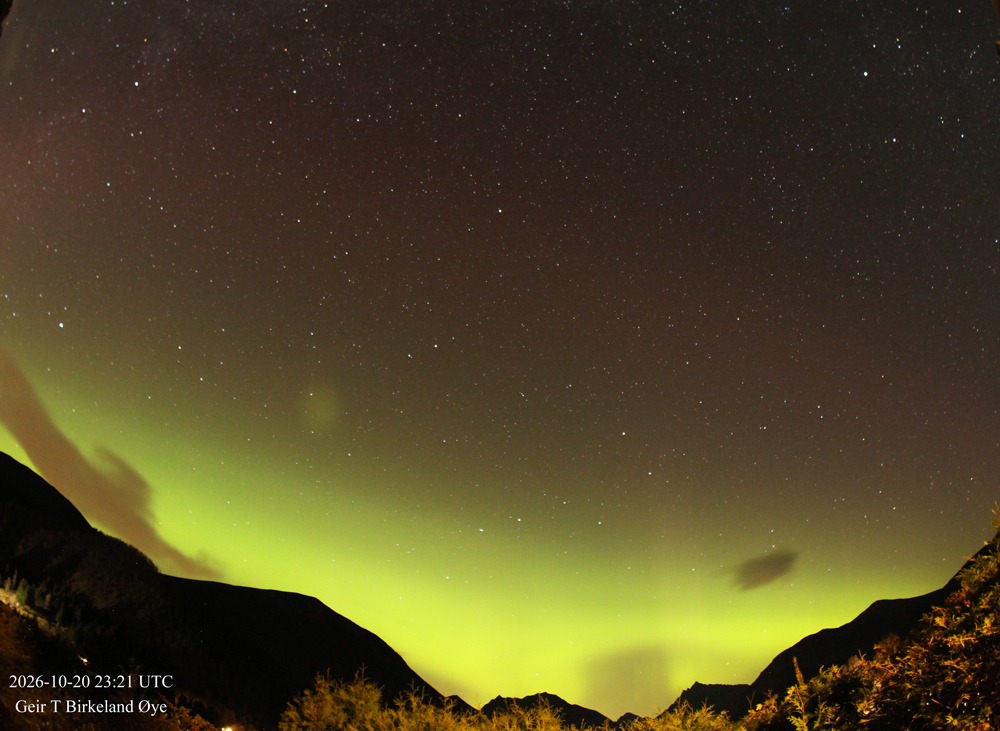
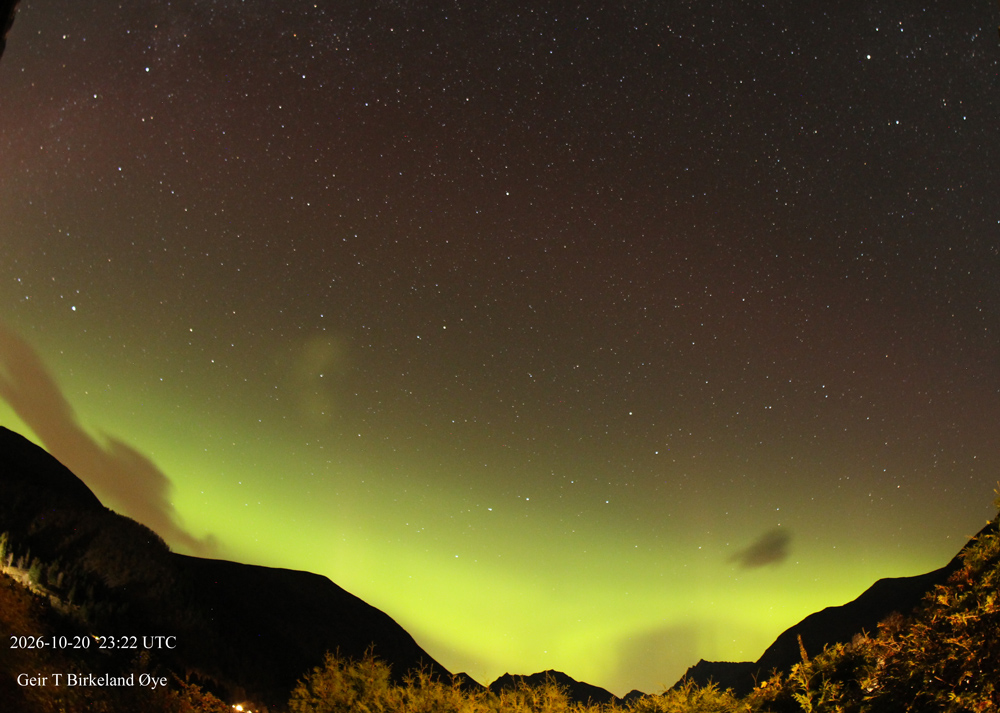
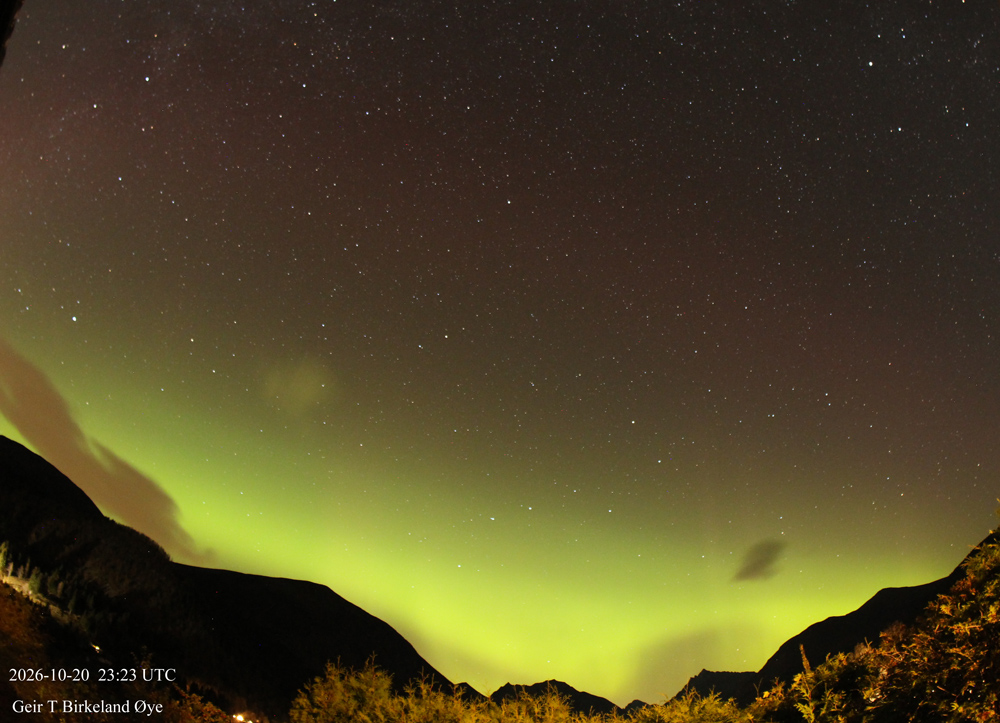
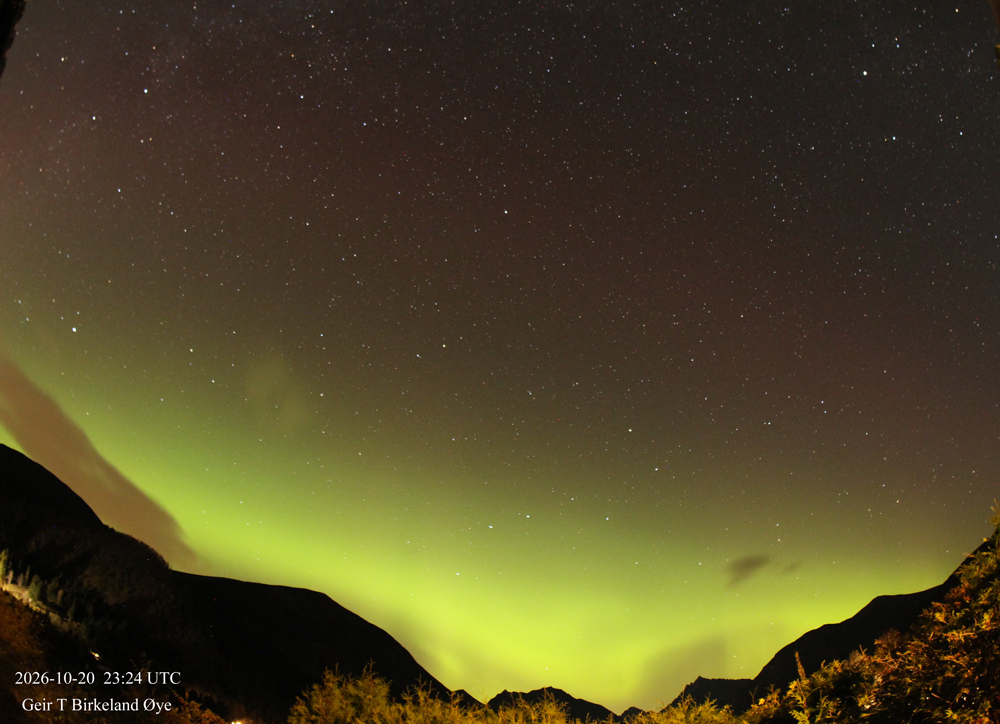
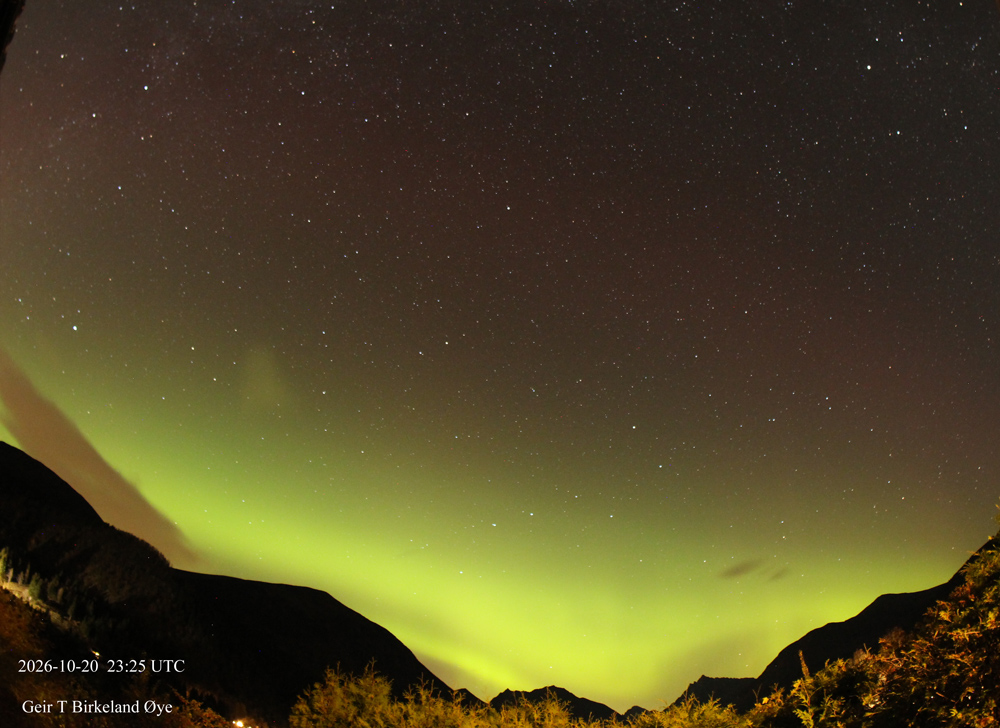
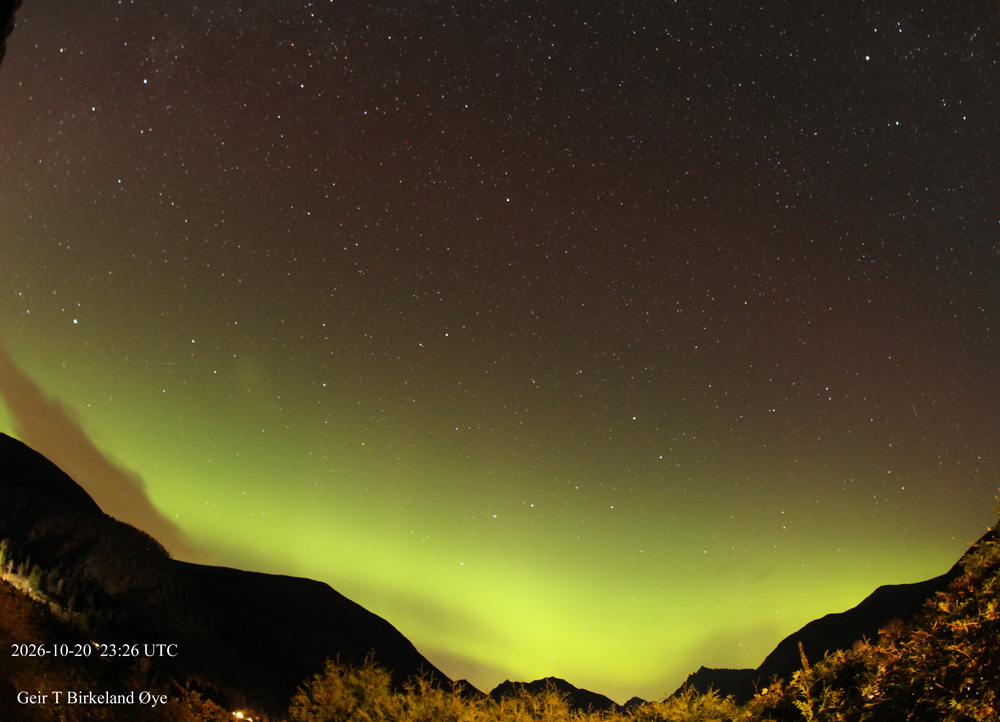
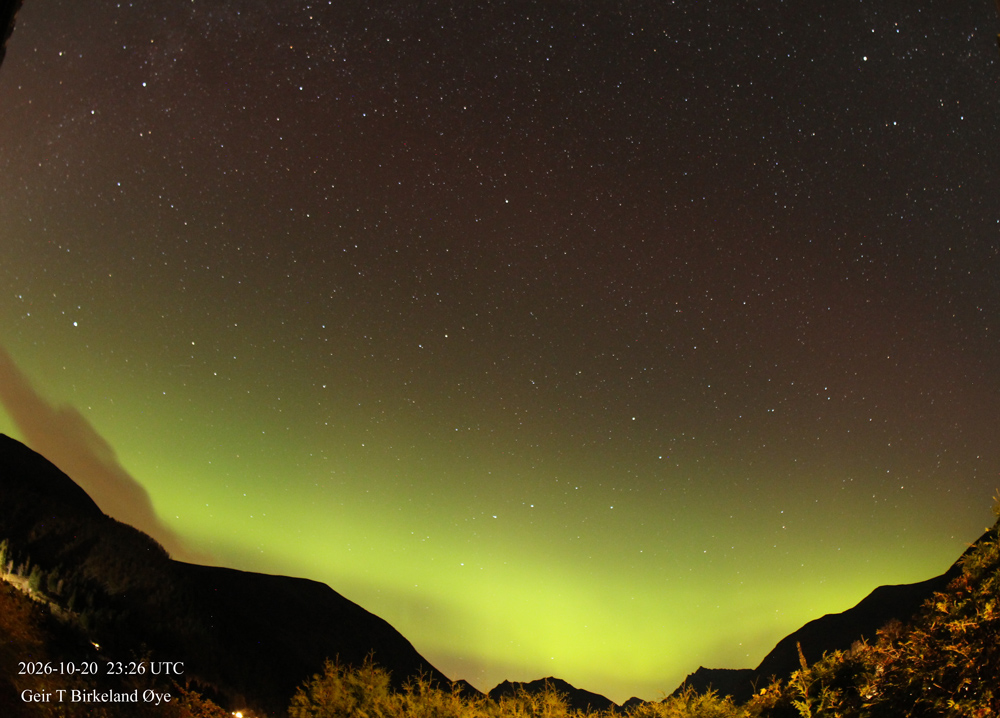
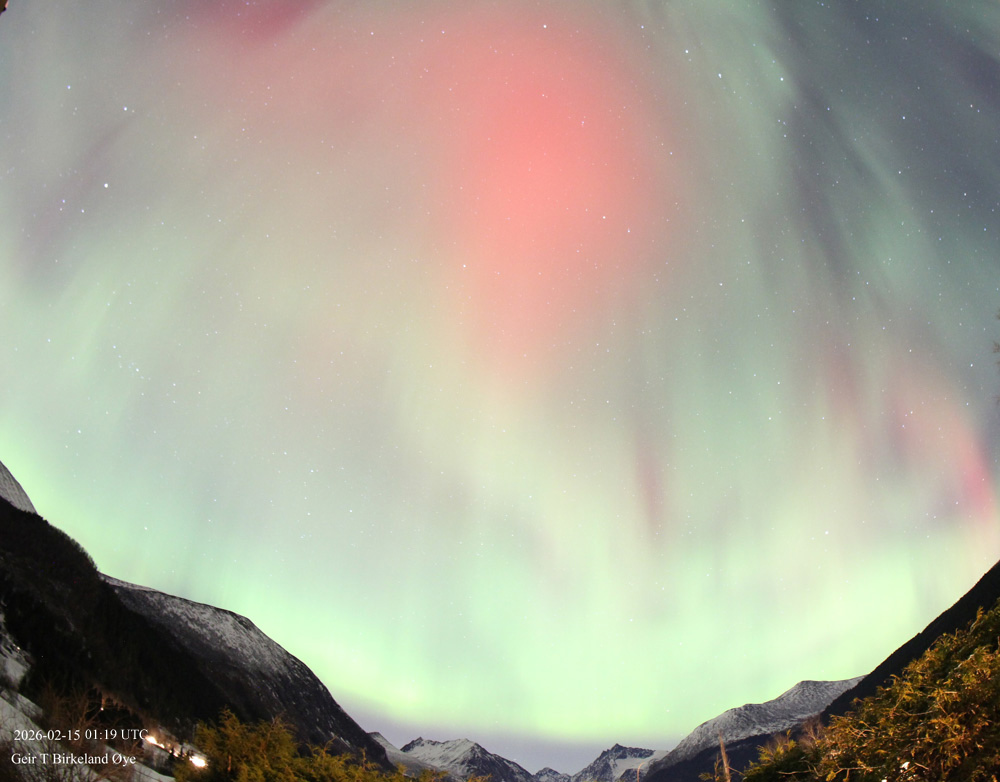
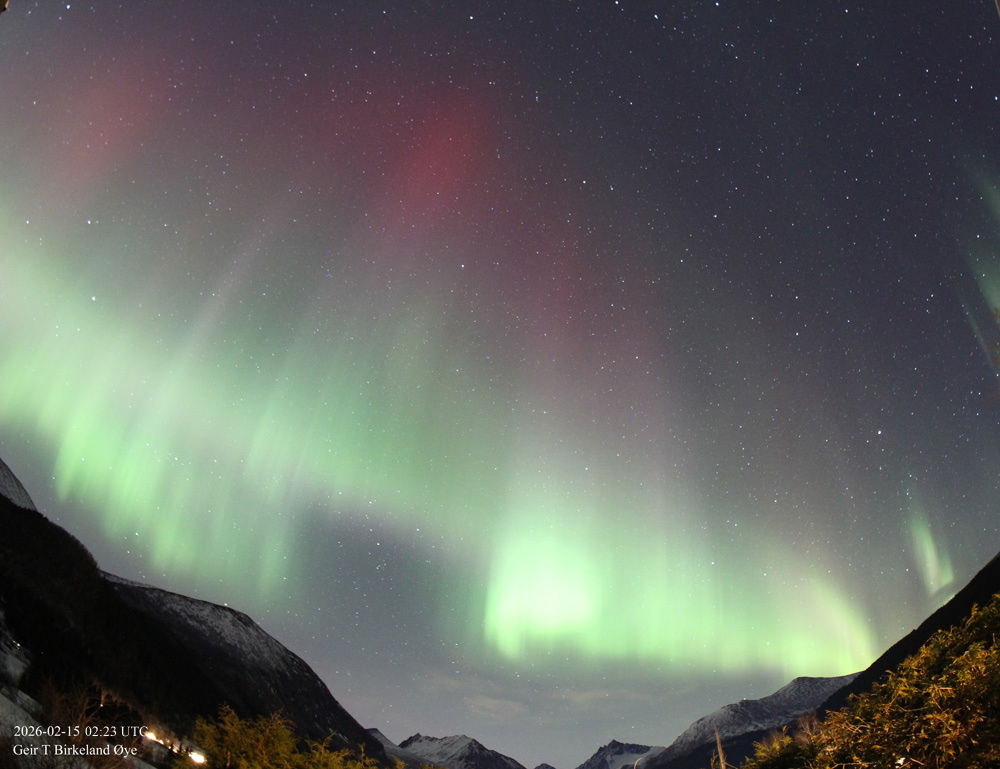
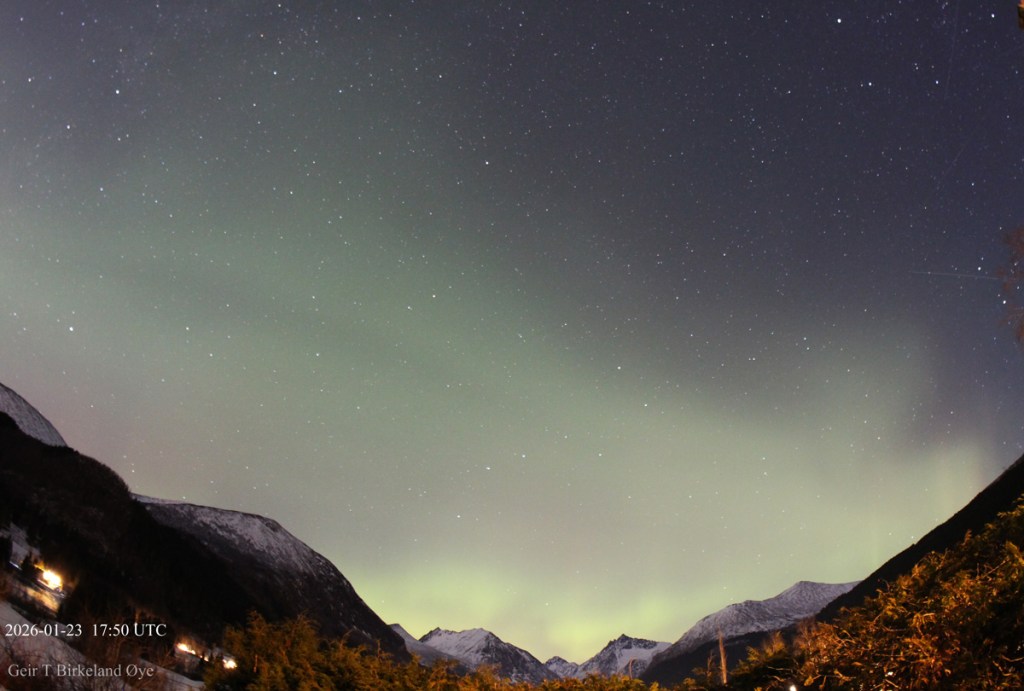
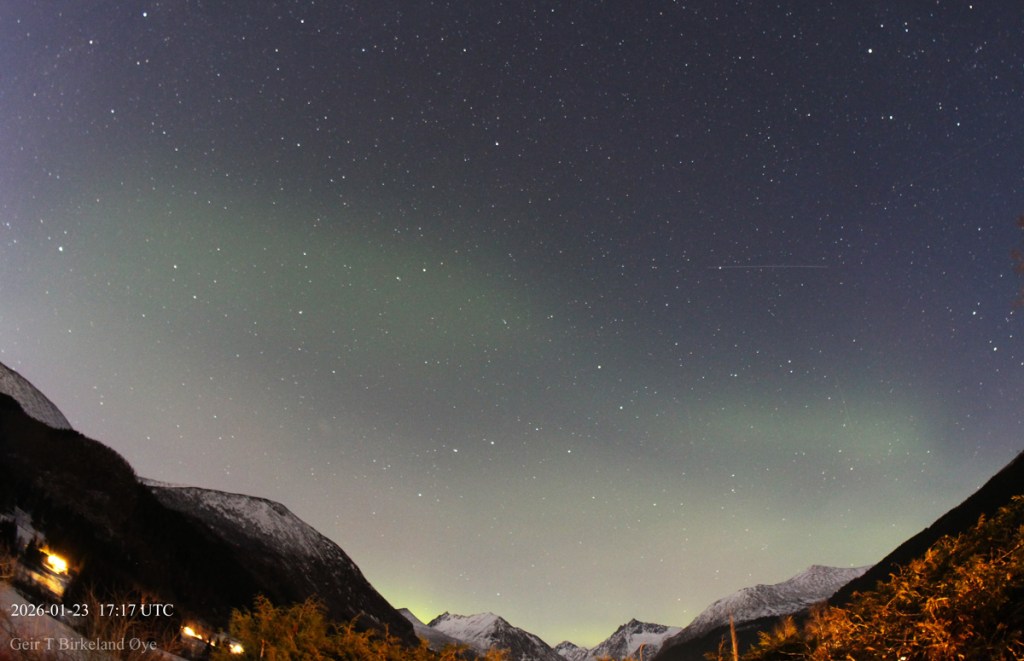
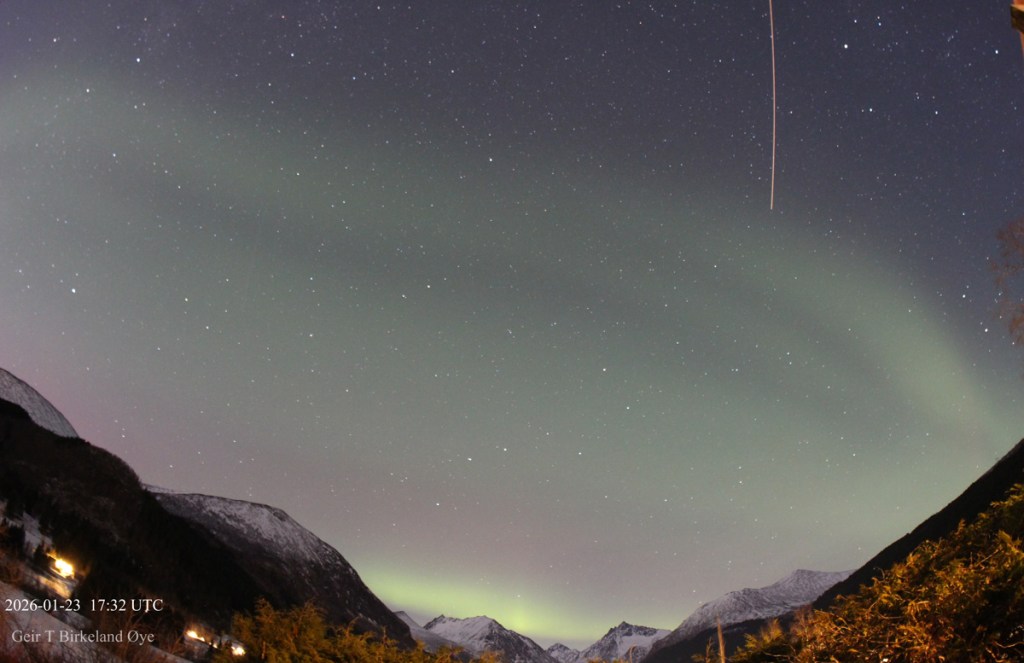
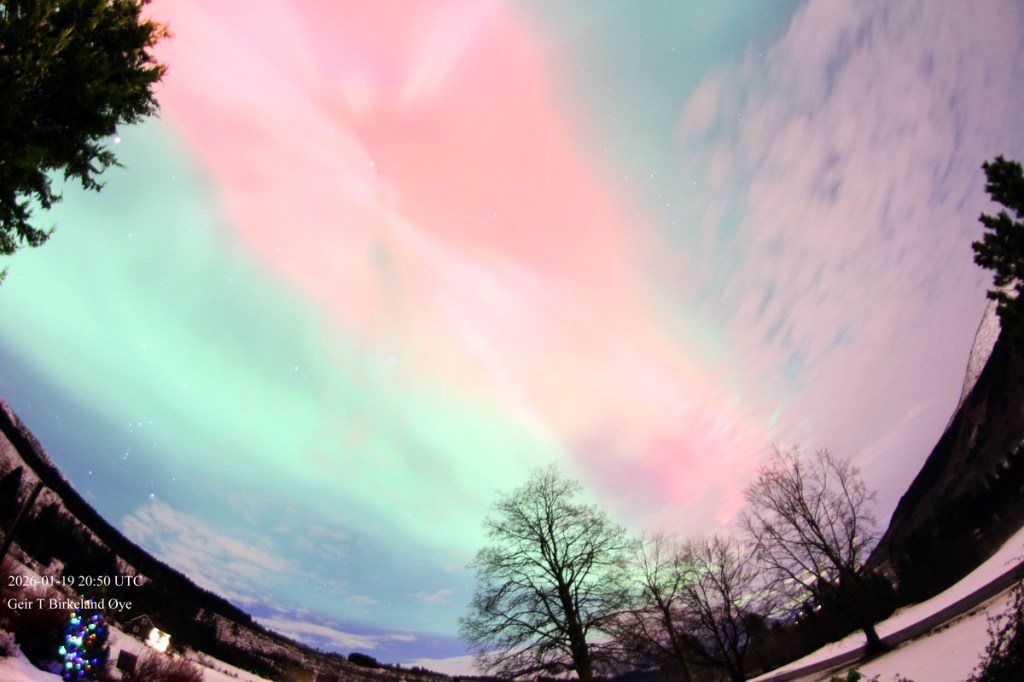
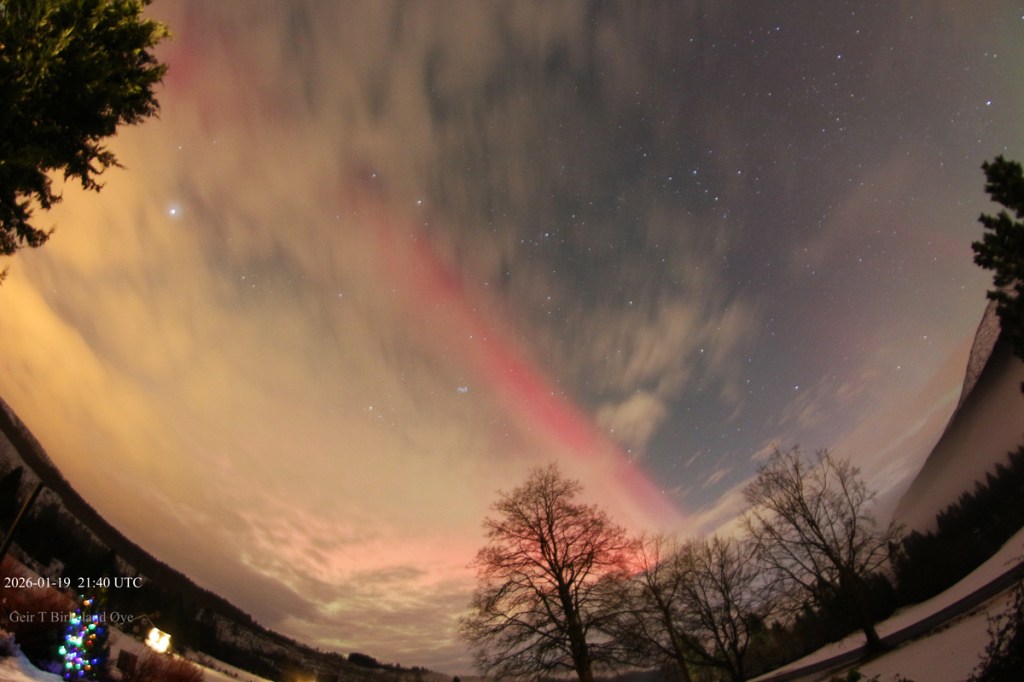
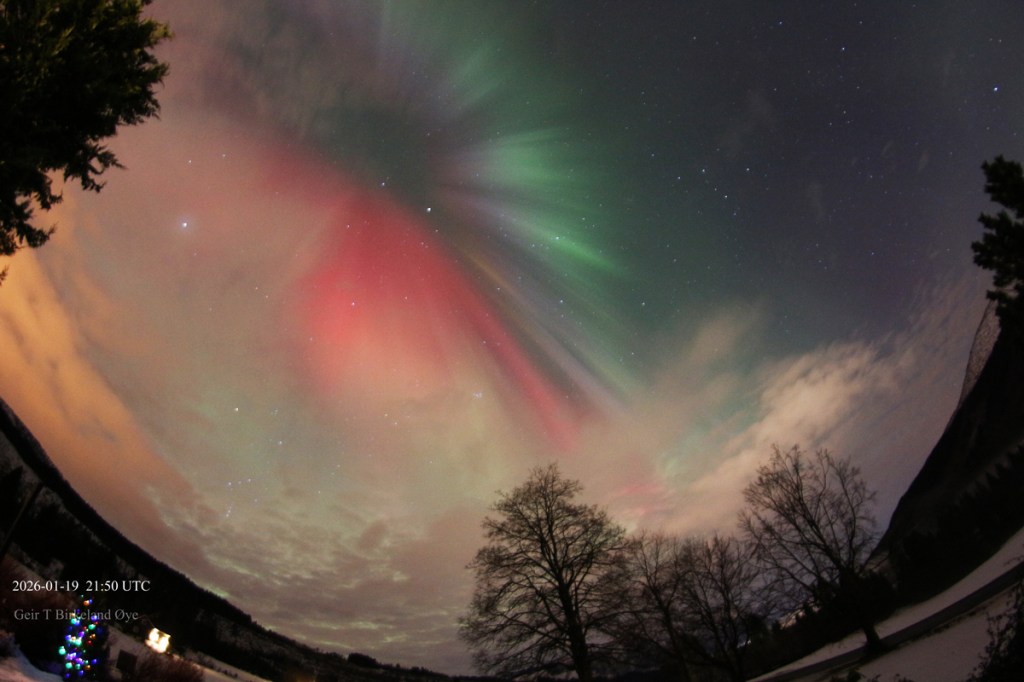
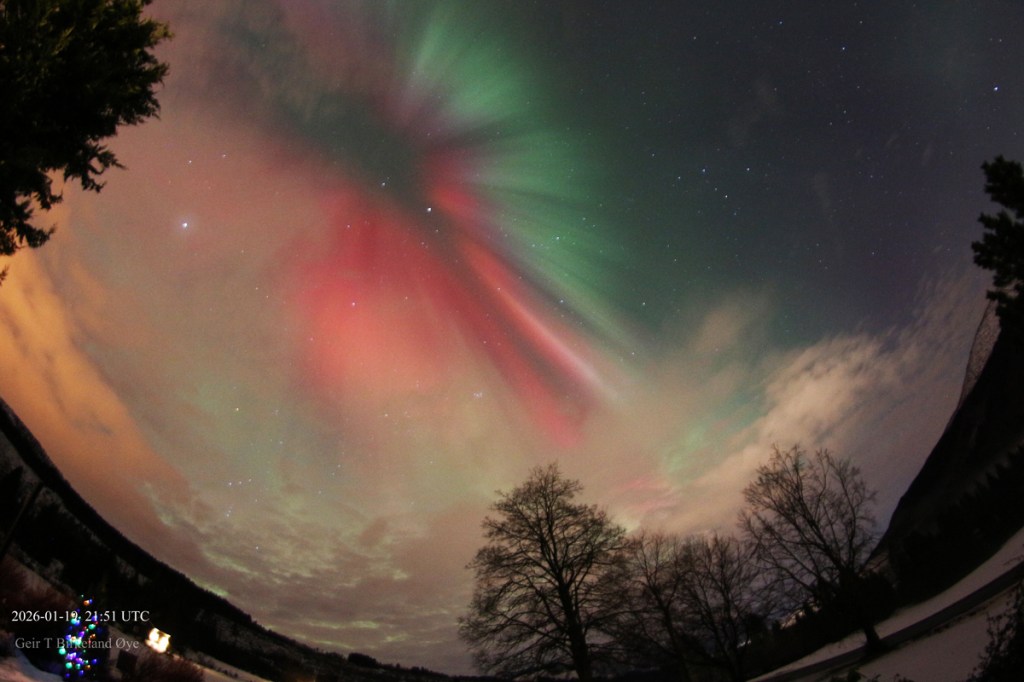
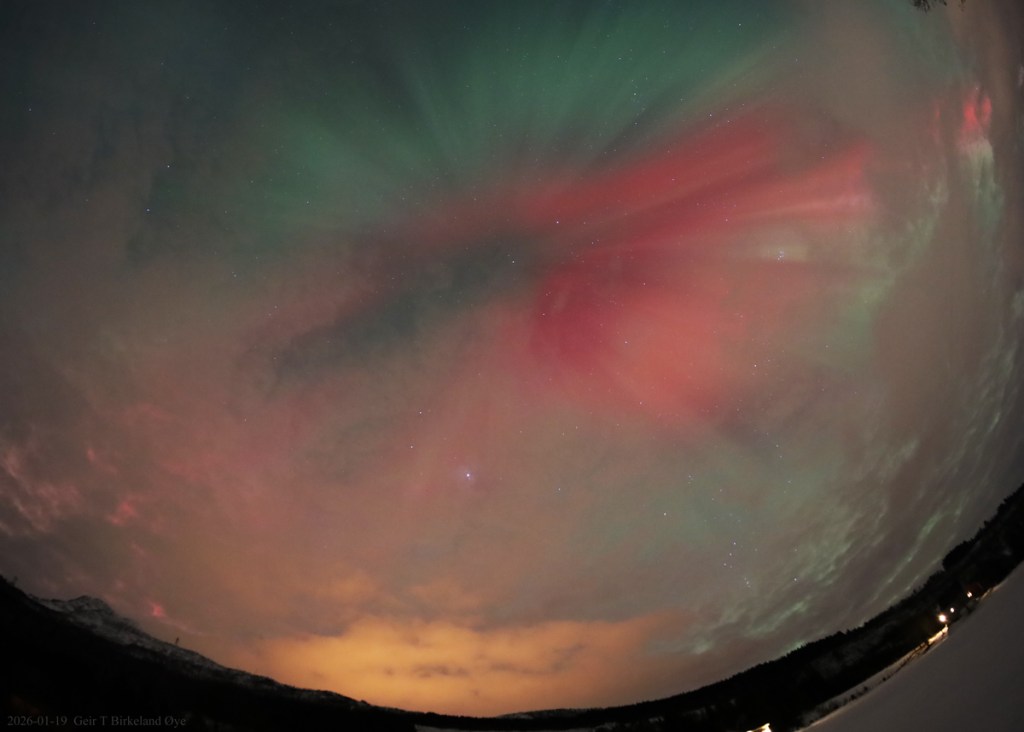
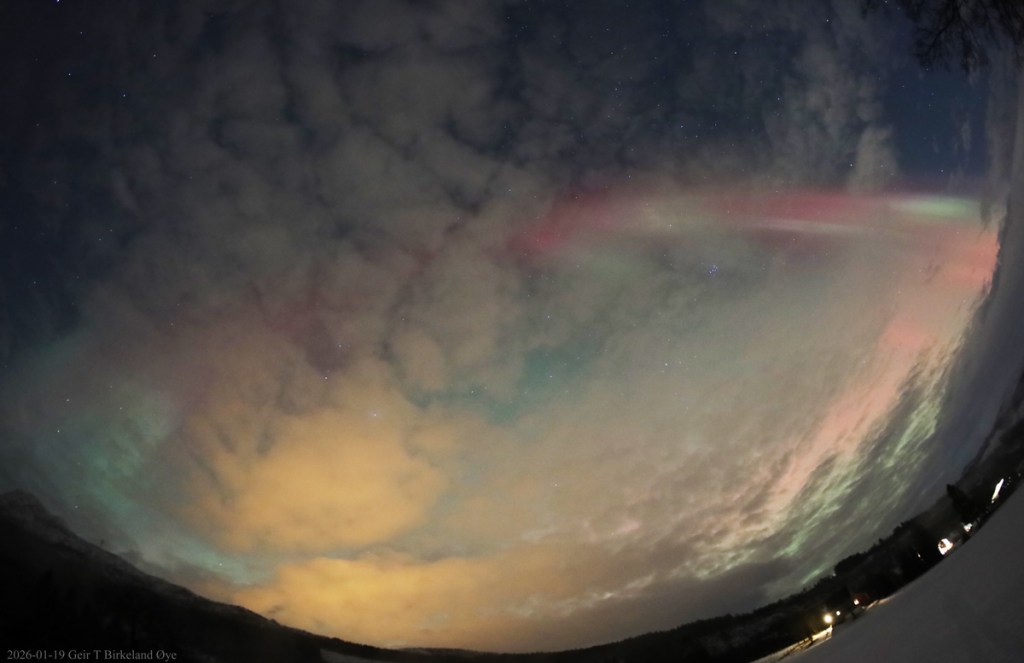
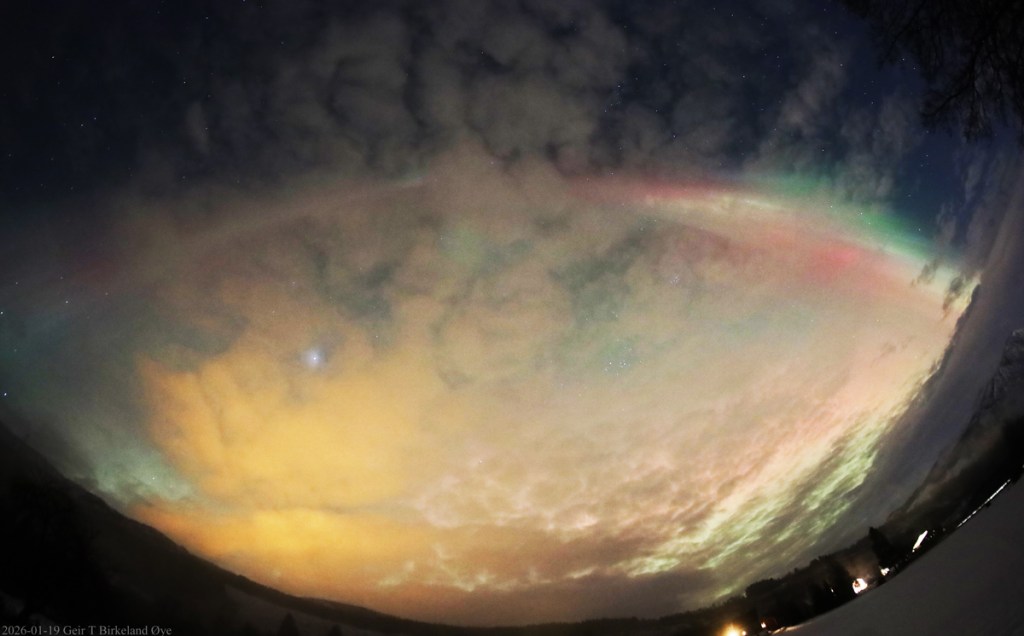
An enduring red arc was observed from 00:45 to 02:46 local time. Clouds interfered with the observation, it looks like RAGDA, but some would probably classify it as SAR arc. Interestingly detail, there were green spherical blobs under the red arc. Please, see photos. Time, date, orientation etc is included in the images. Location: Ørsta, Norway. Details: Canon 650D, 8 mm fisheye lens, iso:1600.
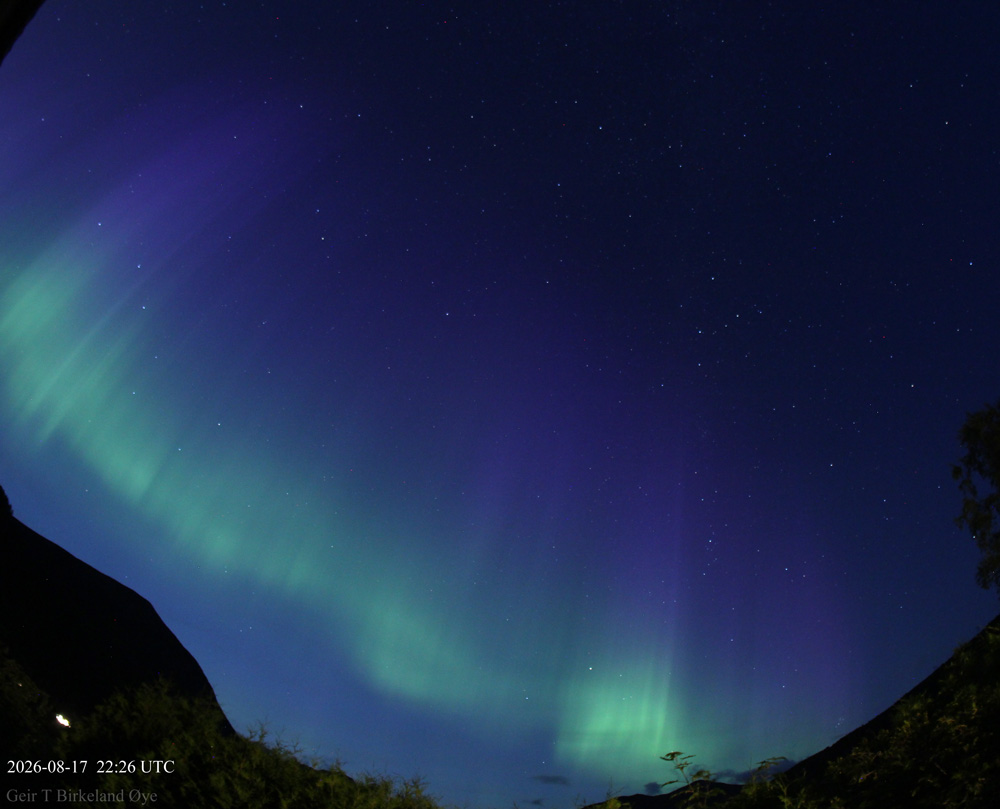
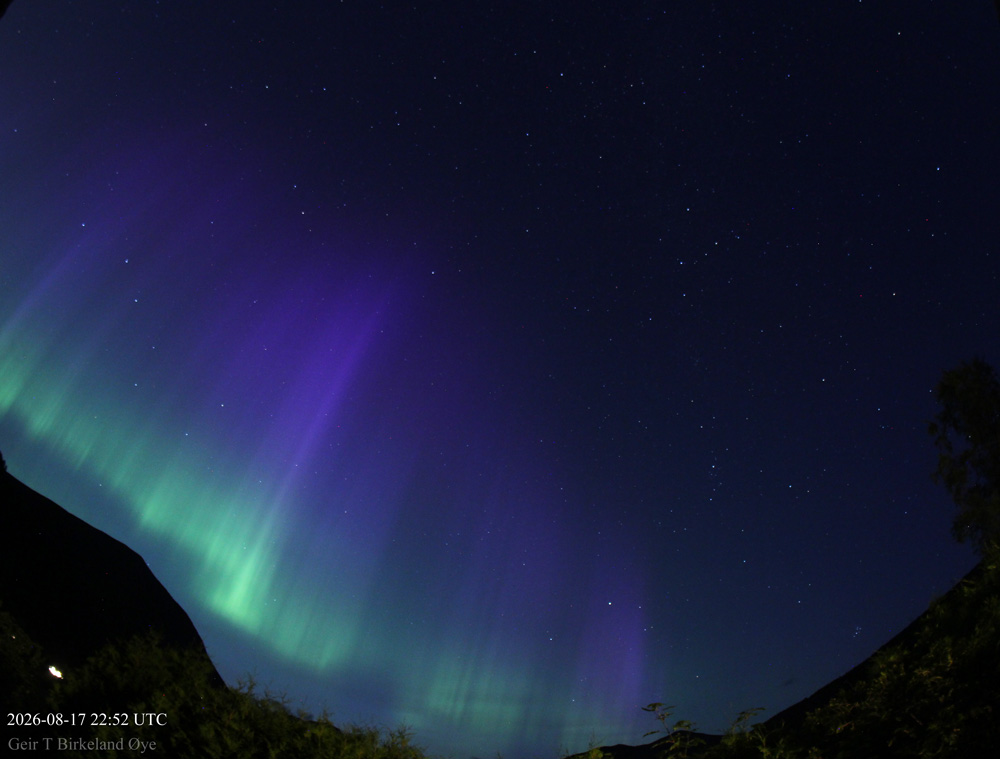
A couple of images of the aurora borealis on August 17/18, 2026, as seen from 62° N. Details: Canon 650D, 8mm fisheye lens, ISO 800. Timestamps are on the images. Location: Ørsta, Norway
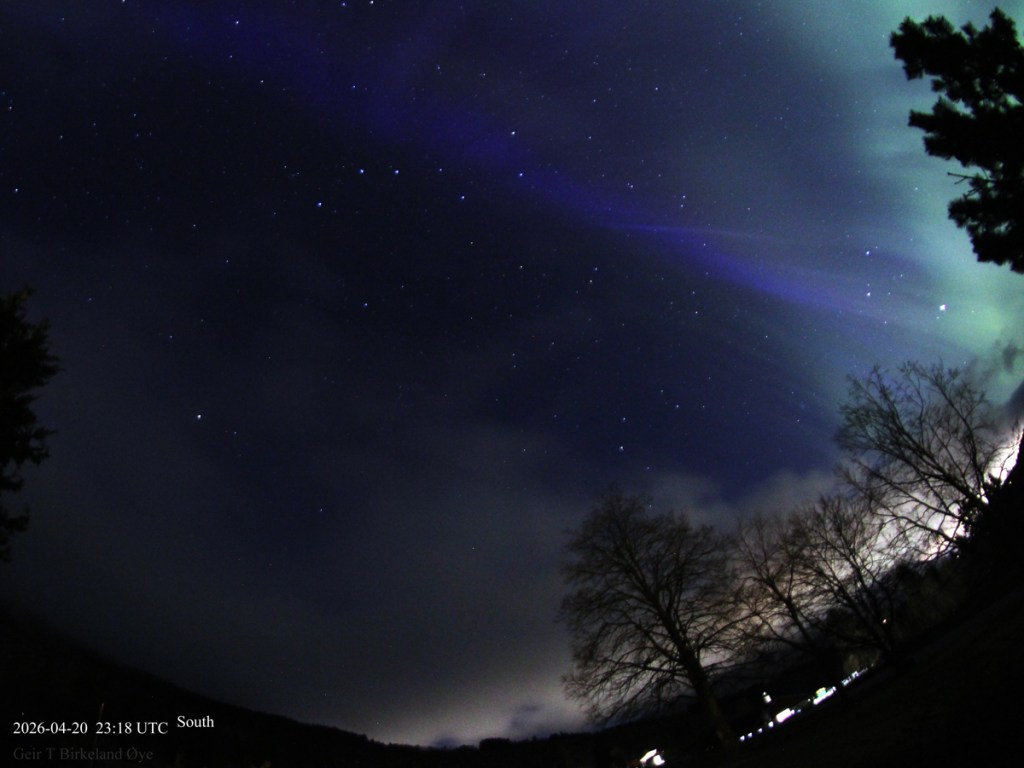
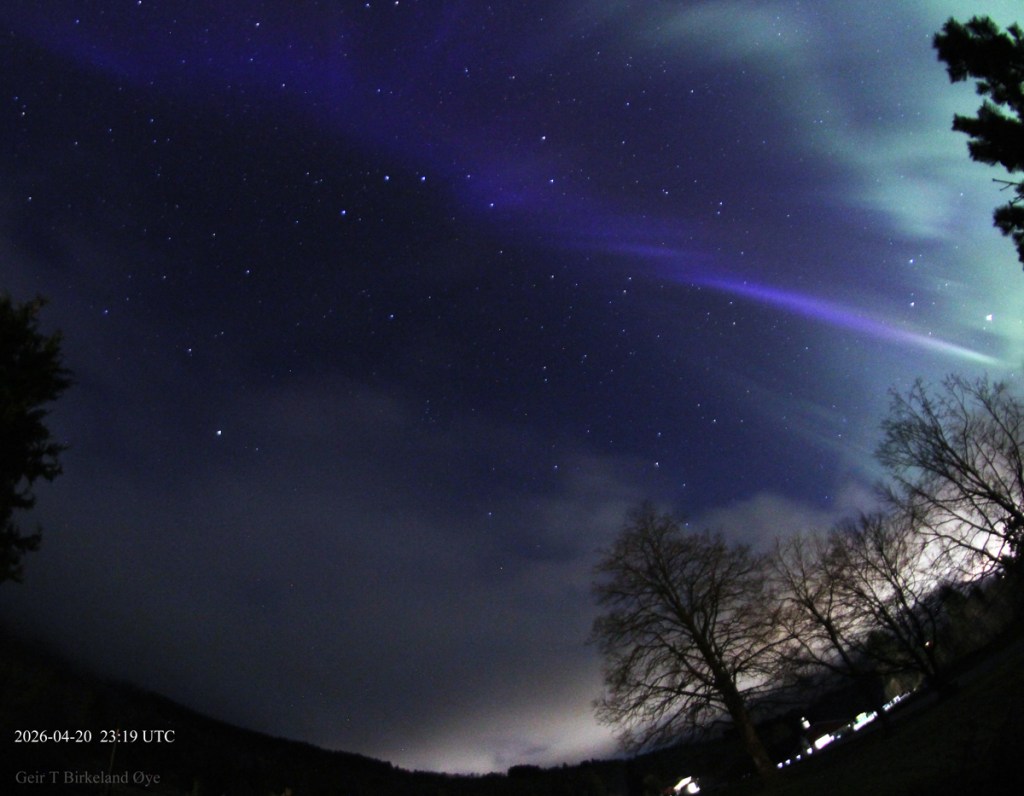
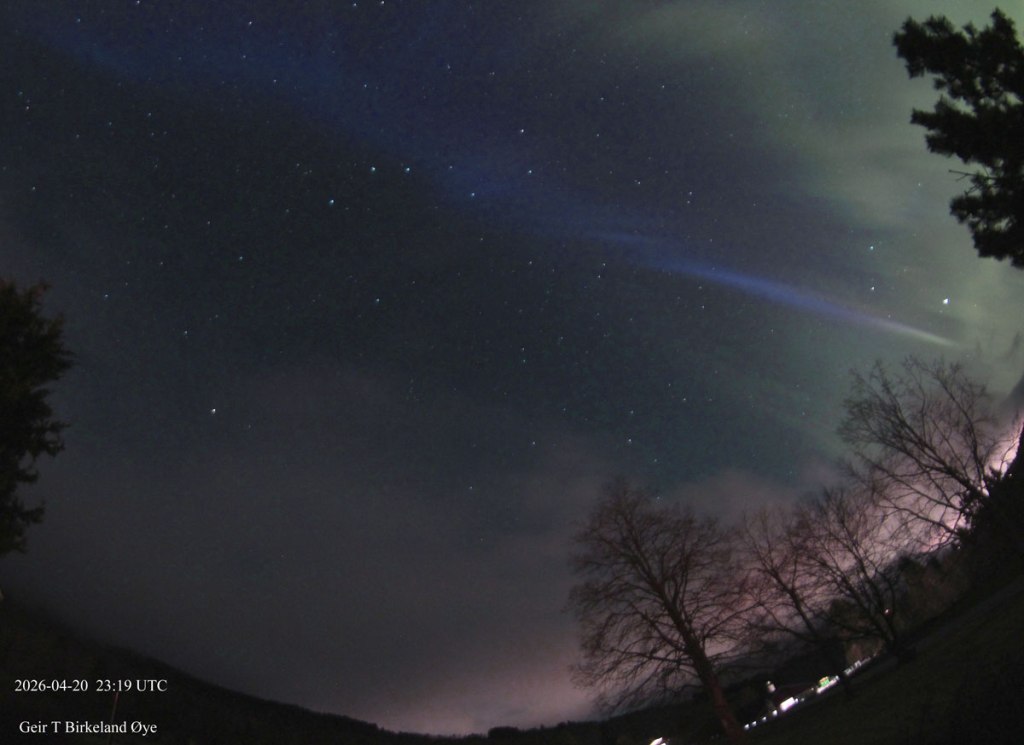
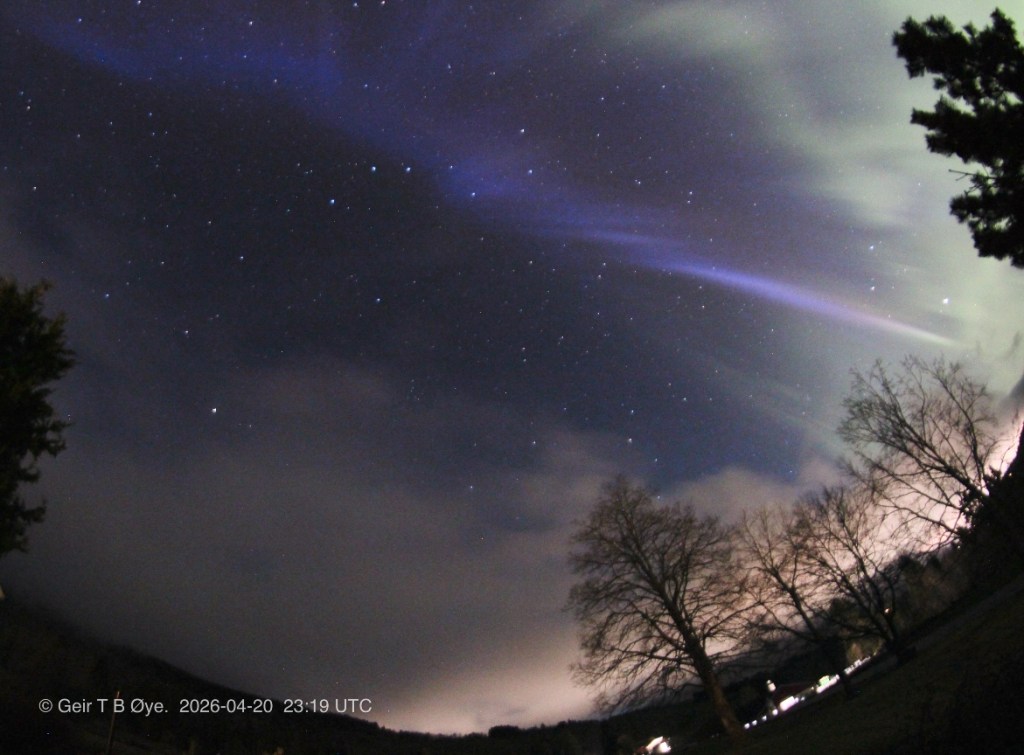
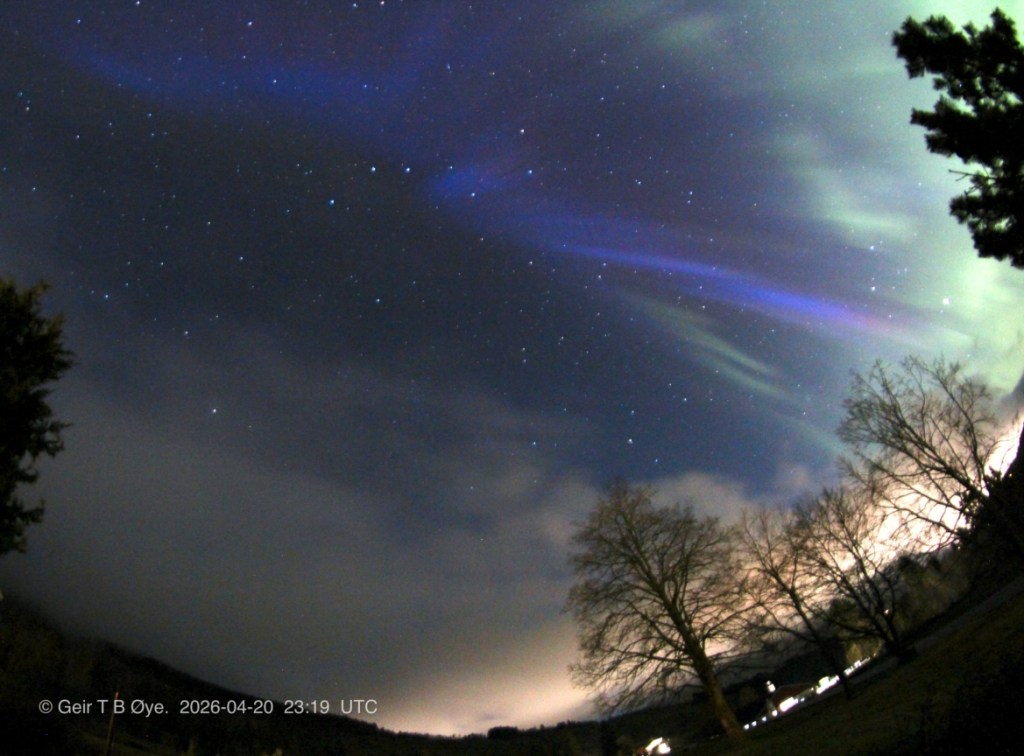
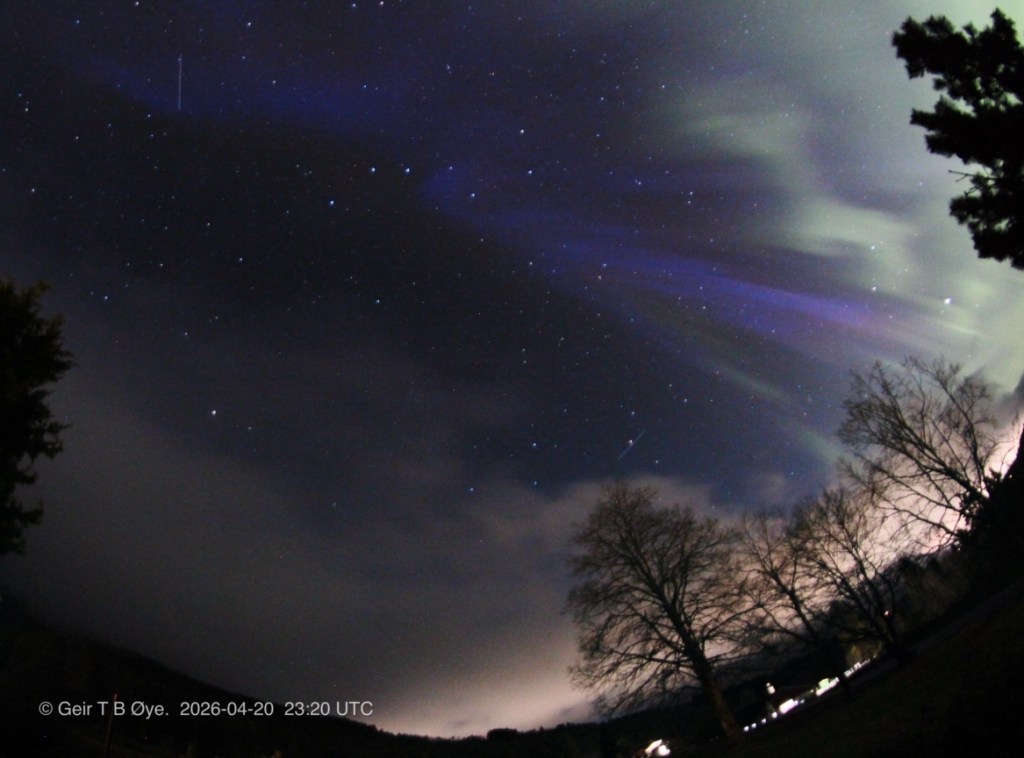
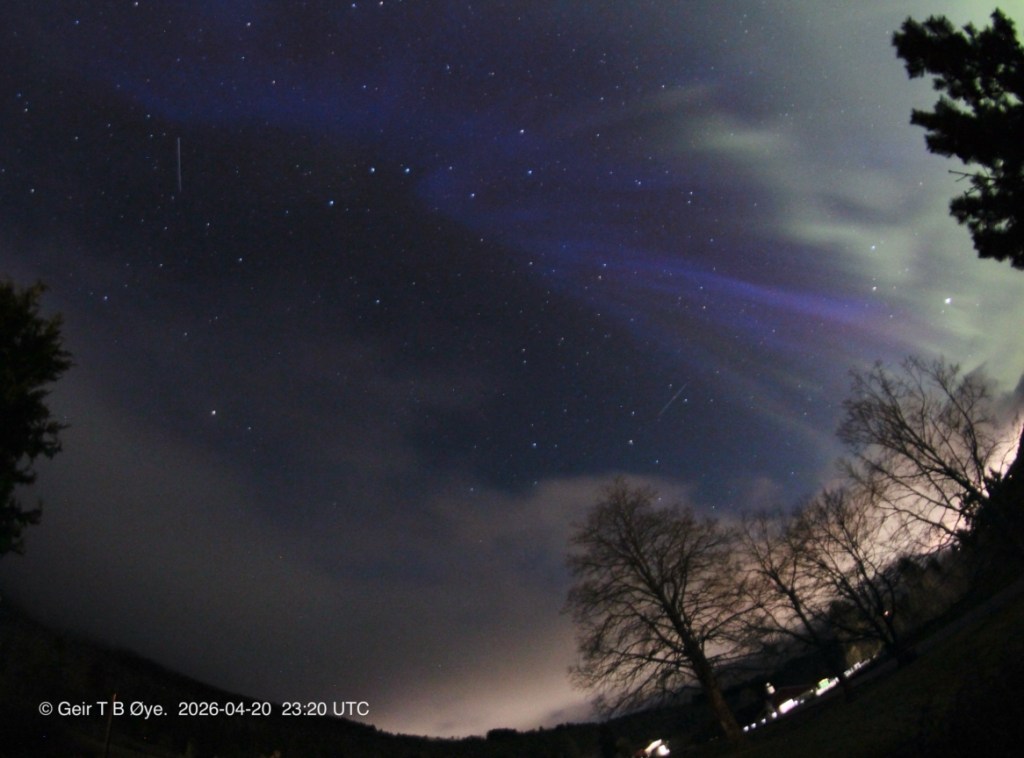
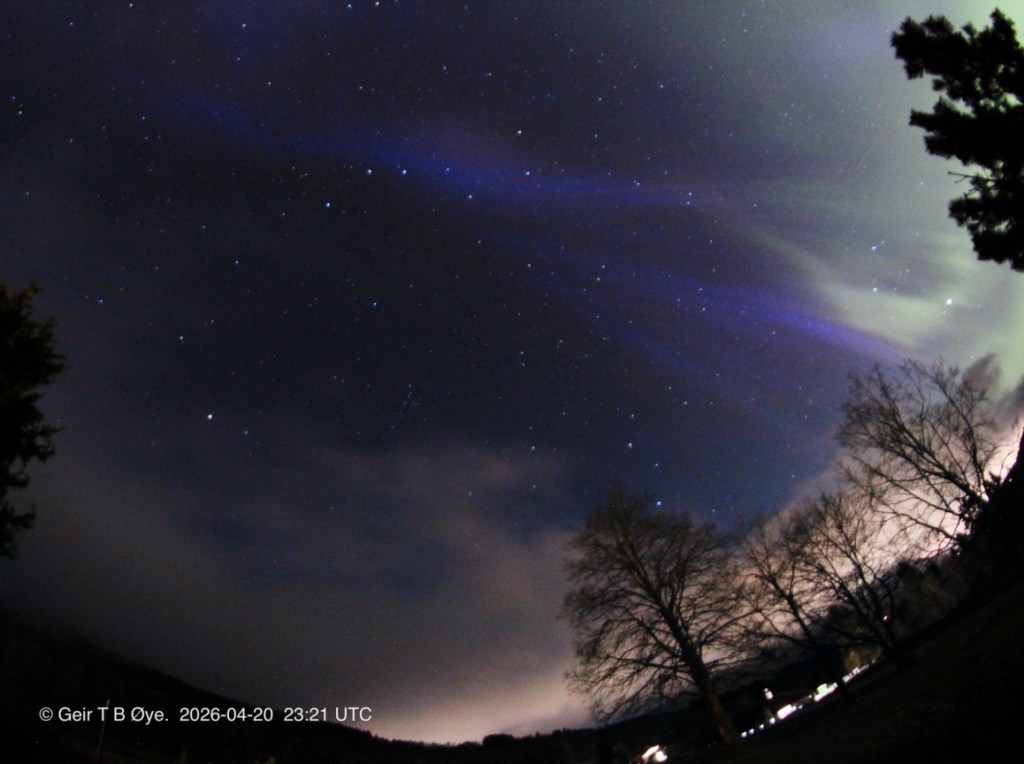
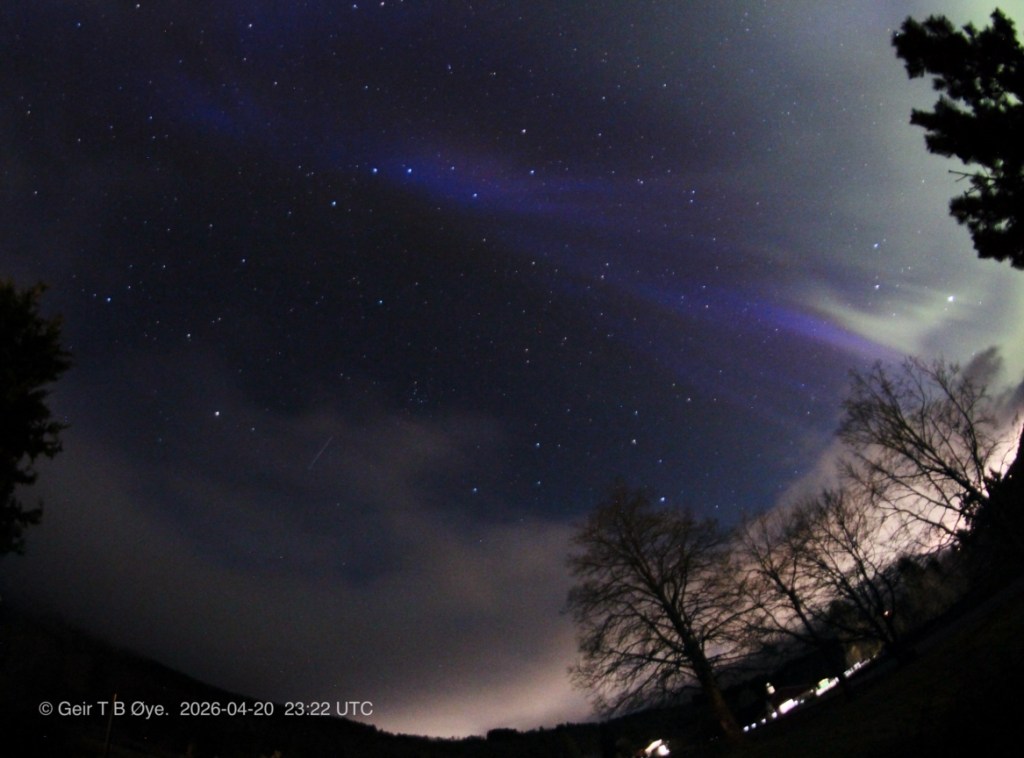
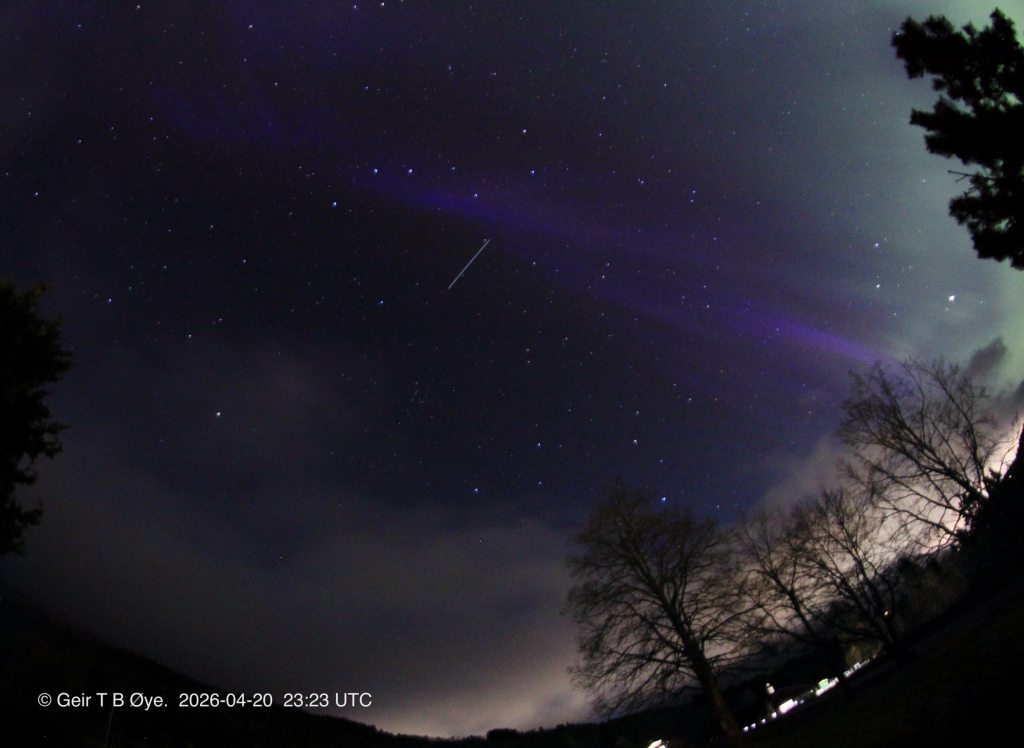
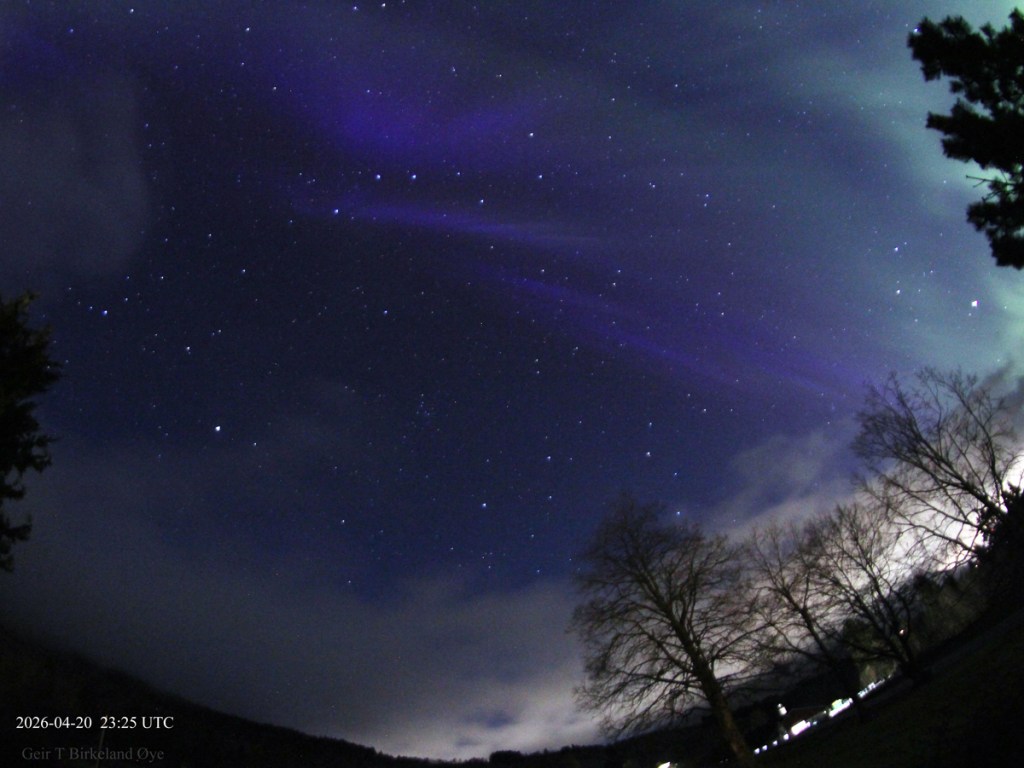
Blue‑tinged auroral corona observation 20 April 2026 — Ørsta, Norway
Time: 23:15–23:30 UTC (initial structured onset ~23:18 UTC)
Observation type: DSLR documentation of a partial auroral corona with blue‑violet lower emission.
Observer: Geir T. Birkeland Øye Location: Ørsta, Norway
Instrument: Canon 650D, 8 mm fisheye, ISO 1600, short‑exposure sequence
Summary
A short‑exposure DSLR sequence recorded the development of a partial auroral corona directly overhead. The first structured rays appeared around 23:18 UTC, marking a brief local intensification during otherwise quiet geomagnetic conditions.
The lower part of the structure showed a blue‑violet tint, transitioning into green emission at higher altitudes. This colour impression is consistent with mixed auroral emissions and may include contributions from molecular nitrogen processes (N₂ / N₂⁺), although no spectroscopic data are available to confirm line dominance.
Auroral structure
The event formed a corona‑like pattern, with rays converging toward the zenith. The geometry was not fully symmetric, and the corona did not develop into a stable, mature form. Such partial or transient corona formations are well‑known during short‑lived intensifications.
Geomagnetic context
Global geomagnetic activity on 20 April 2026 was quiet to moderate (Kp 1–3). However, regional Scandinavian magnetometer data show small, coincident disturbances during the observation window, consistent with a brief localised enhancement.
Short‑duration variations of this type are not always visible in 3‑hour Kp indices but can still produce brief auroral brightenings.
Geomagnetic data (TRO2A, local time)
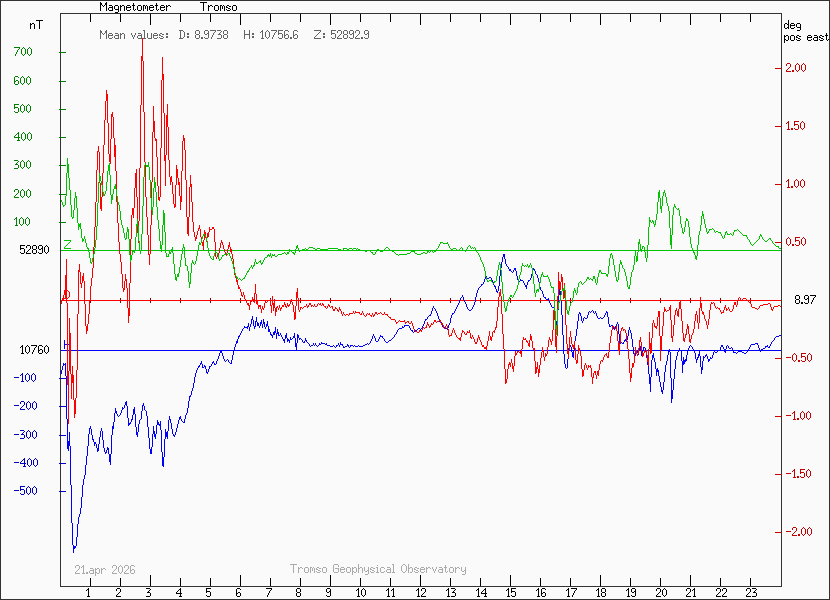
TRO2A magnetometer data (local time). The disturbance at 01:20 CEST corresponds to 23:20 UTC and matches the timing of the observed intensification.
Geomagnetic signature (TRO2A magnetometer)
The small disturbance visible around 01:20 local time corresponds to 23:20 UTC on 20 April, matching the timing of the observed auroral intensification.
The H‑component shows a weak but clearly defined negative dip lasting a few minutes, while the D and Z components display synchronous minor variations. Such brief, low‑amplitude deviations are typical of localized auroral onset‑type intensifications and do not necessarily appear in the 3‑hour Kp index.
This signature supports the interpretation of a short‑lived auroral intensification with partial corona formation.
Source: Tromsø Geophysical Observatory (TRO2A)
The Solund (SOL1A) magnetometer shows weak but coincident variations around 23:20 UTC that correlate with the TRO2A negative dip. Although the SOL1A signal is smaller, the synchronous behaviour supports that the brief intensification observed in Ørsta was a real regional (localized) auroral enhancement rather than an instrumental anomaly.
Seasonal light conditions
At this time of year, the Sun remains only a few degrees below the horizon. This twilight regime in the upper atmosphere can:
increase contrast between aurora and background sky
make faint emissions more visually apparent
influence colour balance in photographic recordings
It does not increase auroral emission strength itself.
Interpretation
The event is best described as a short‑lived auroral intensification with partial corona formation, displaying a visually enhanced blue‑violet lower region. The colour impression likely reflects a combination of:
molecular nitrogen emissions
rapid temporal changes during onset
viewing geometry near zenith
seasonal twilight contrast
Corrected master version (cyan/blue reduction applied).
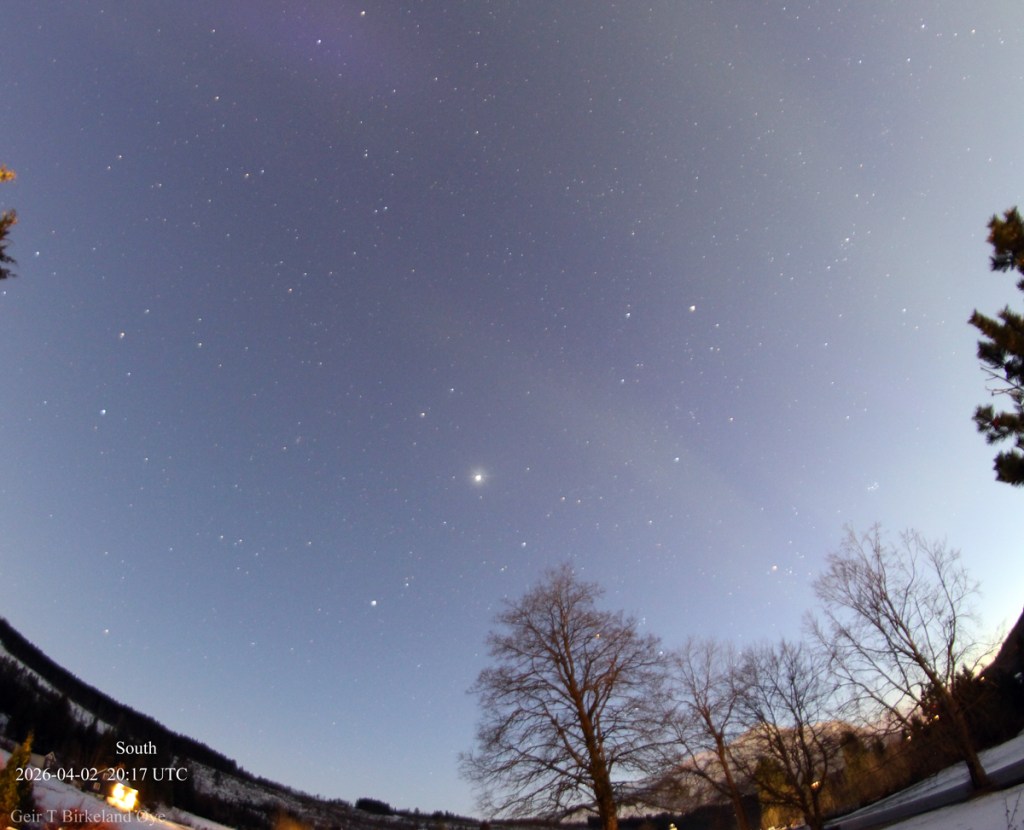
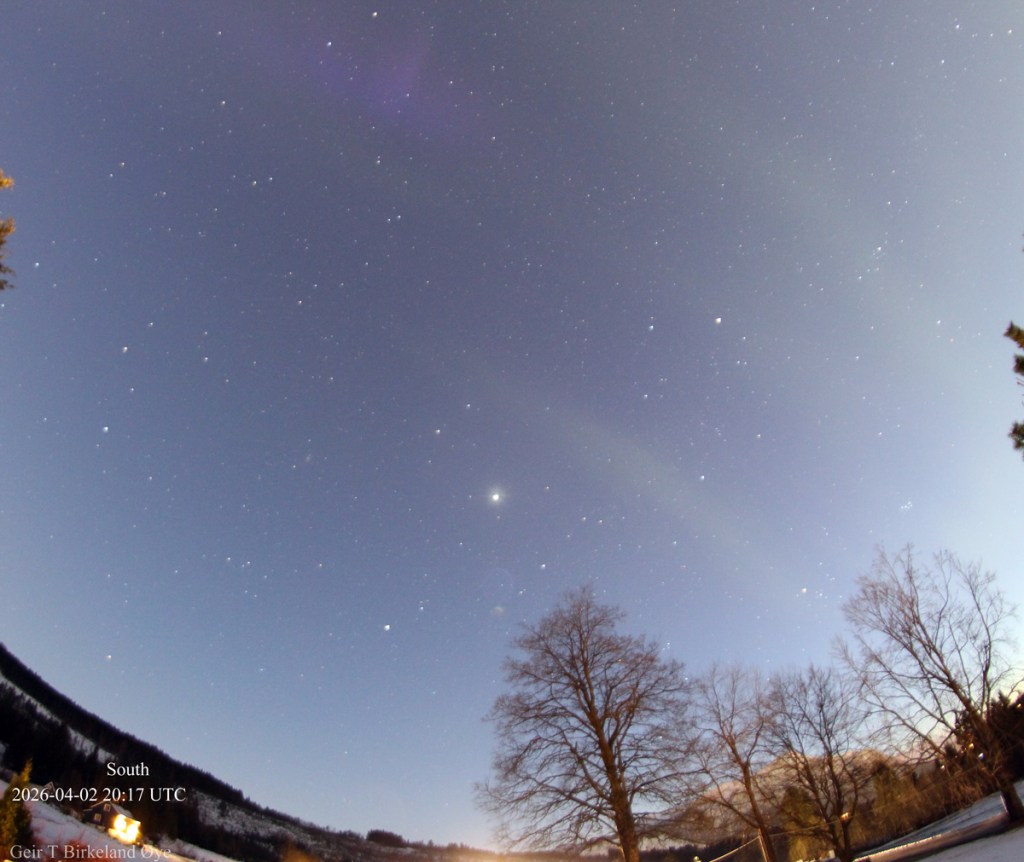
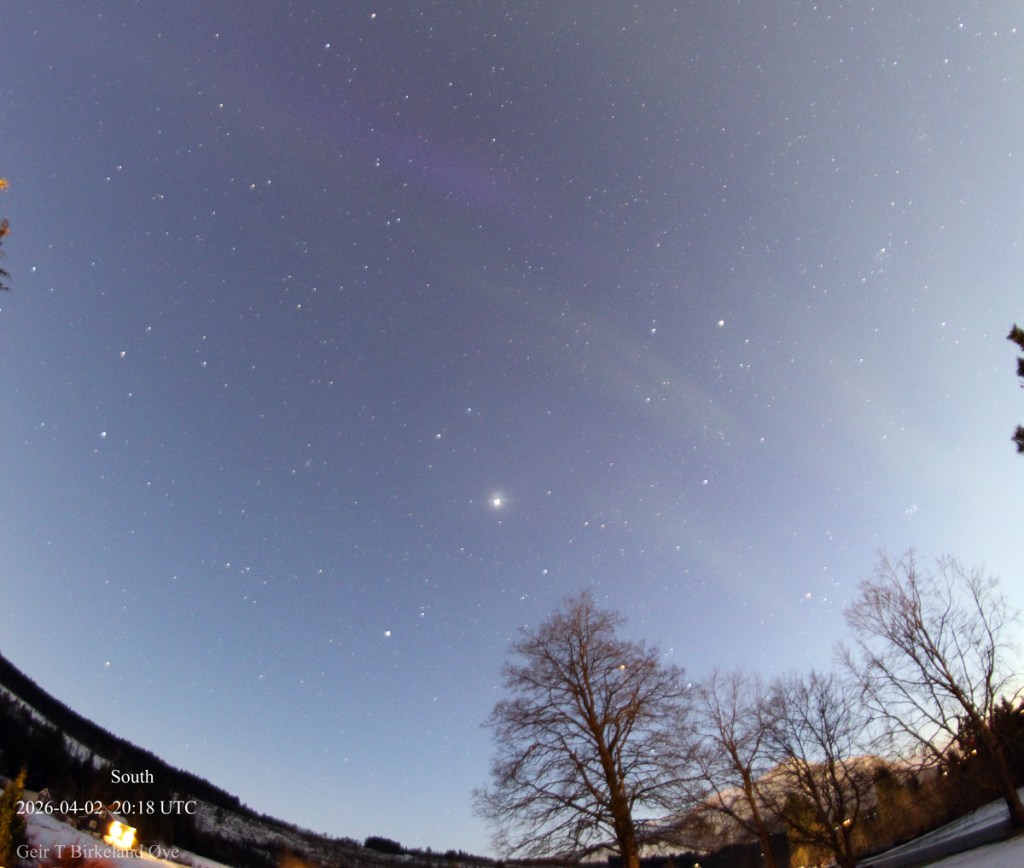
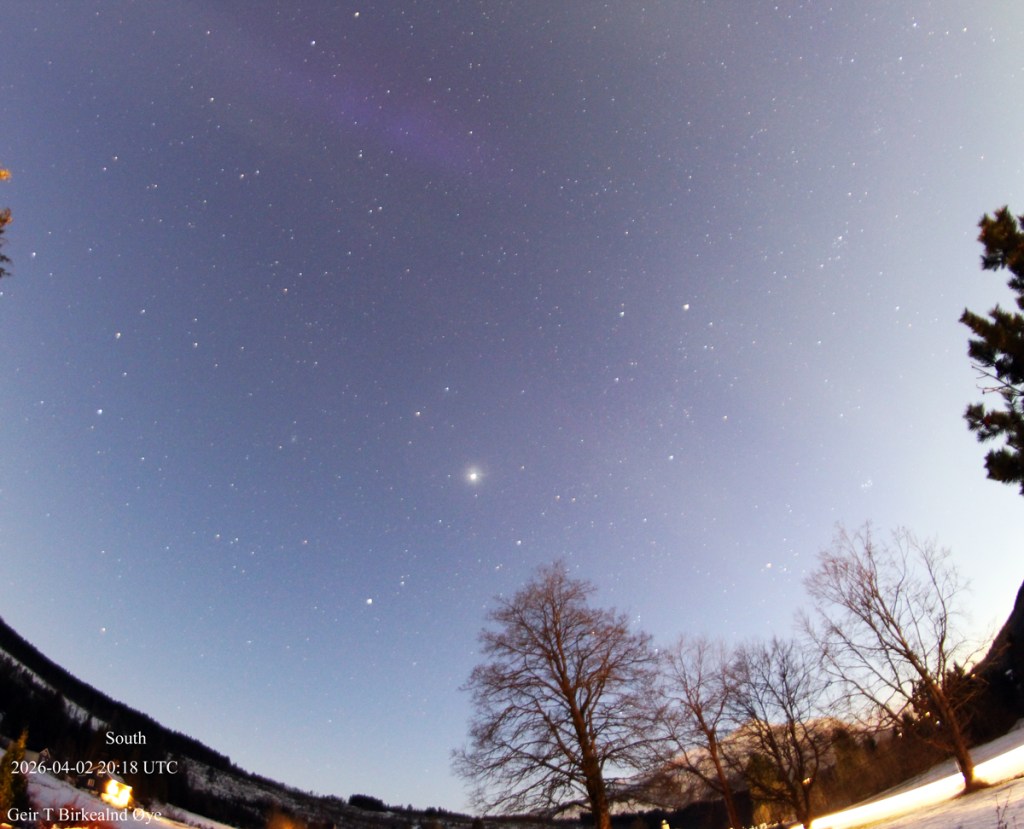
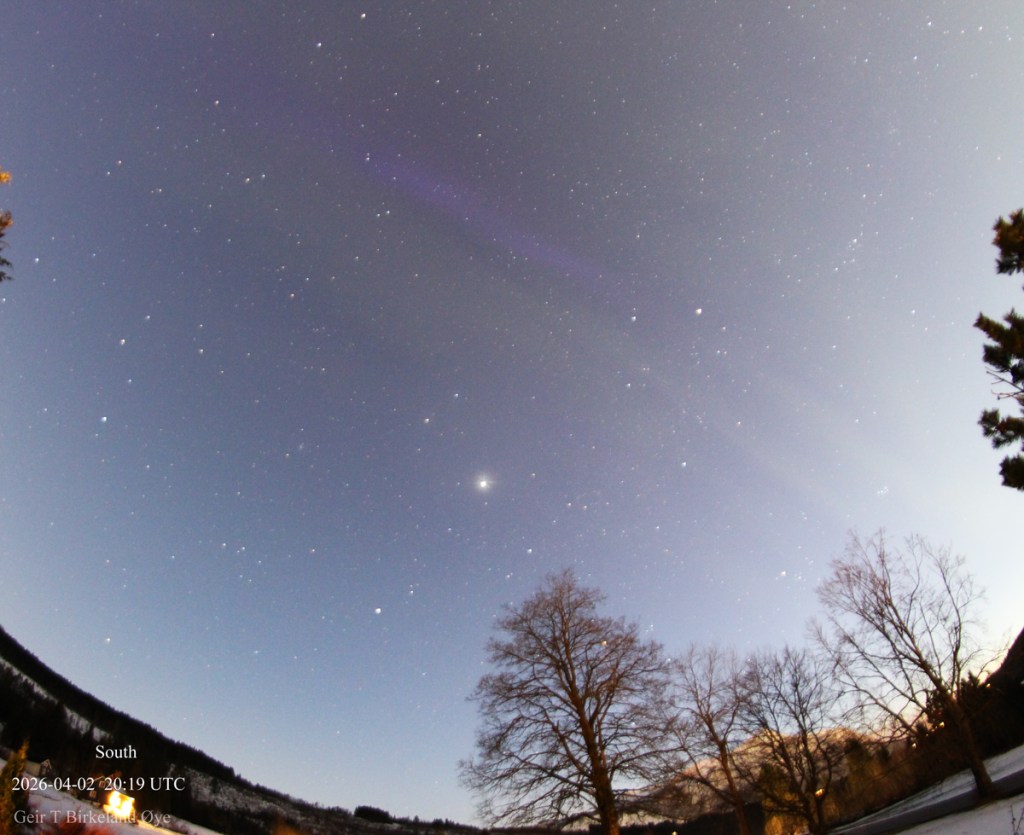
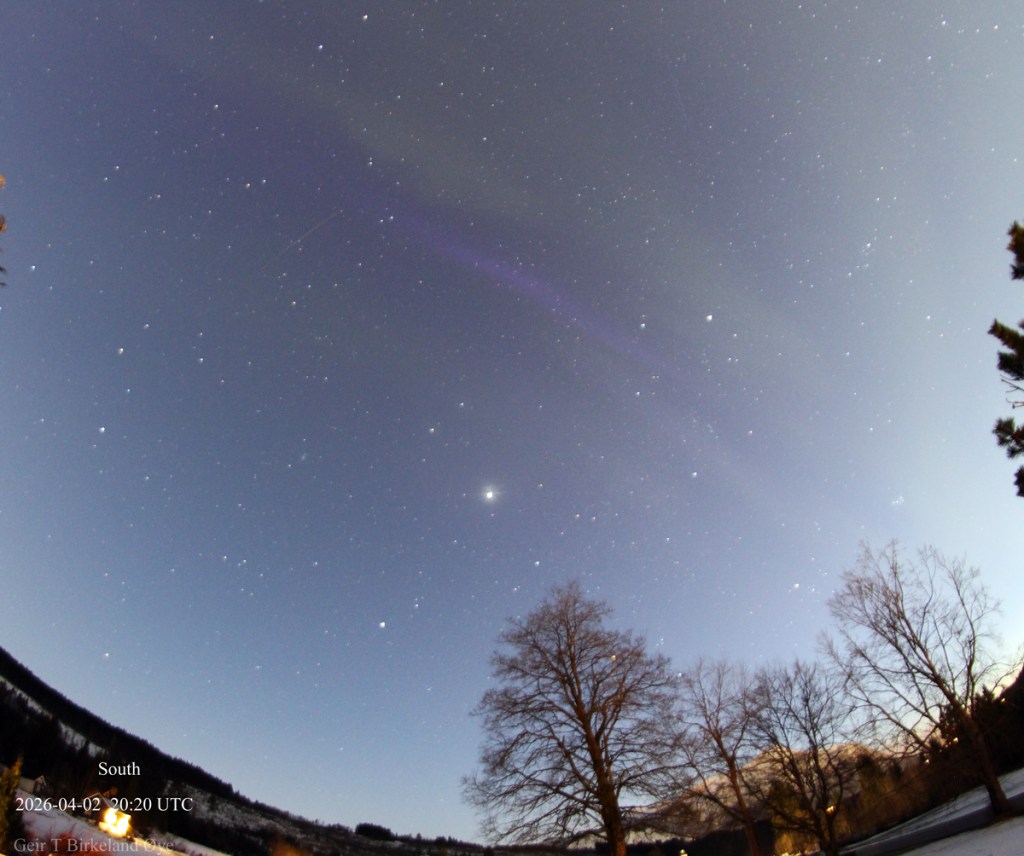
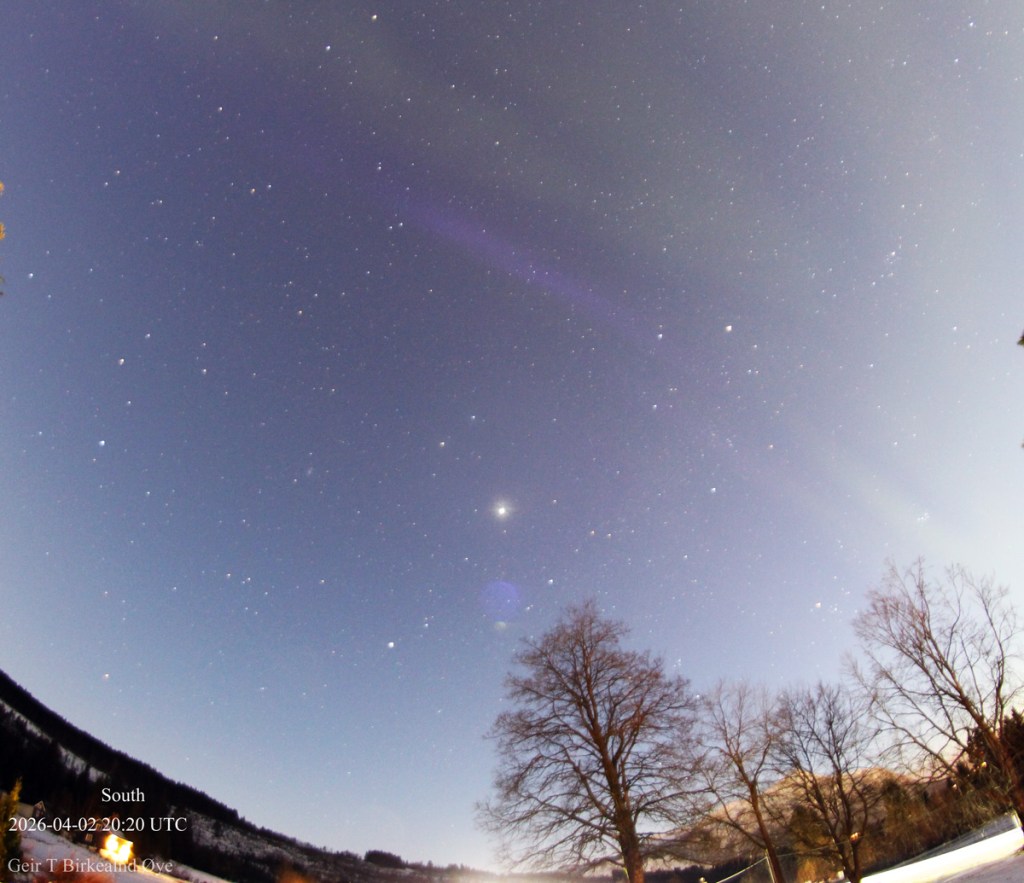
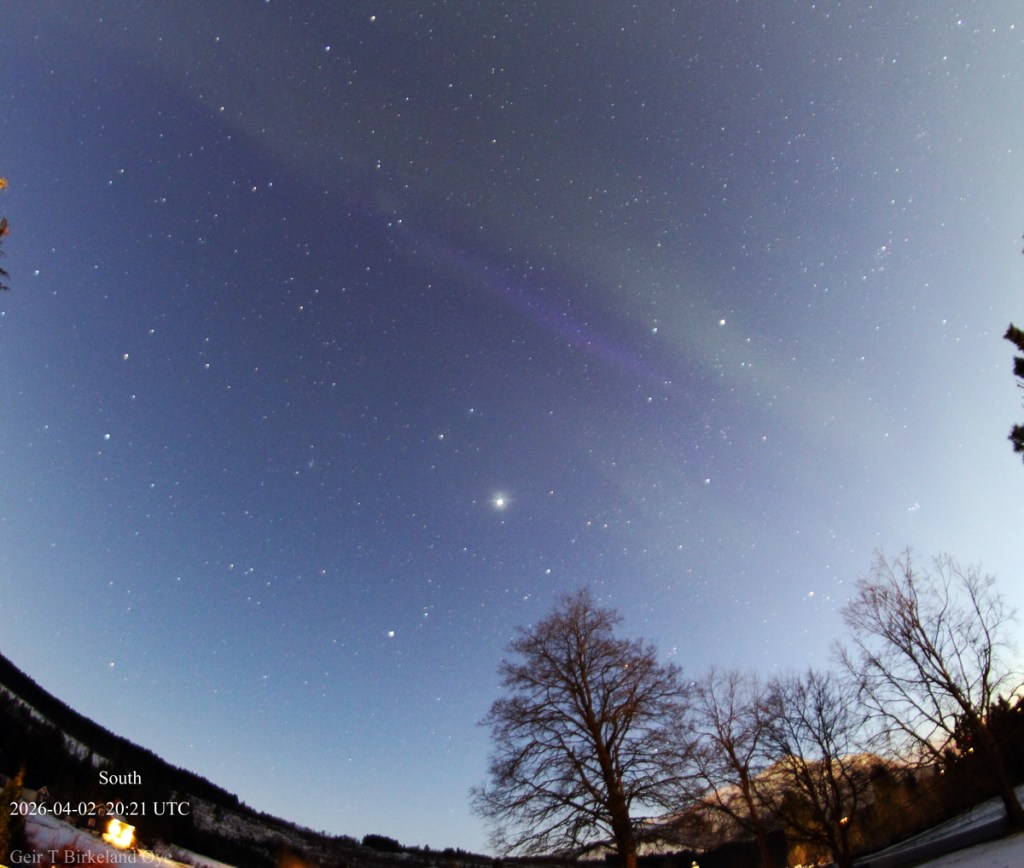
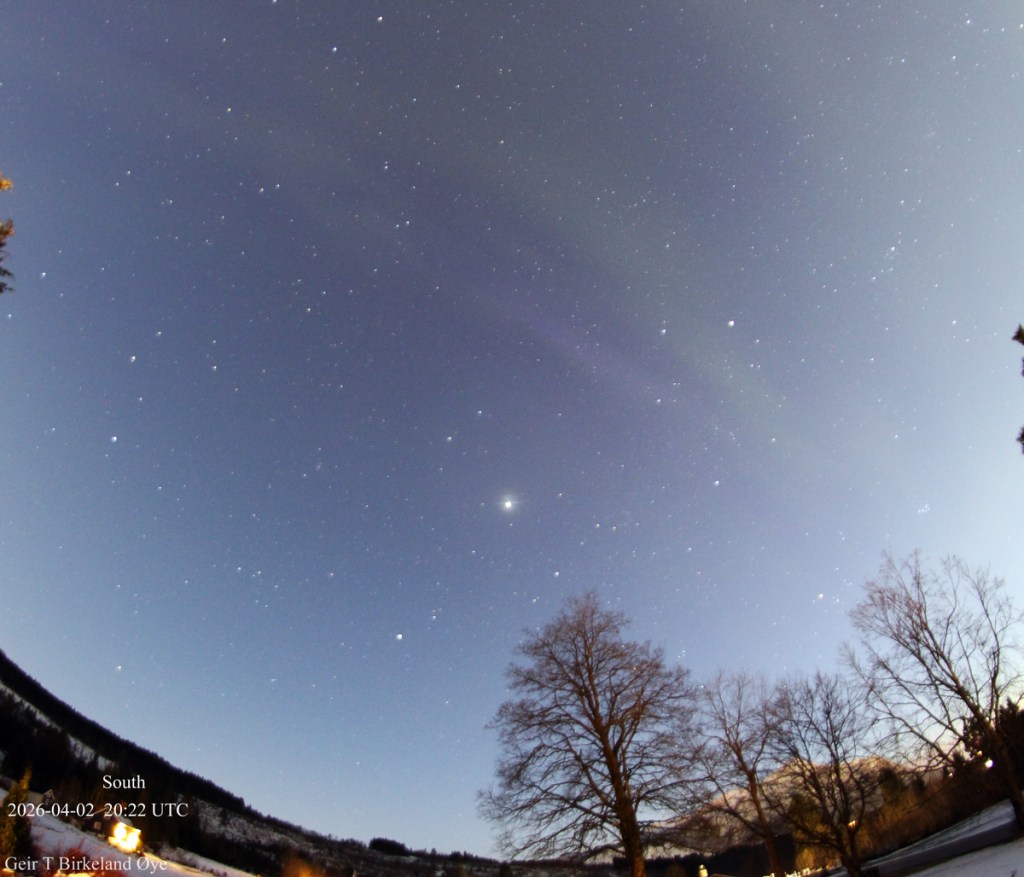
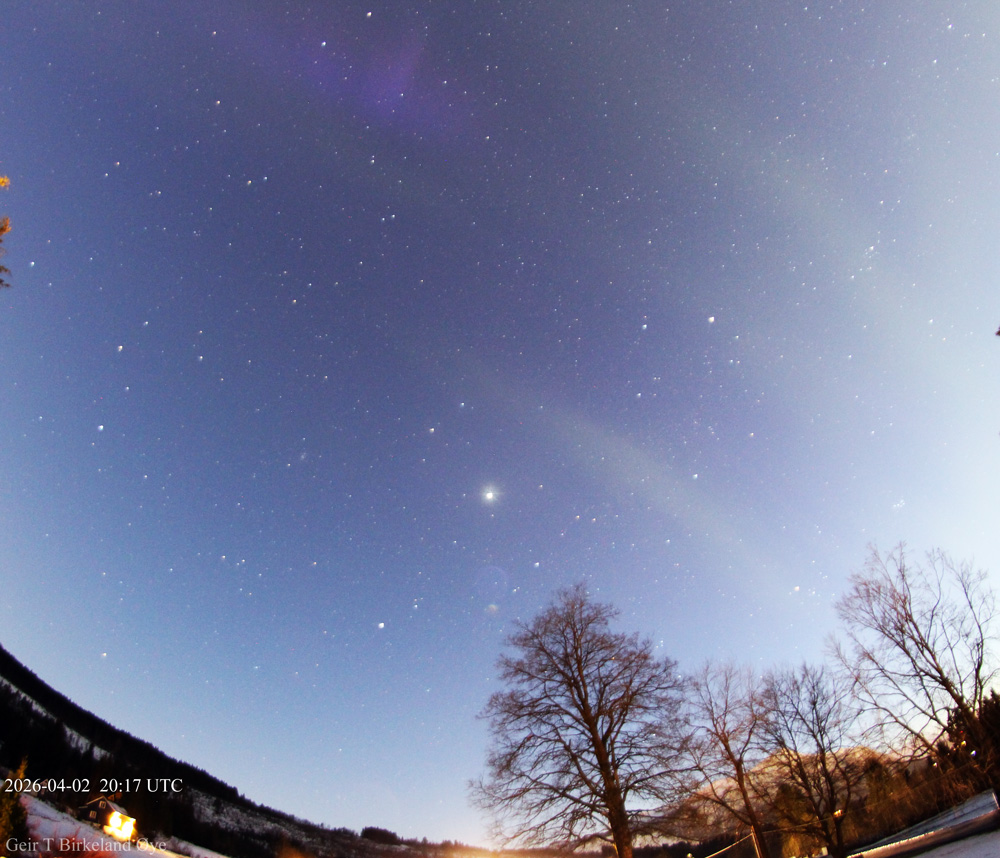
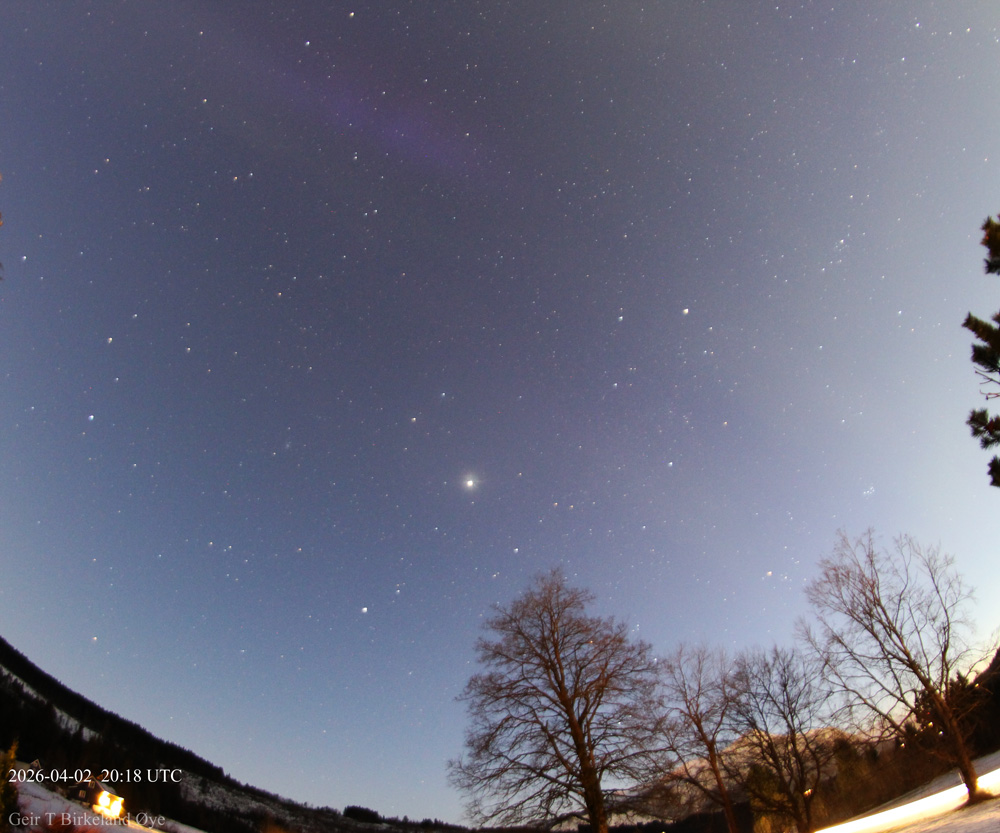
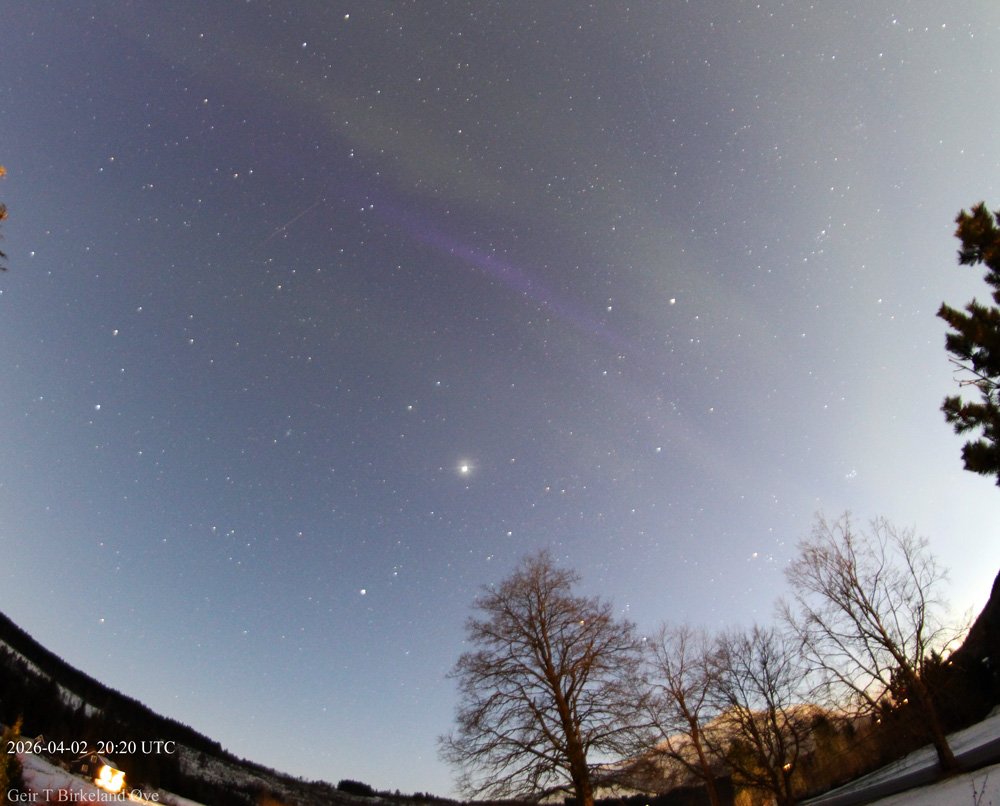
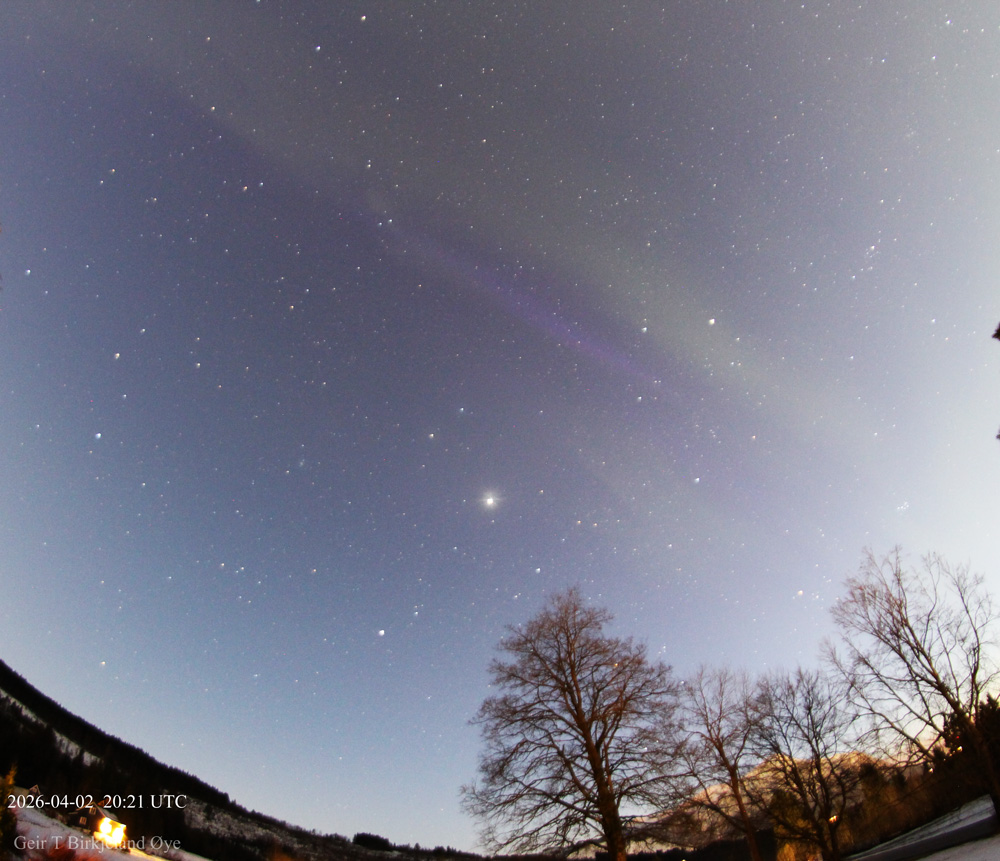
Time: 20:16–20:22 UTC Observation type: DSLR documentation of a transient subauroral STEVE‑like emission Observer: Geir T. Birkeland Øye Location: Ørsta, Norway
Instrument: Canon 650D, 8 mm fisheye lens, high‑resolution short‑exposure sequence
Summary
A transient subauroral optical emission consistent with the STEVE (Strong Thermal Emission Velocity Enhancement) phenomenon was observed south of the auroral oval on 2 April 2026. The event began as a compact purple/magenta subauroral blob around 20:16 UTC, which rapidly elongated into a narrow, well‑defined east–west arc. The emission persisted for approximately six minutes before dissipating.
Throughout the entire sequence, the structure displayed a stable purple–magenta continuum with no green (557.7 nm) or red (630.0 nm) oxygen‑line auroral features, and no curtain‑like or rayed morphology. This spectral appearance is characteristic of STEVE, which is known to produce broadband continuum emission rather than discrete auroral lines.
The full evolution—from initial blob to mature arc and final fading—was captured in a time‑stamped DSLR sequence.
Optical and morphological characteristics
Initial localized subauroral blob with purple/magenta emission
Rapid transition into a narrow, east–west oriented arc
No picket‑fence structures, no rayed curtains, and no oxygen‑line signatures
Emission remained smooth, featureless, and continuum‑dominated
Arc located equatorward of the main auroral oval, consistent with subauroral ion drift regions
This morphology aligns with documented STEVE events associated with SAID/SAPS channels.
Geomagnetic and solar‑wind context
Solar wind conditions on 2 April were already disturbed due to preceding coronal mass ejections (CMEs). Such conditions are favourable for the formation of subauroral ion drift channels, which can generate STEVE‑type emissions.
Key contextual points:
Disturbed solar wind from earlier CMEs
Enhanced geomagnetic activity at subauroral latitudes
Conditions supportive of fast, localized ionospheric flow channels
STEVE events are commonly short‑lived under such transient SAID/SAPS regimes
The brief duration (6 minutes) is fully consistent with known STEVE behaviour.
Interpretation
The event is best classified as a STEVE‑type subauroral emission, based on:
Subauroral location
Purple/magenta continuum emission
Absence of discrete auroral lines
Rapid blob‑to‑arc evolution
Occurrence during disturbed geomagnetic conditions
The high‑resolution, time‑stamped imagery provides a complete record of the event, including the rarely documented initial blob phase, making this a scientifically valuable observation.
Norsk
STEVE‑liknande subauroral emisjon – 2. april 2026
Ei kortvarig subauroral lysfenomen vart observert sør for nordlysovaen i Ørsta mellom 20:16 og 20:22 UTC. Hendinga starta som ein kompakt lilla/magenta “blob”, som raskt strekte seg ut til ein tydeleg aust–vest‑gåande STEVE‑struktur.
Emisjonen hadde gjennom heile forløpet ein jamn lilla/magenta kontinuerleg spektral karakter, utan grøne eller raude oksygenliner og utan gardin‑ eller strålestrukturar. Dette er typisk for STEVE, som ikkje er eit tradisjonelt nordlys, men eit optisk uttrykk for raske subaurorale ionedriftar (SAID/SAPS).
Solvindforholda var forstyrra av tidlegare CME‑ar, noko som gav gode vilkår for slike fenomen. Den korte varigheita er i tråd med kjende STEVE‑observasjonar.
Hendinga er klassifisert som ei STEVE‑type subauroral emisjon, og bileta dokumenterer heile utviklinga frå første blob til bortfall.
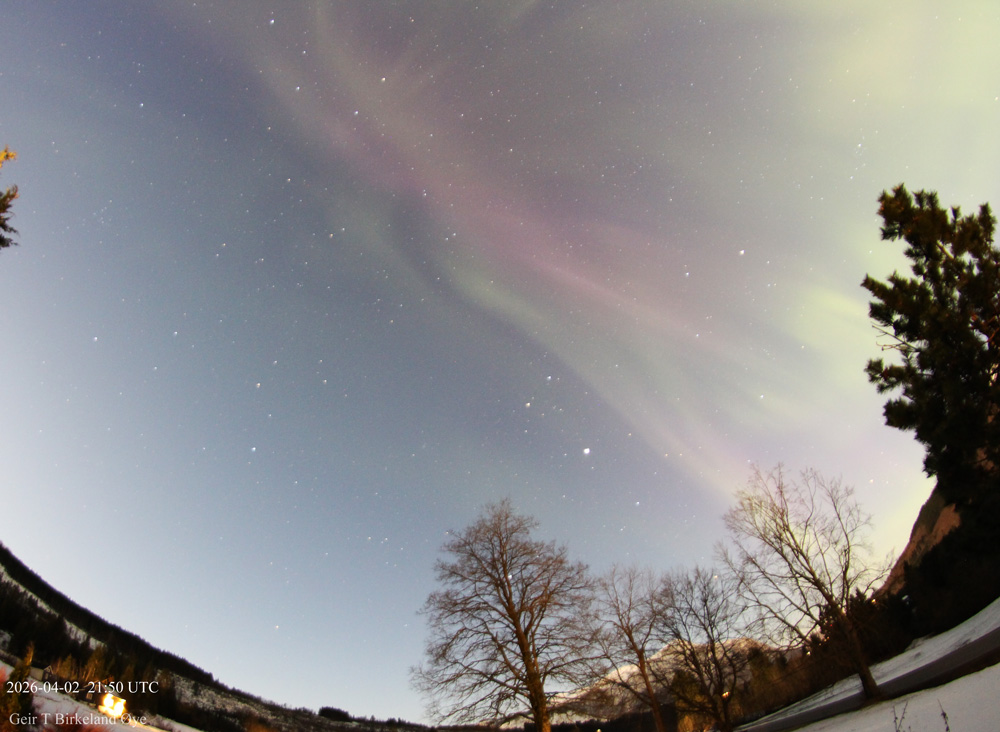
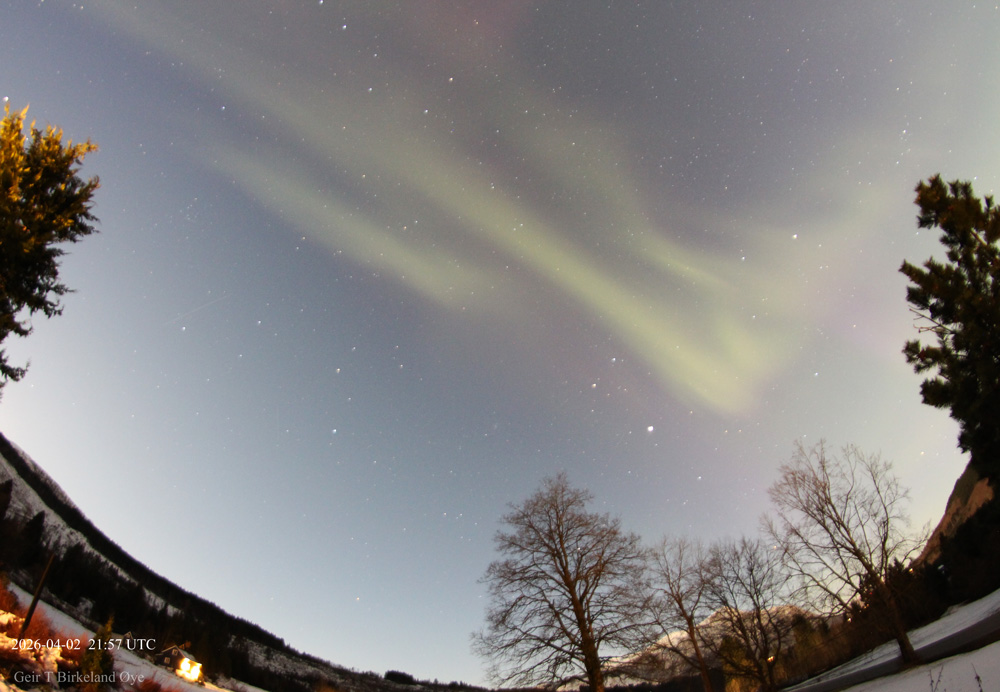
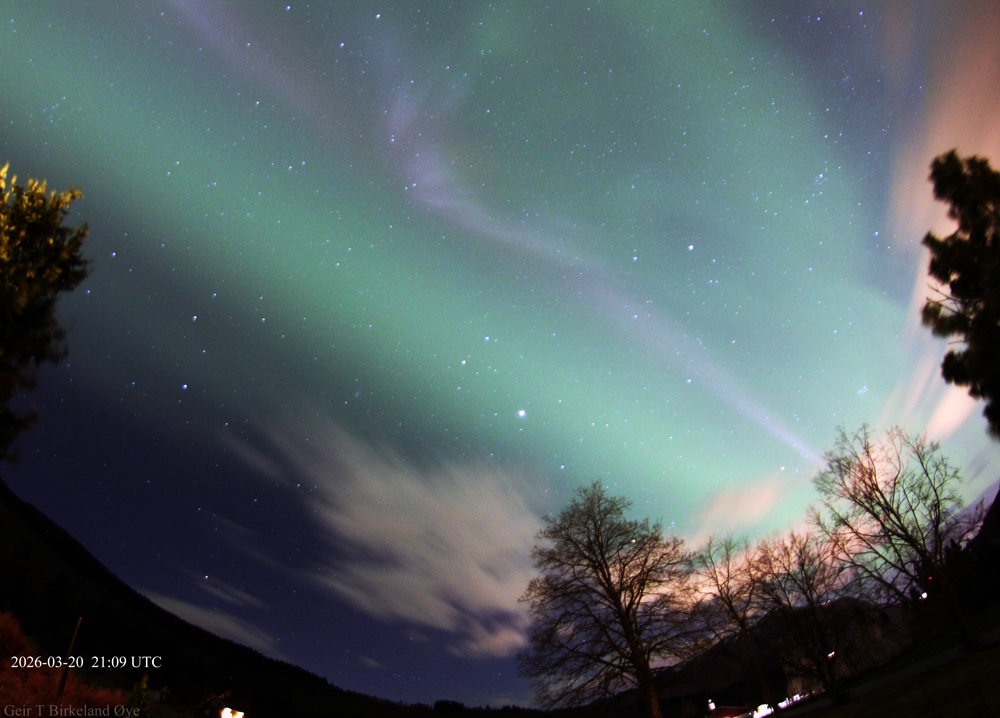
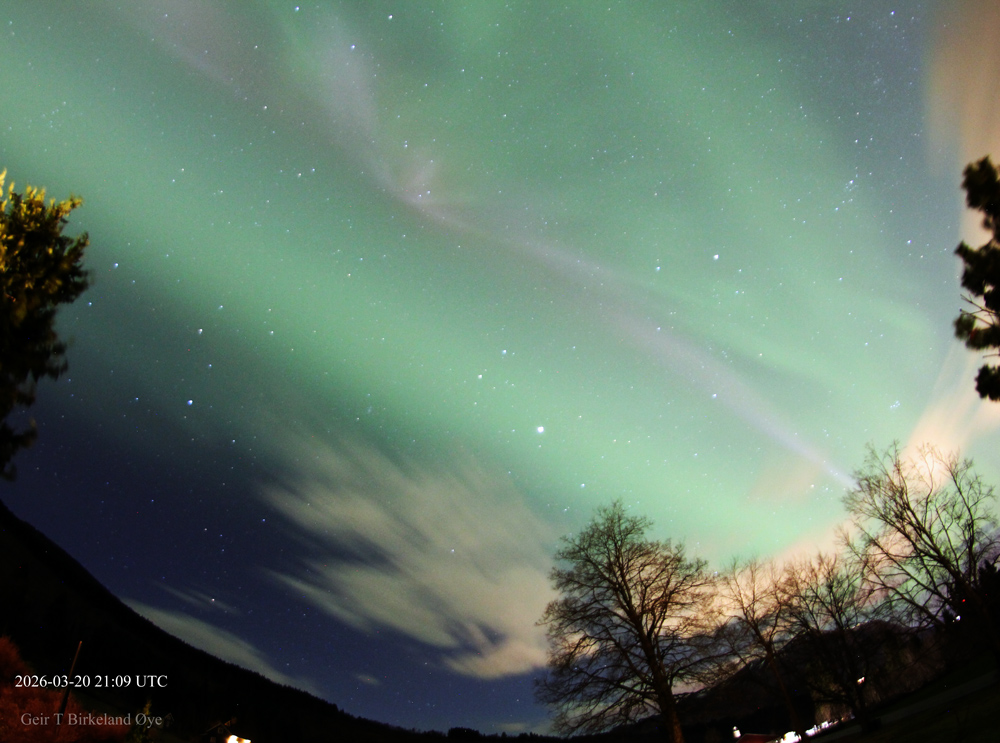
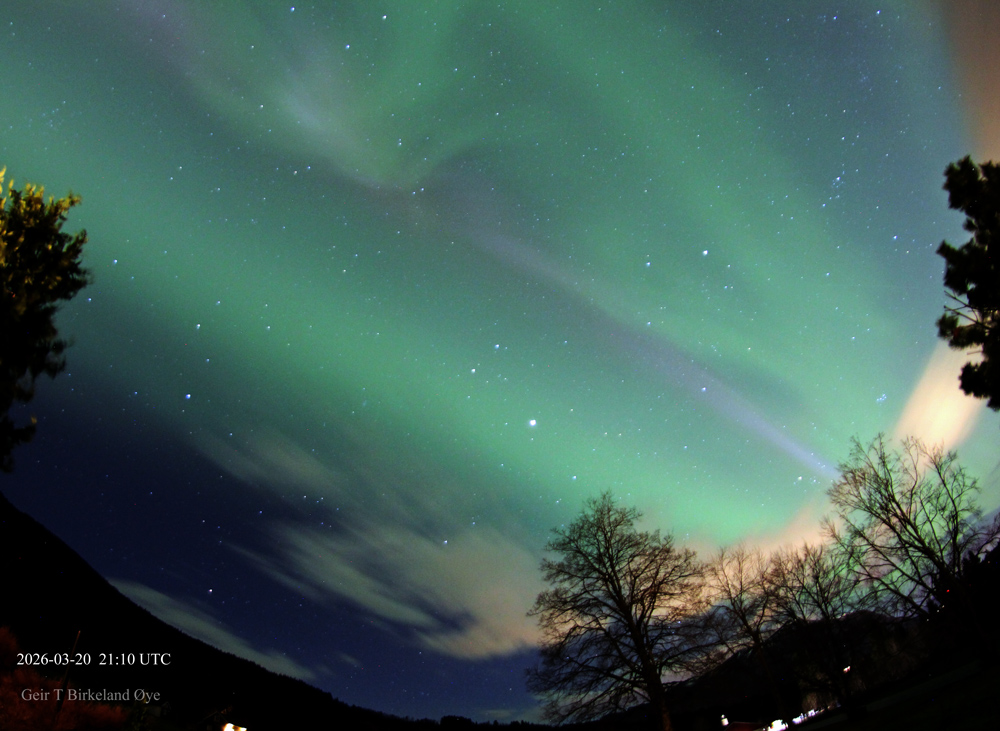
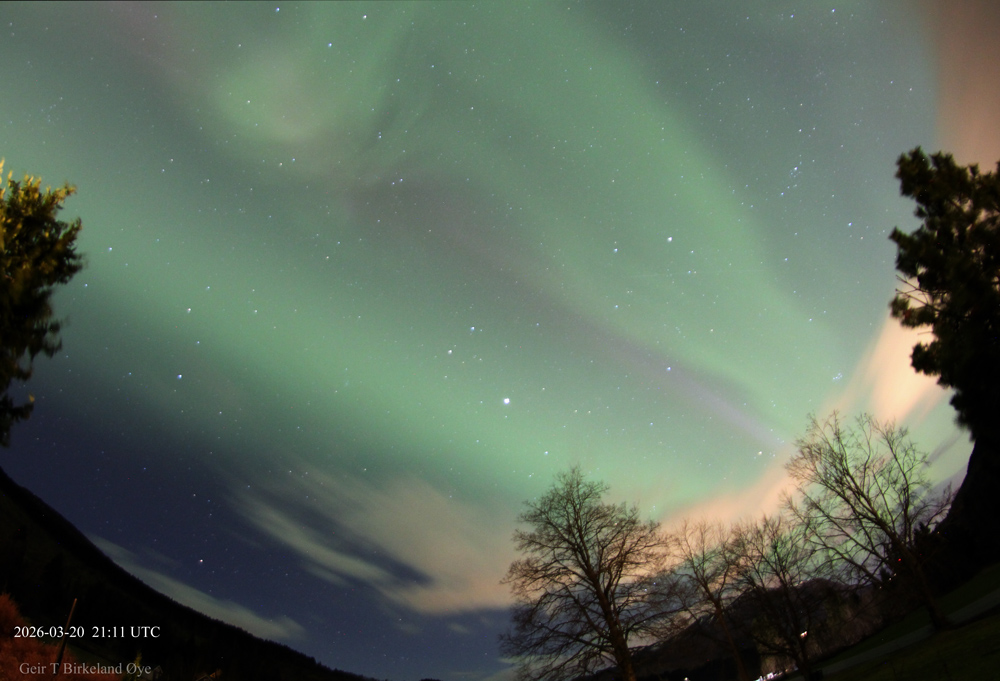
The auroras shone brightly enough to be visible in a sky dominated by the full Moon. Here are a few images from April 02 with timestamps in UTC. Details: Canon 650D, 8mm fisheye lens.
Nice auroral activity in between the clouds, wind and precipitation. A faint but distinct pink STEVE structure appeared in the eastern sky during an intense auroral outbreak after a CME impact. It was visible only from 22:08 to 22:11 before clouds returned. The images show a clear mauve/pink hue distinct from the surrounding green and violet aurora. This represents an atypical but confirmed STEVE variant. A few images. Details: Canon 650D/RP, fisheye lenses. Various iso and exposure settings. Location: Ørsta, Norway.
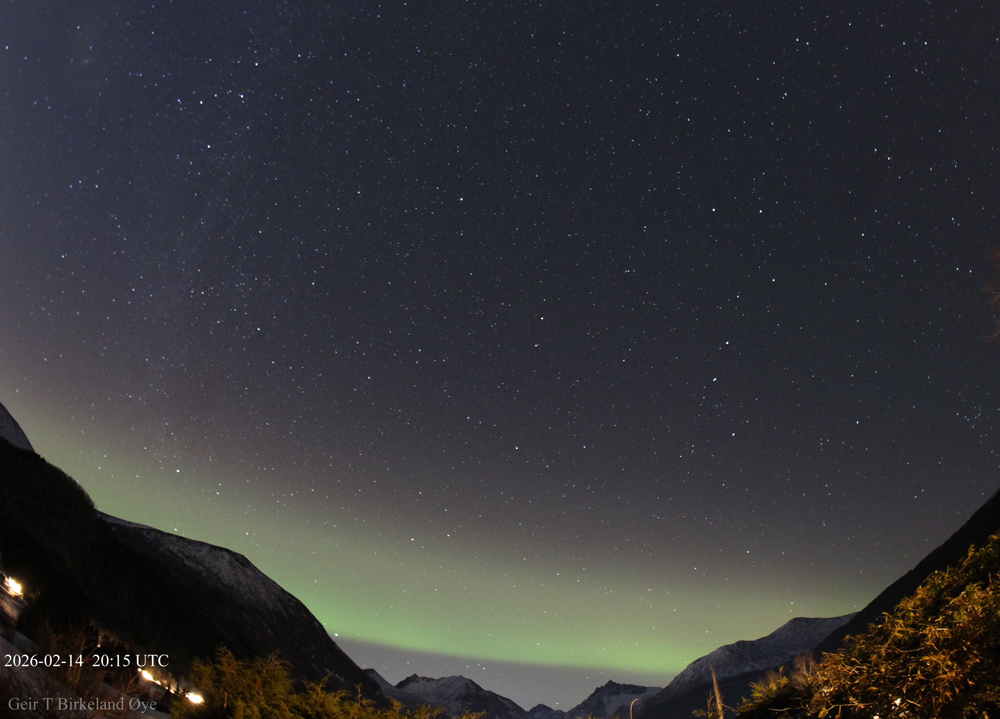
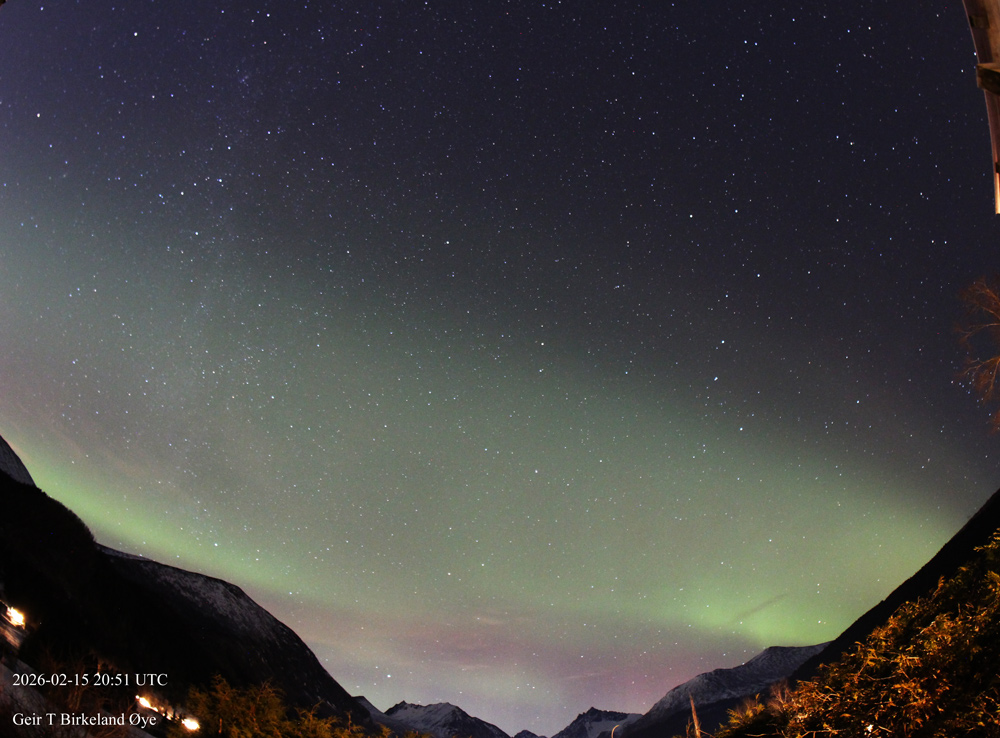
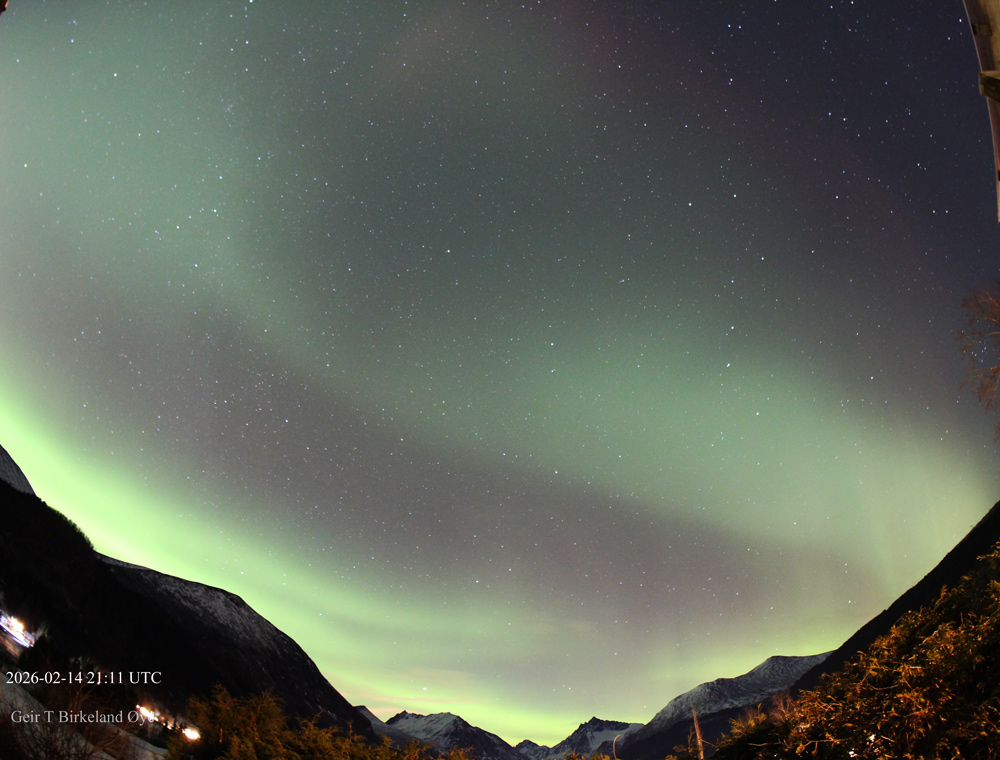
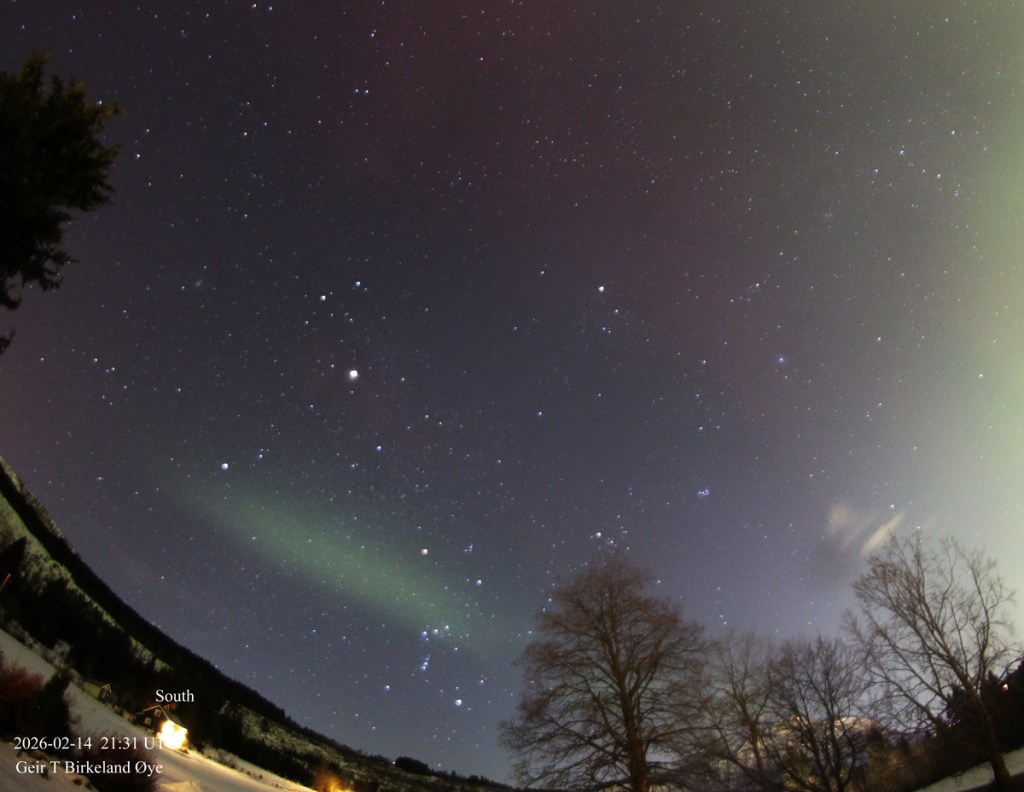
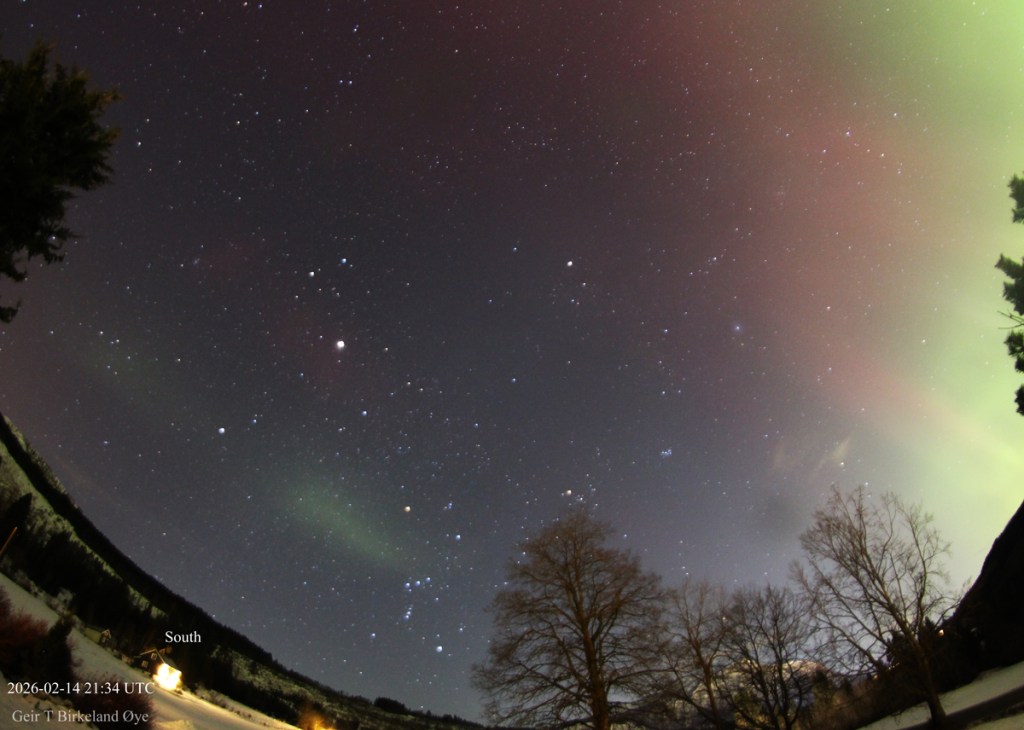
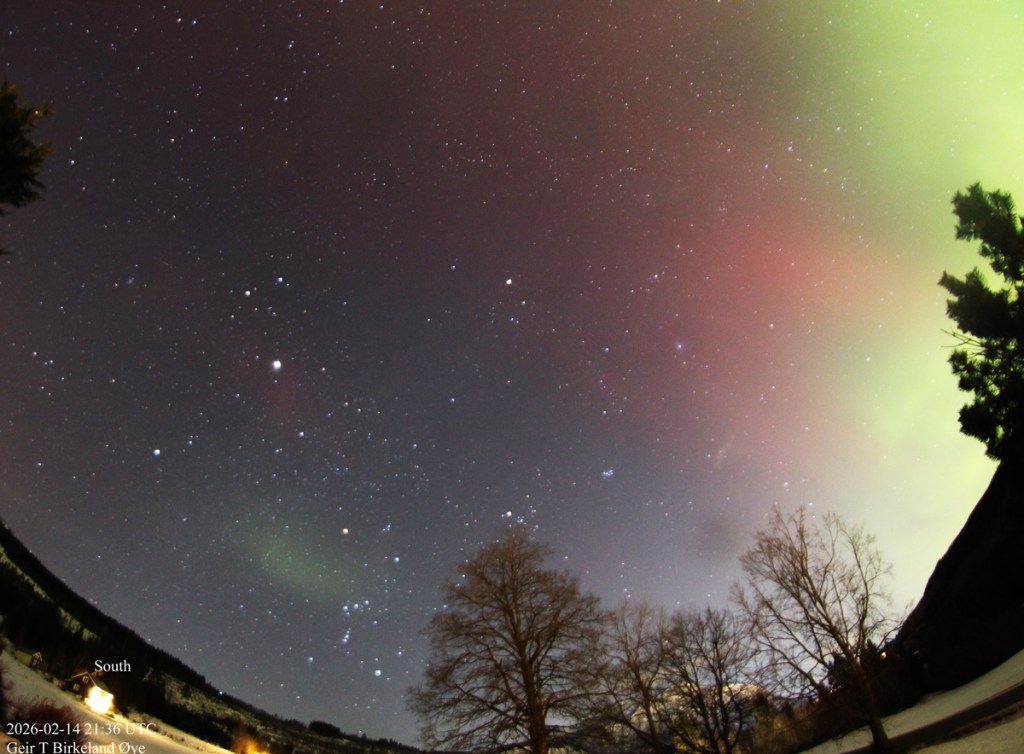
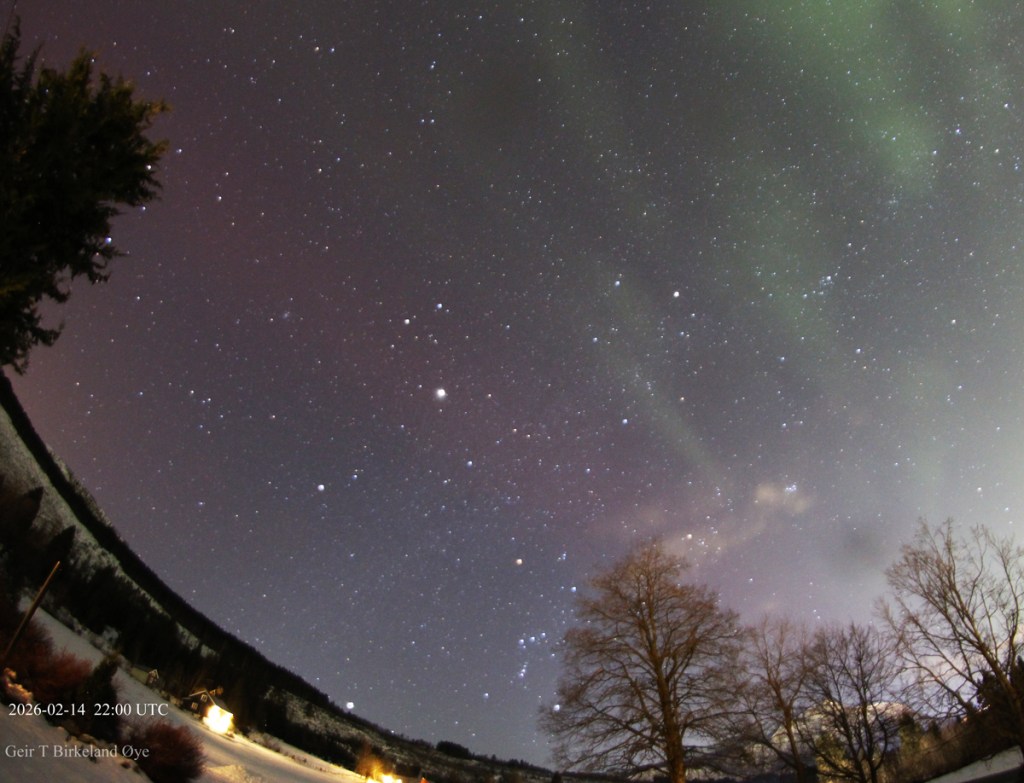
During the CIR-impact on February 14-15, 2026, there was an instance of what looked like RAGDA to the south. A few images from local time 22:31 to 22:36 (or 21:31 to 21:36 UTC, if you wish). Following the RAGDA phenomenon a SAR-arc appeared, it lingered on, here photographed at local time 23:00 (UTC 22:00).
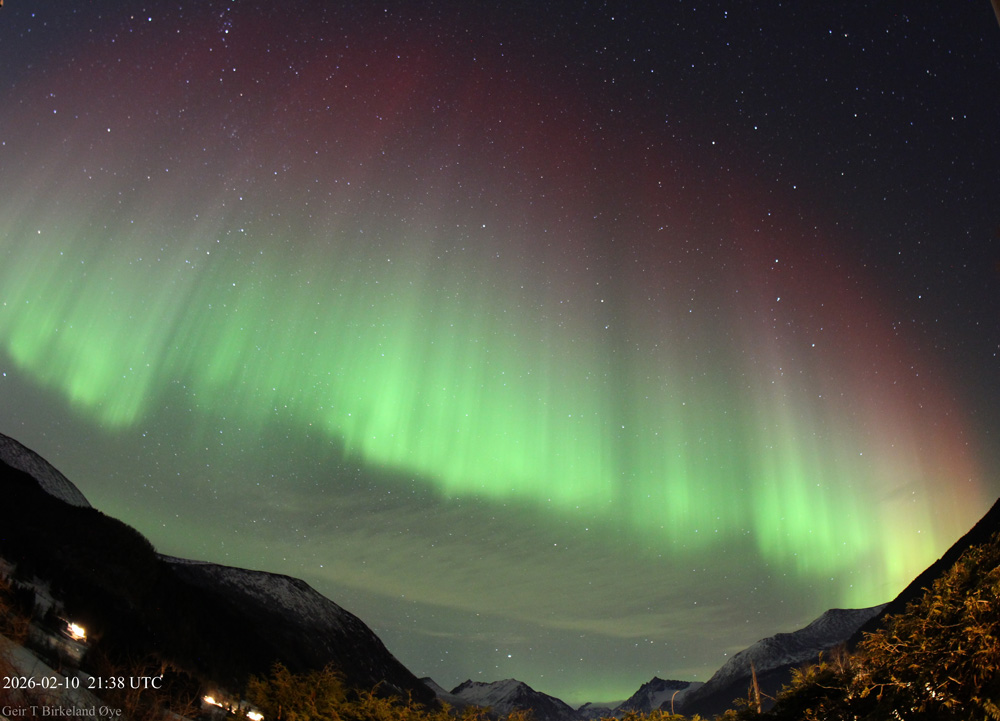
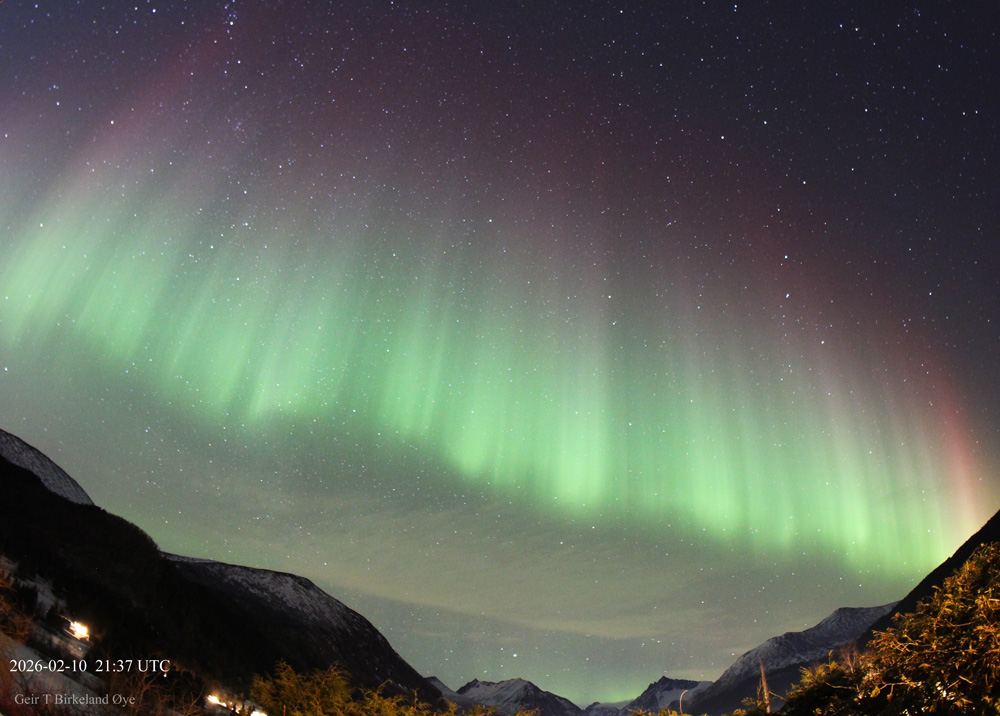
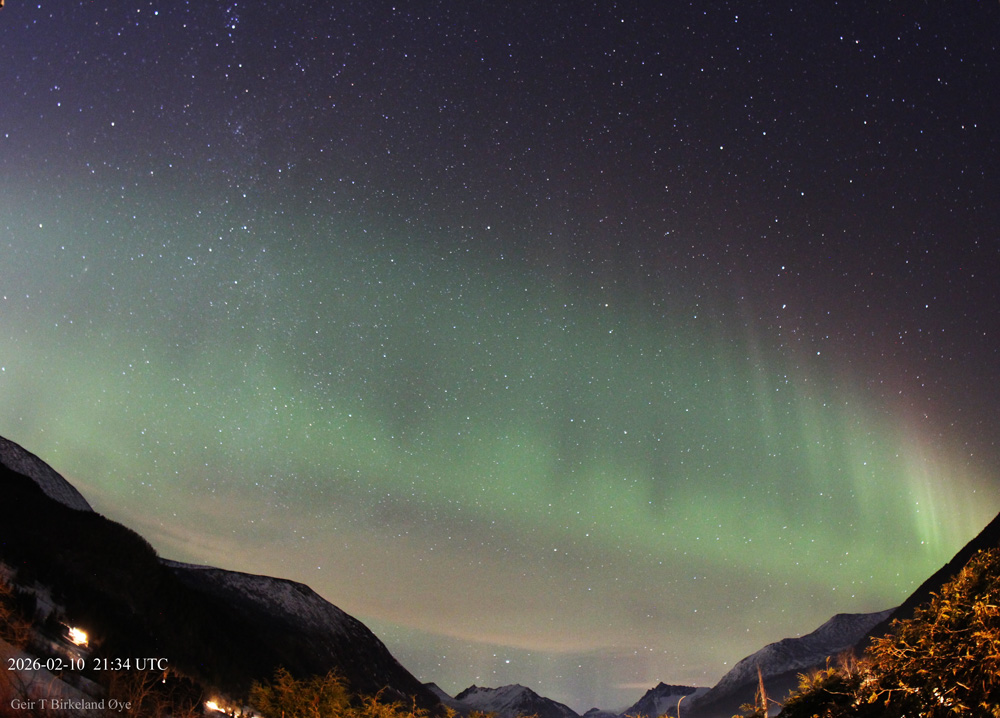
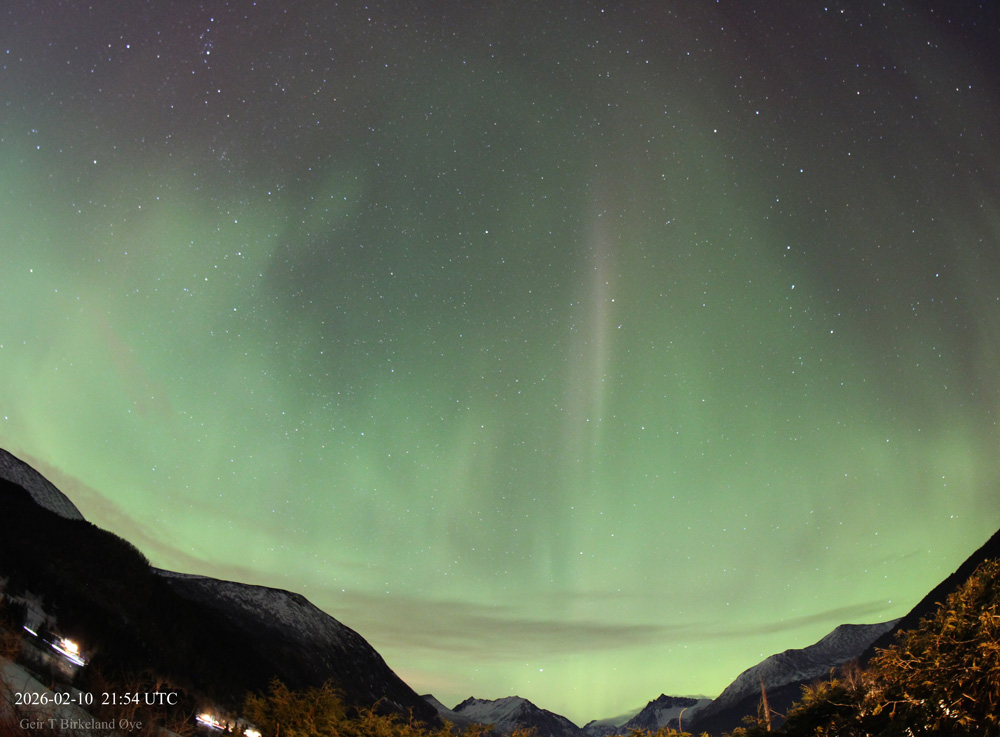
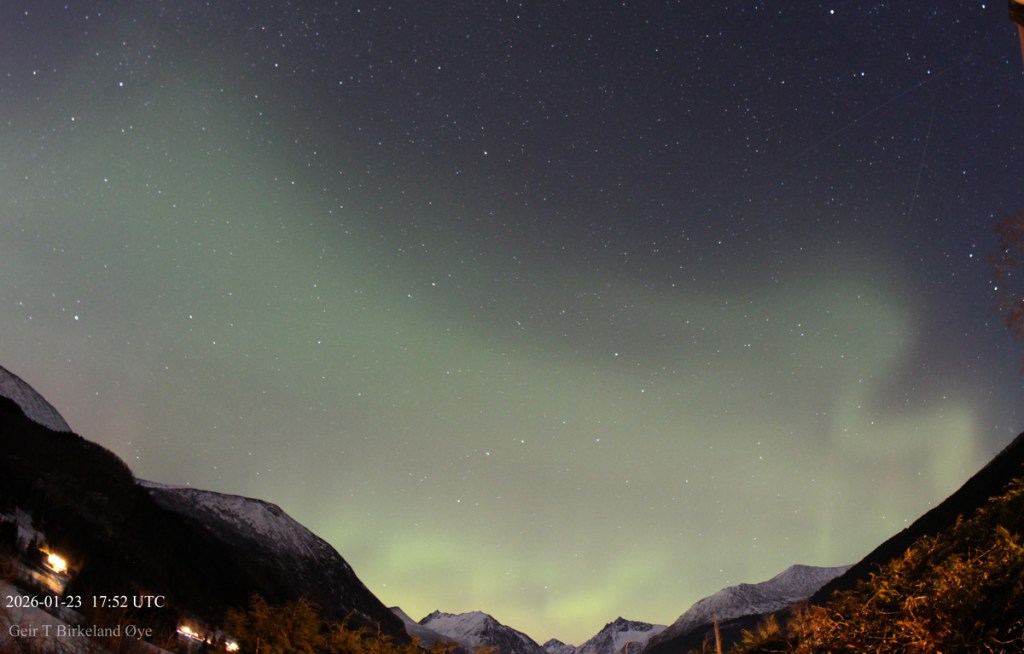
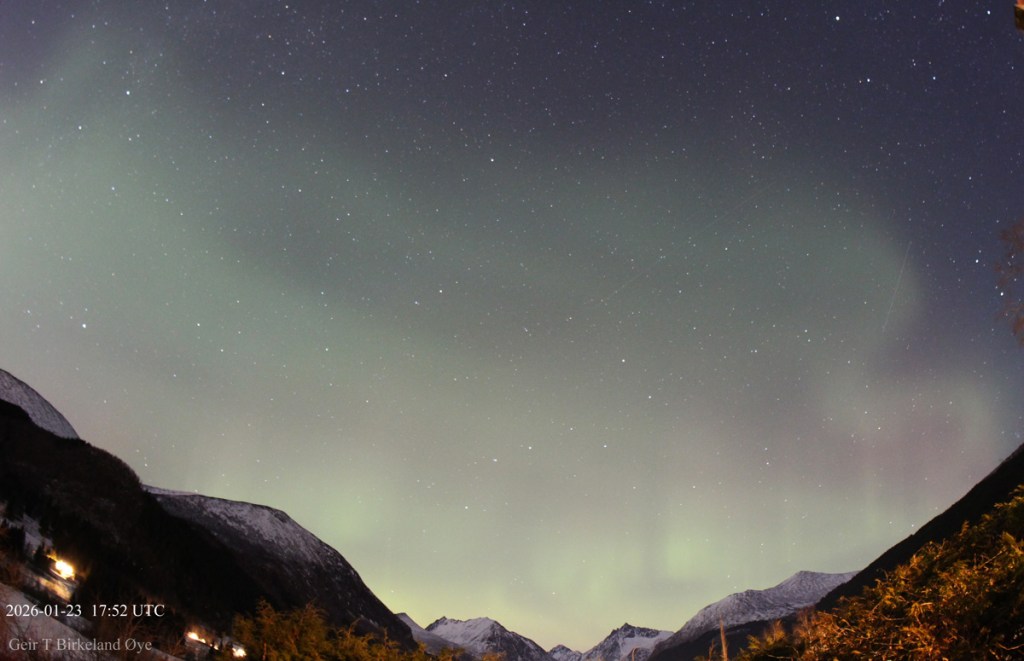
Nice colorful auroral curtains over the valley on February 10, 2026. Here are a few images with timestamps in UTC. Details: Canon 650D, 8mm fisheye lens. Iso: 1600
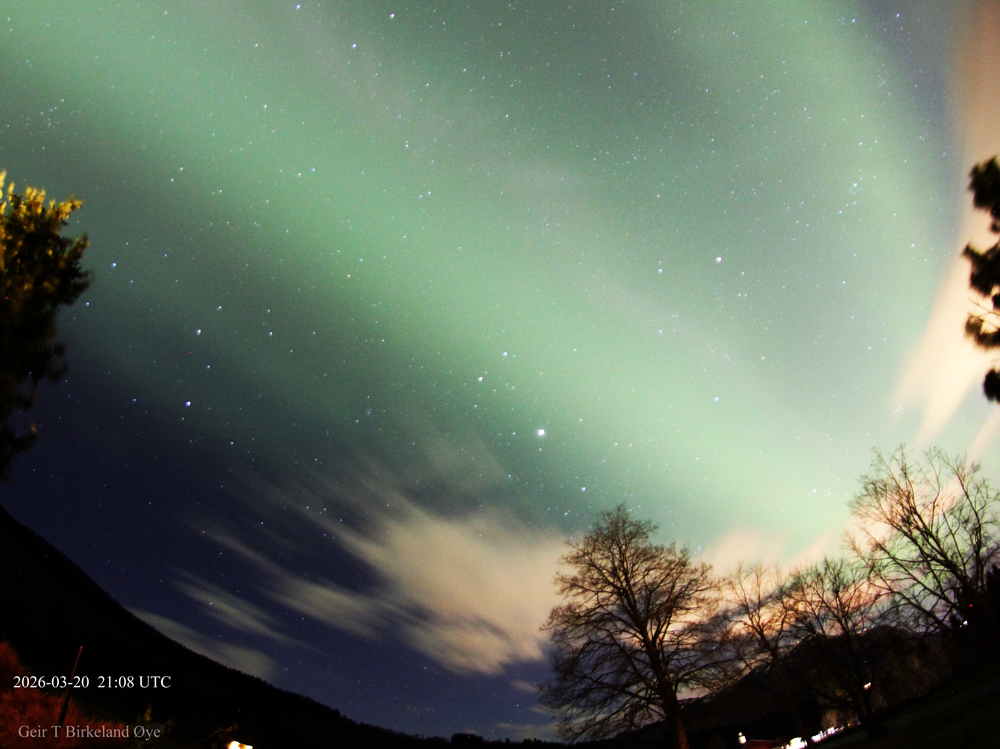
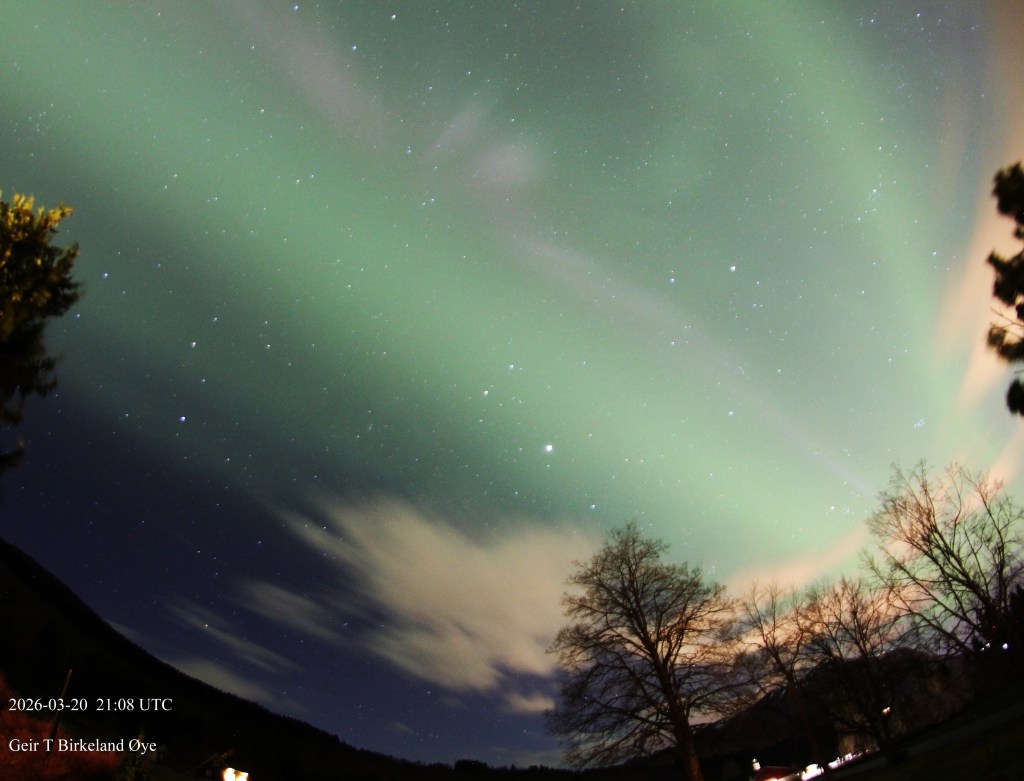
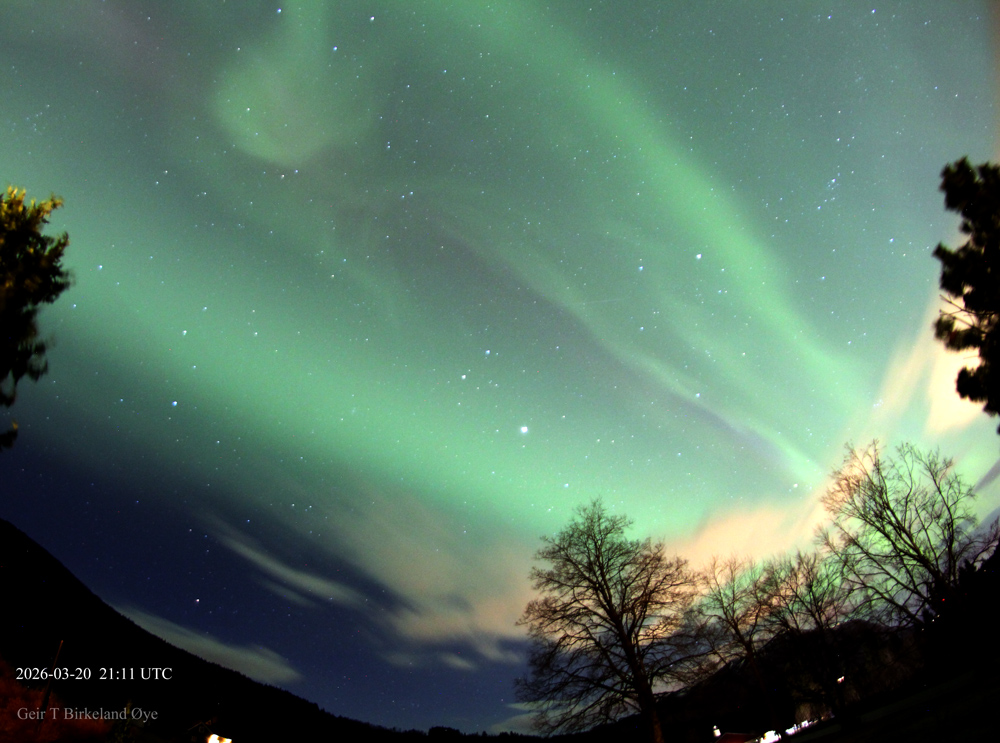
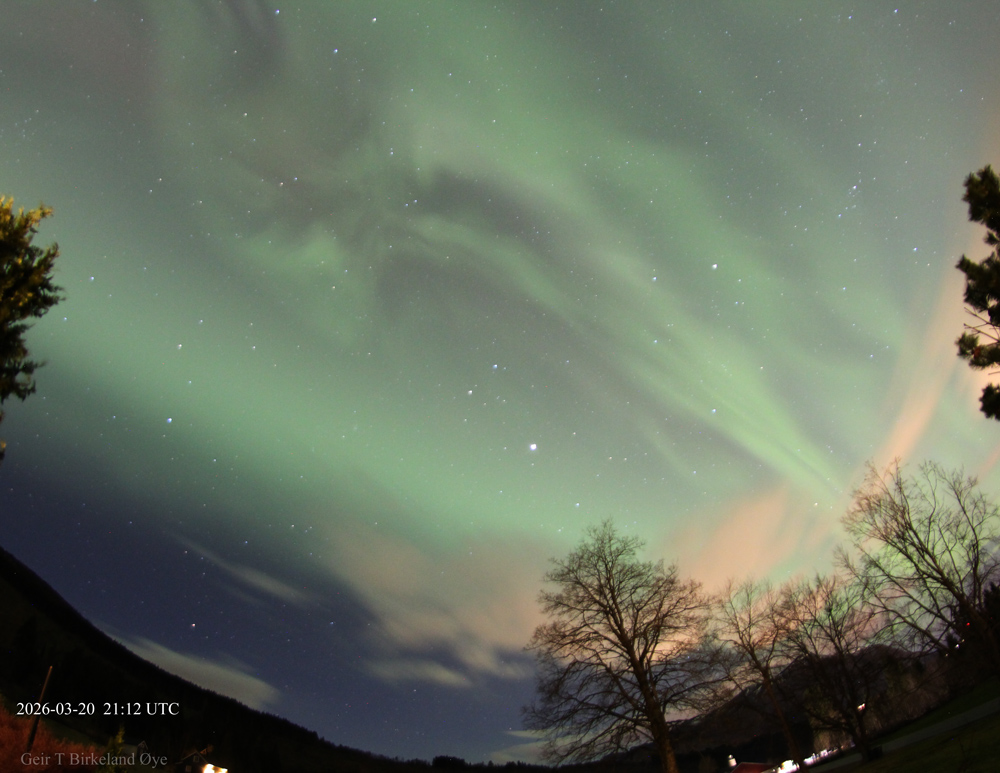
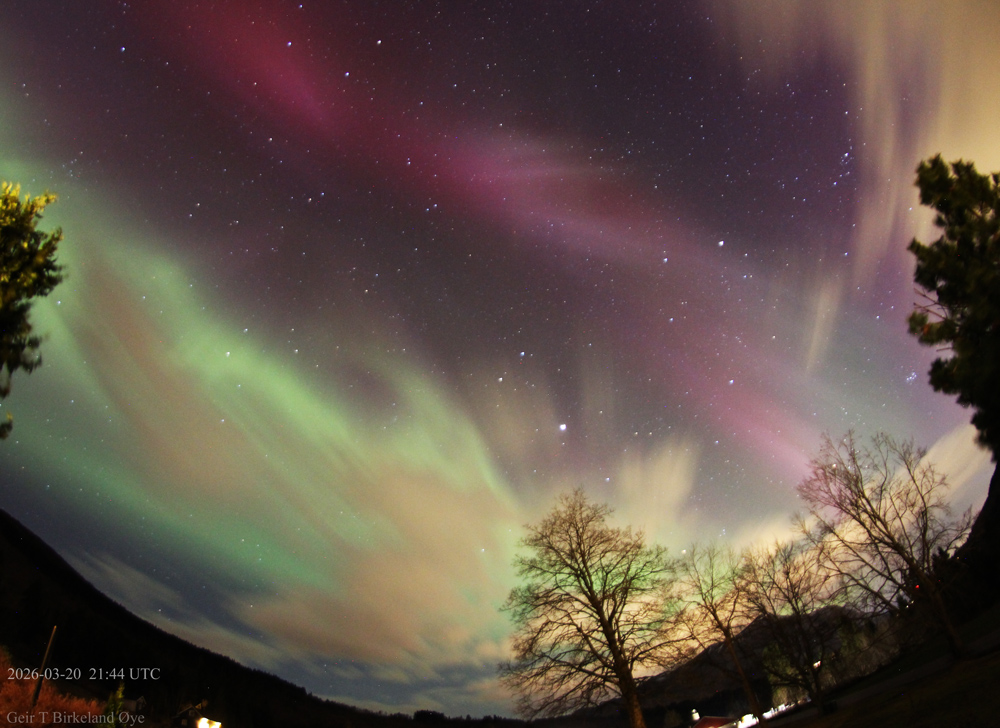
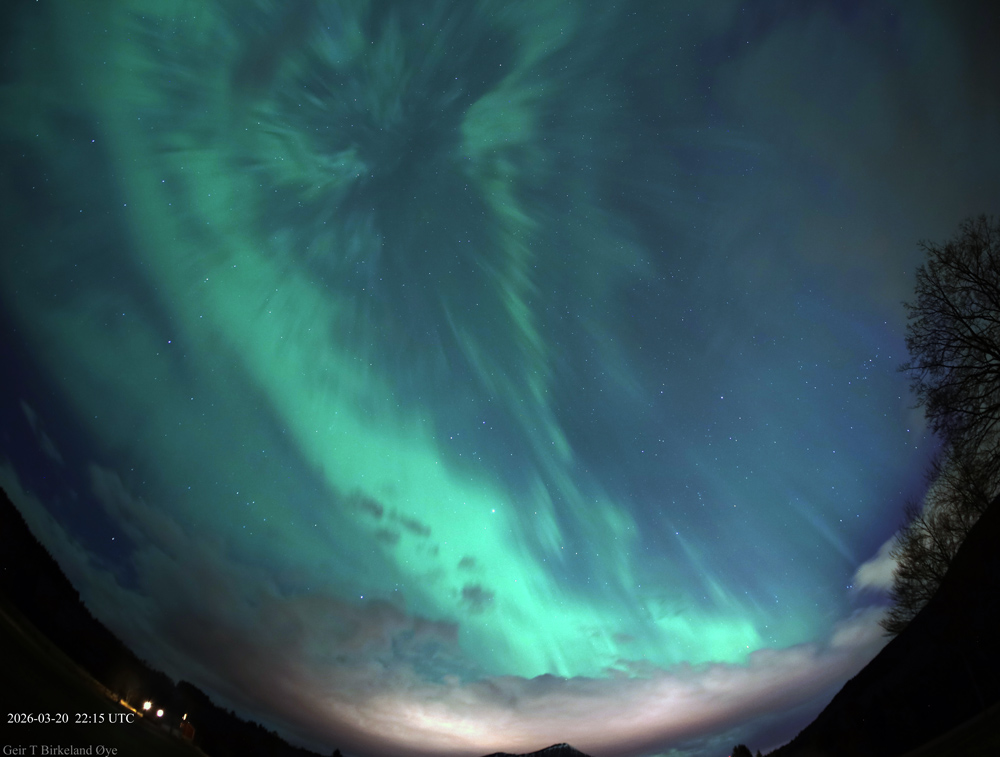
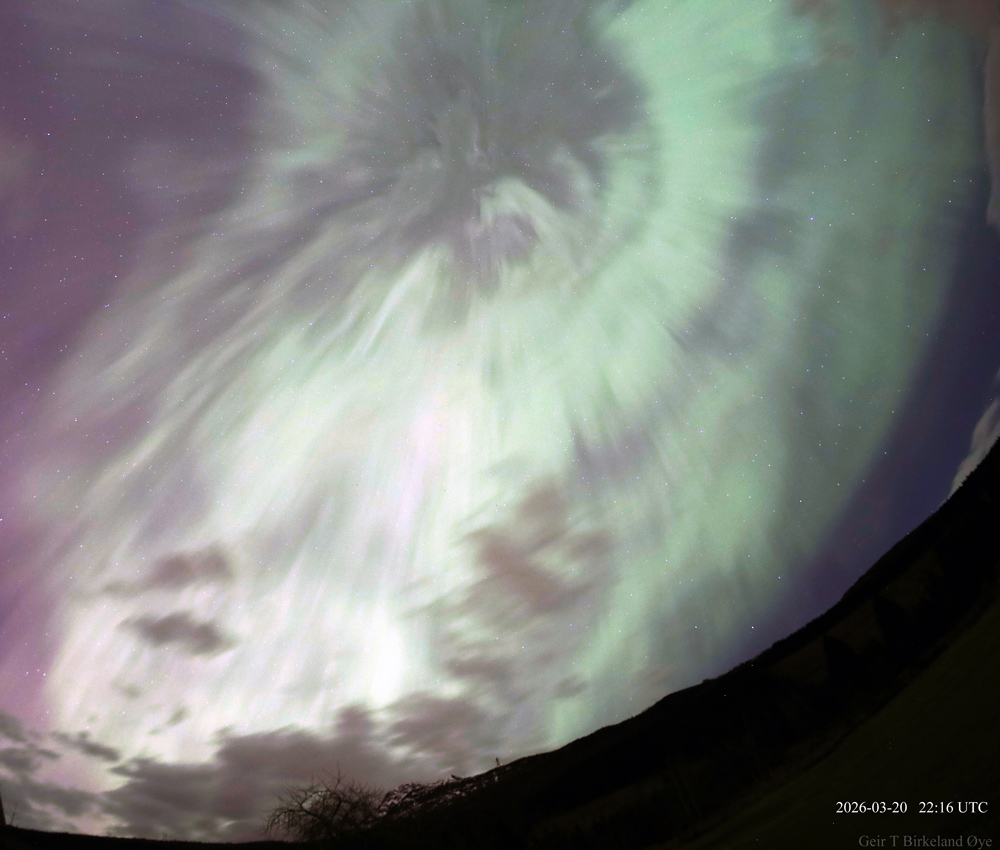
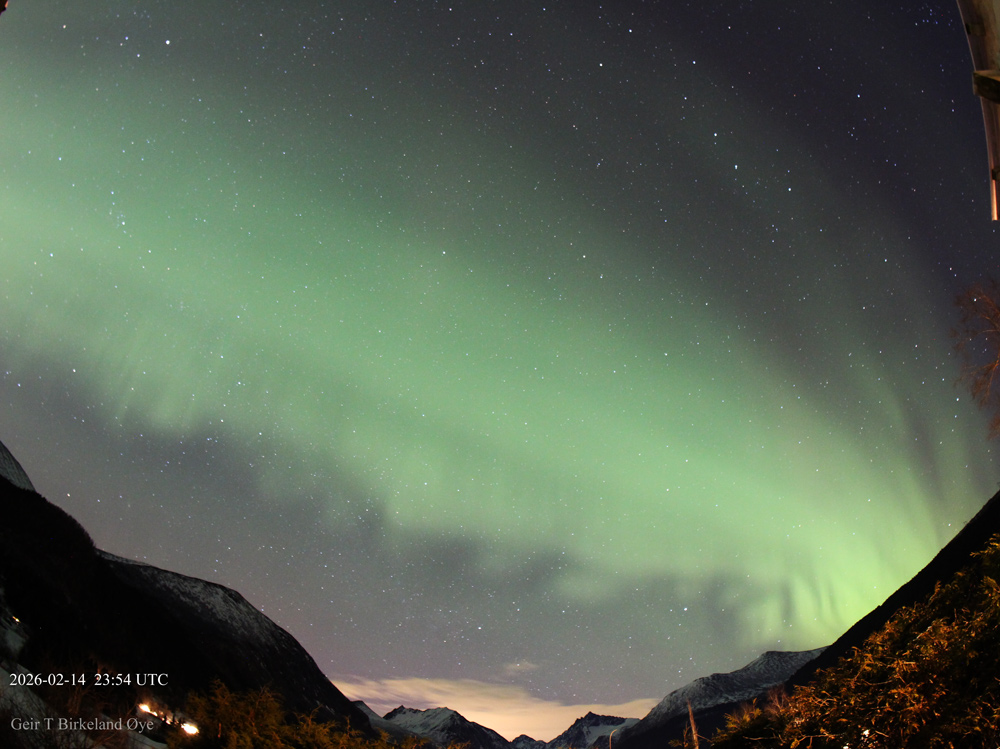
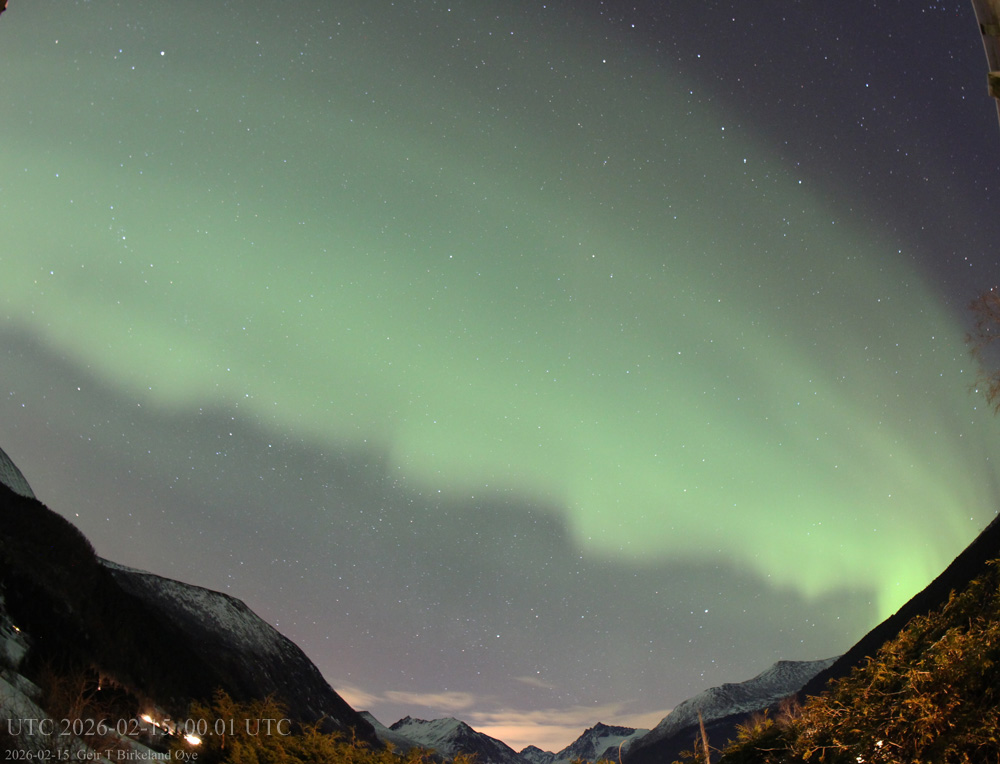
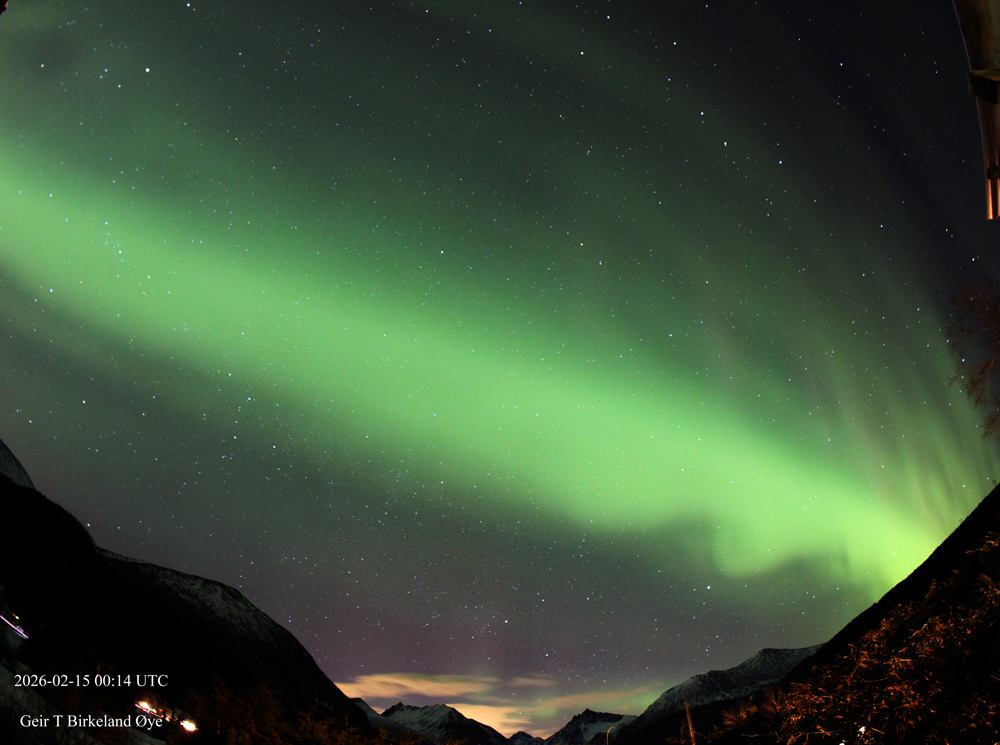
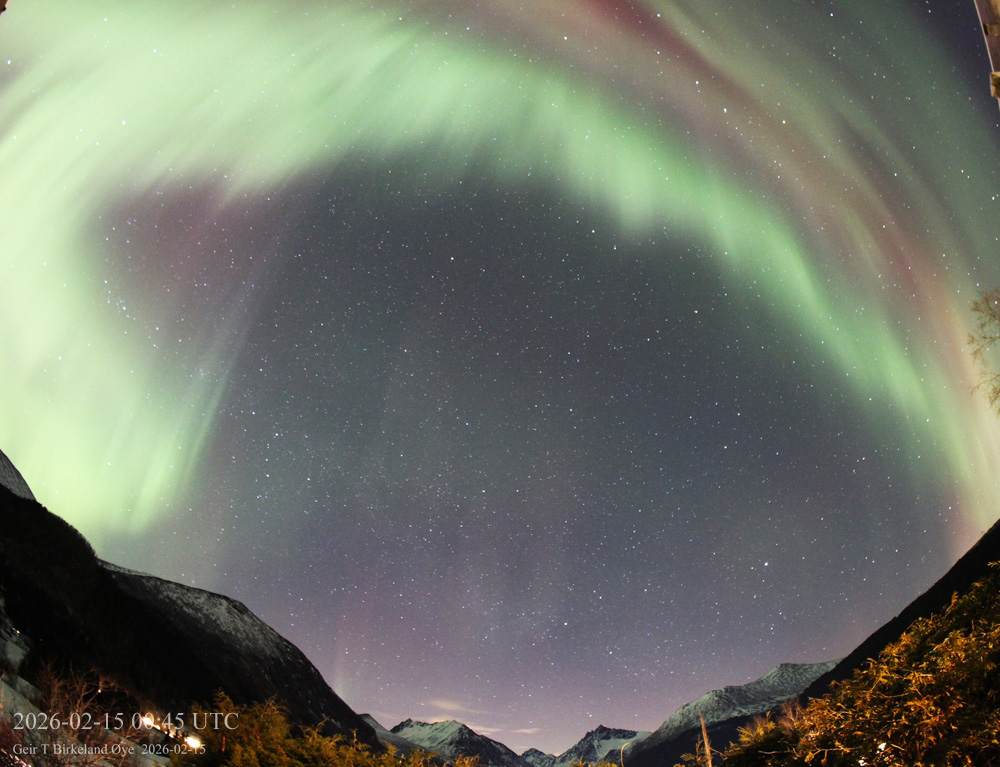
An intense auroral storm. Unfortunately, as seen from this location (Ørsta, Norway) interfered by clouds. Details: Canon 650D/RP and fisheye lenses. Please, find time on images.