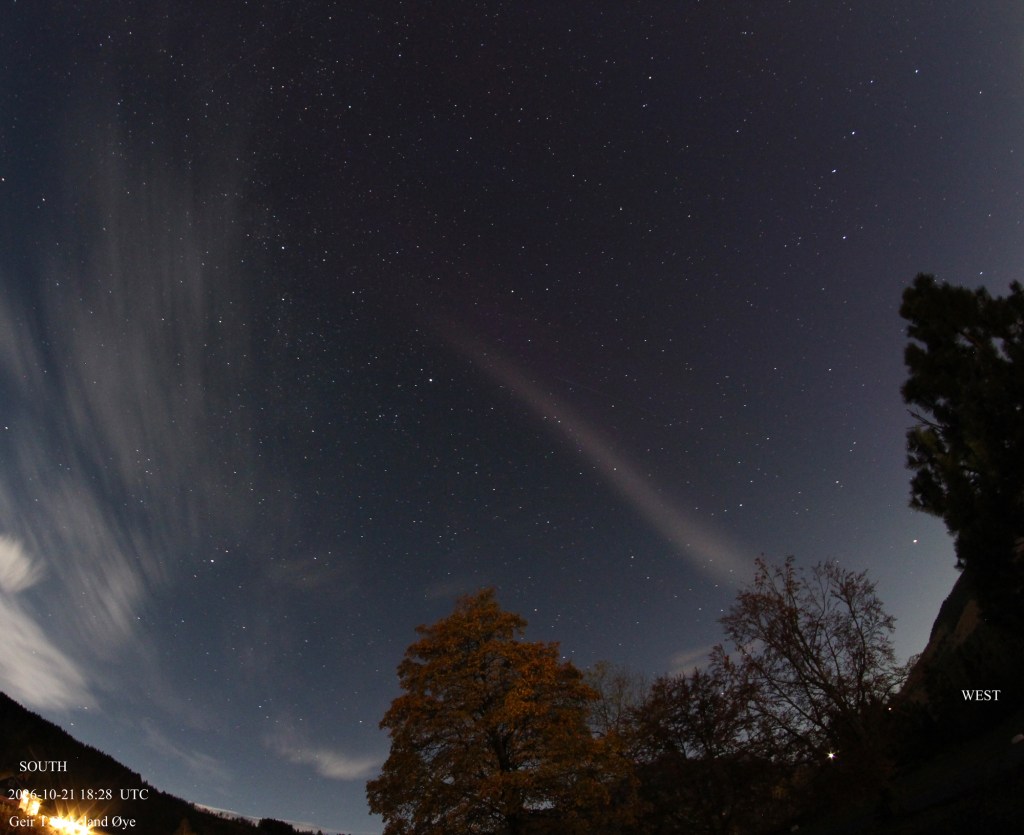
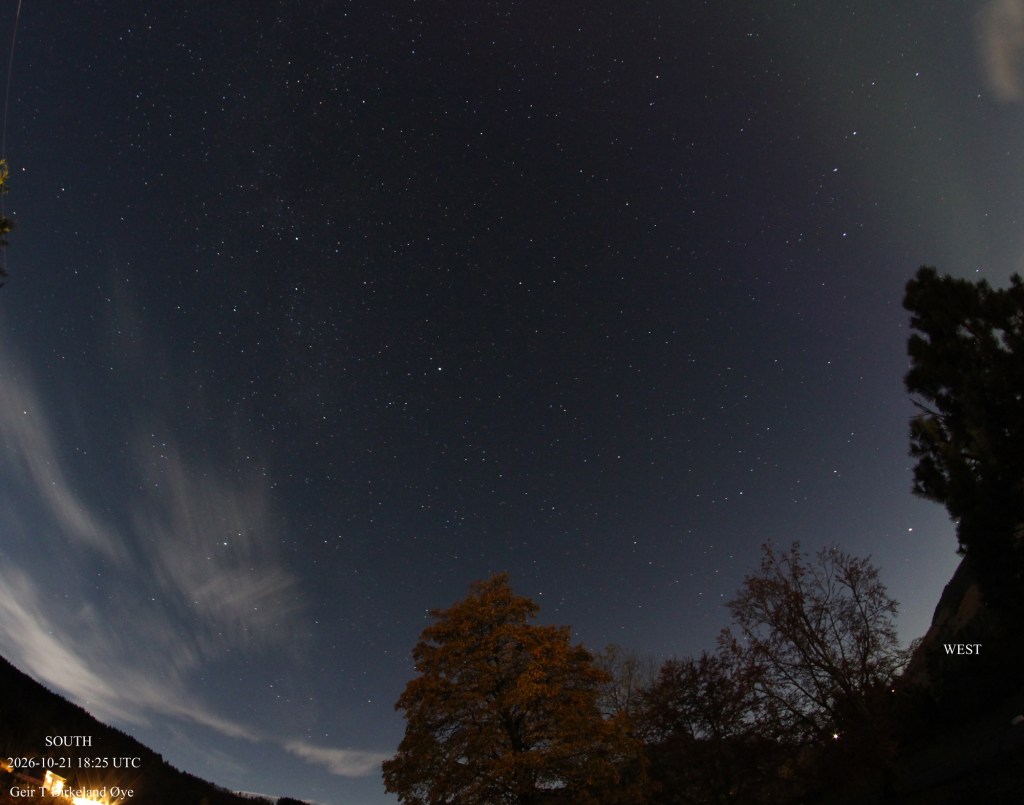
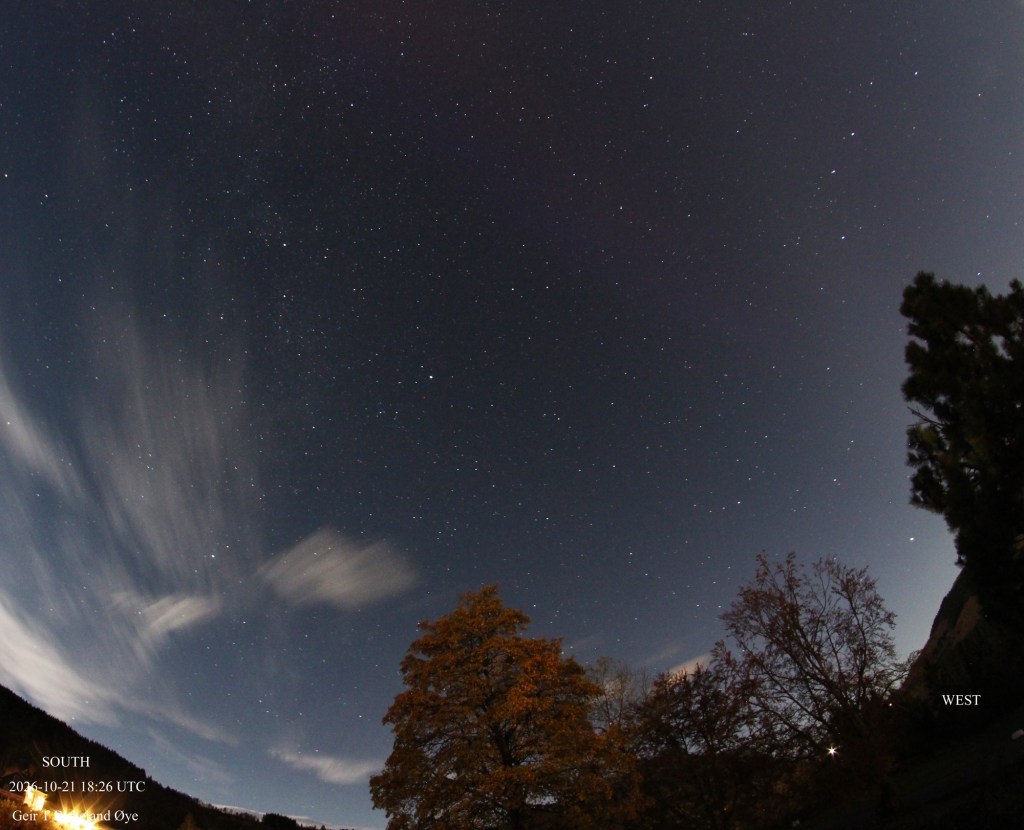
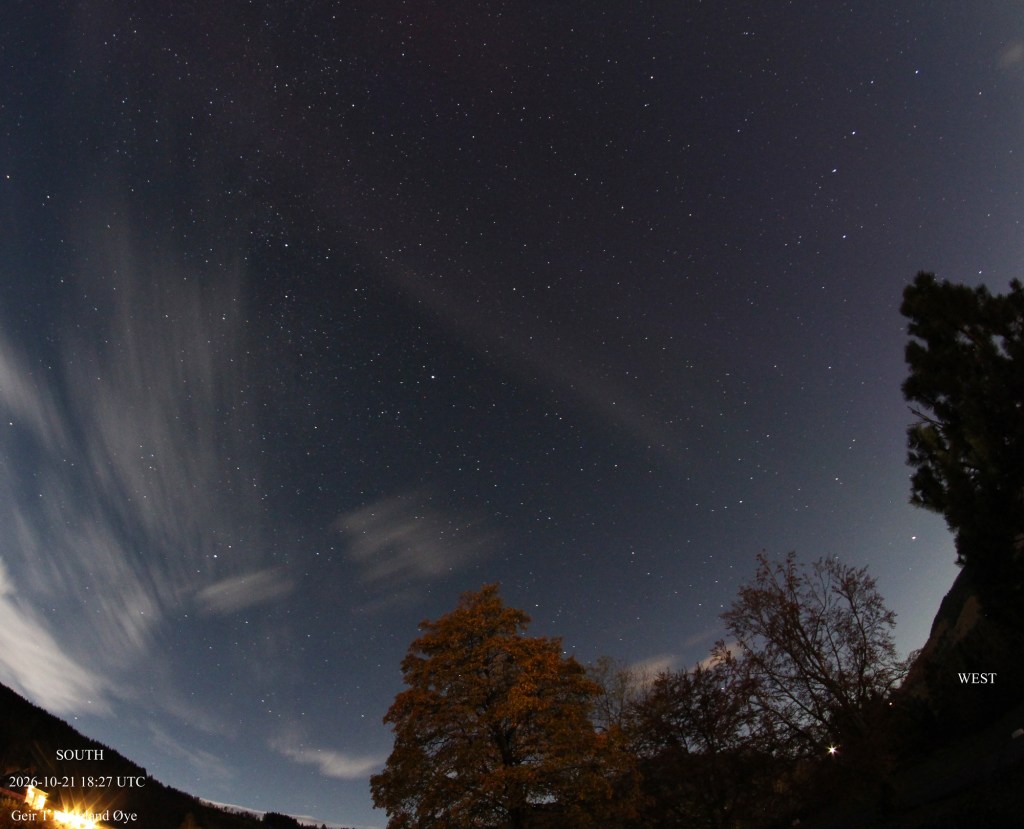
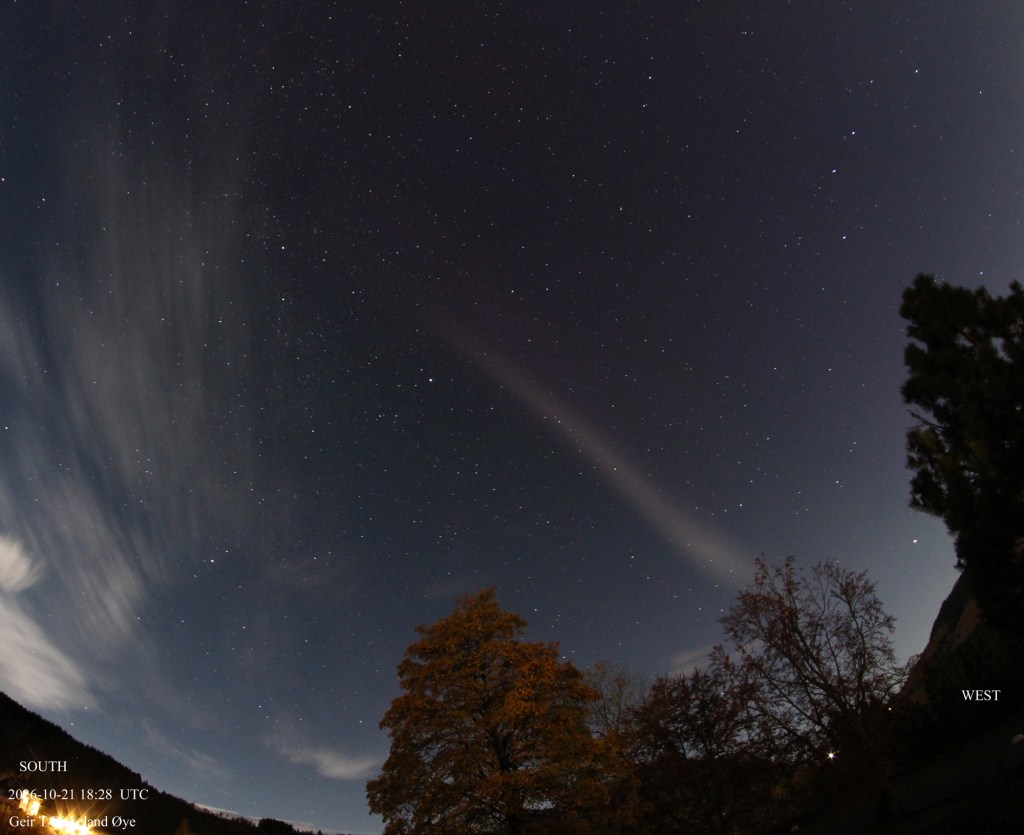
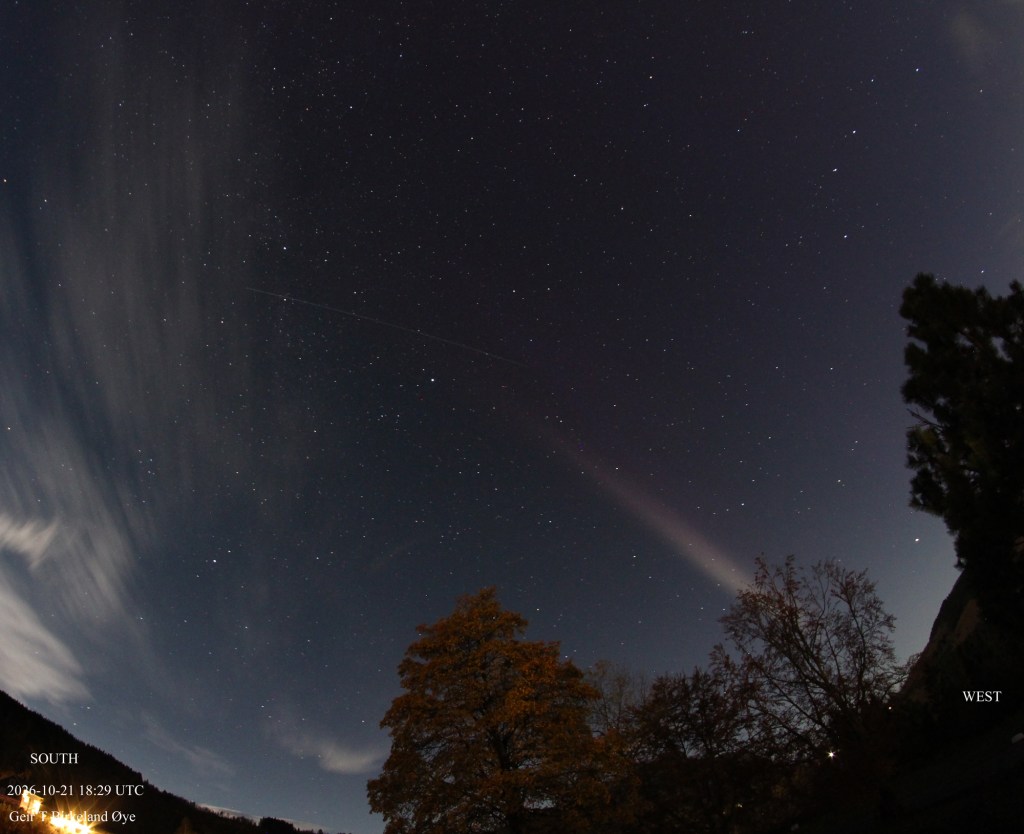
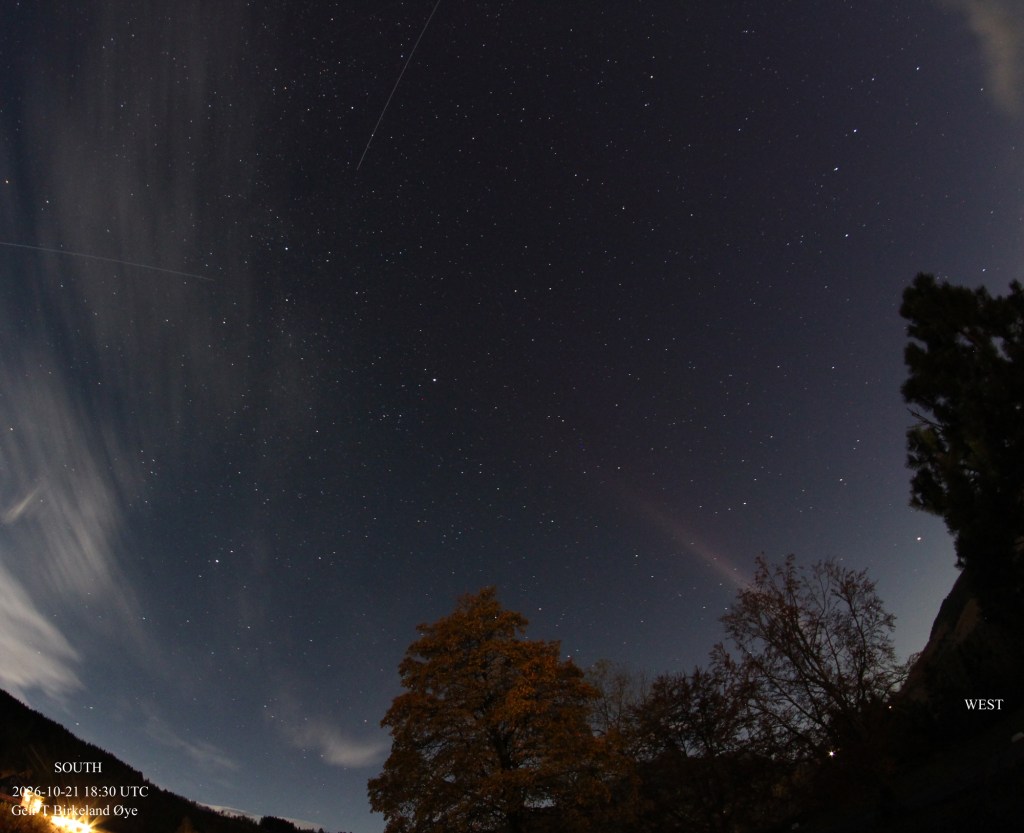
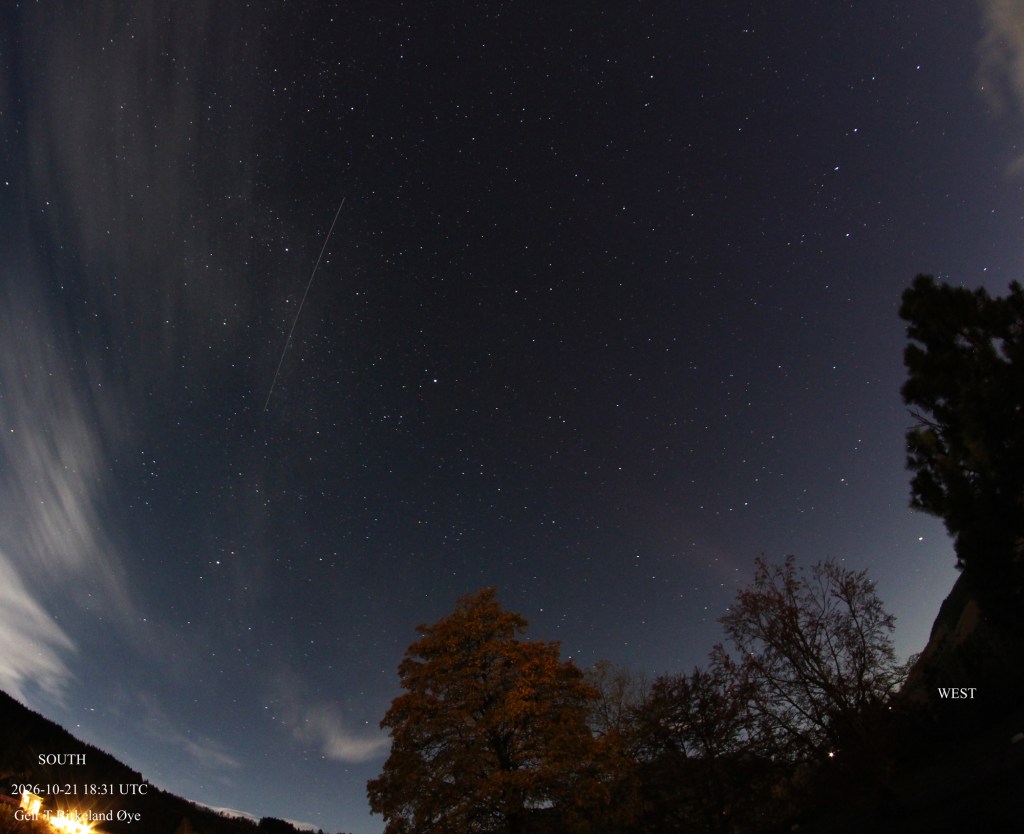
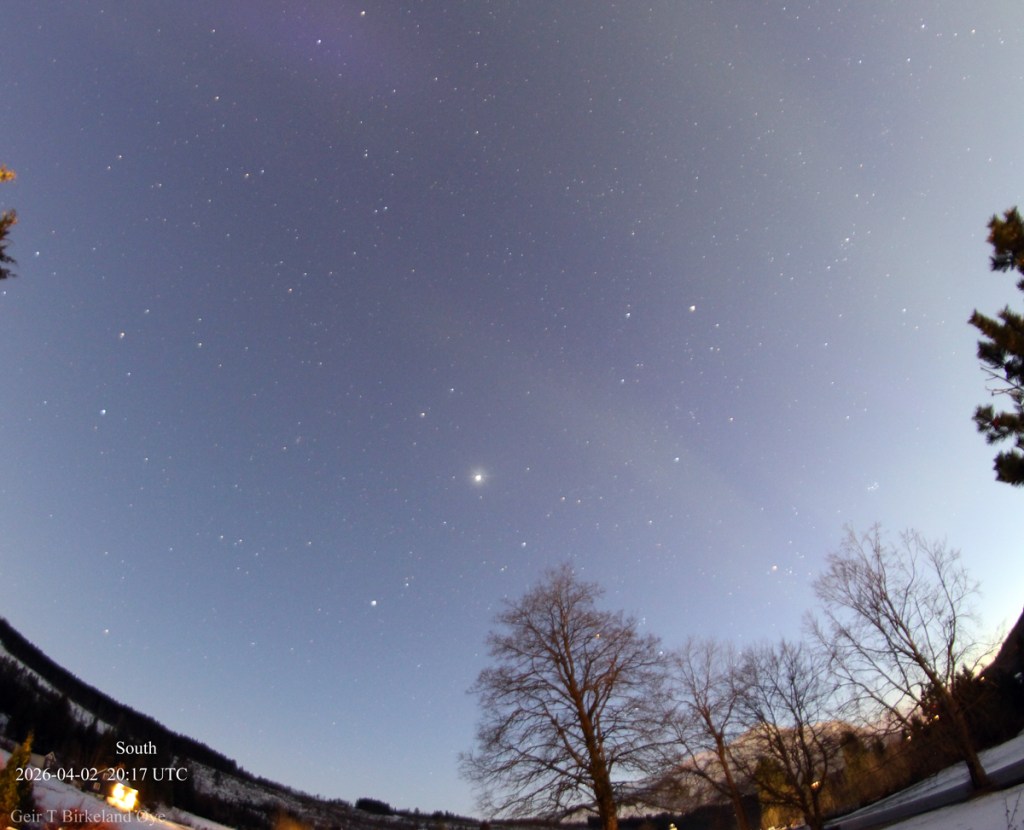
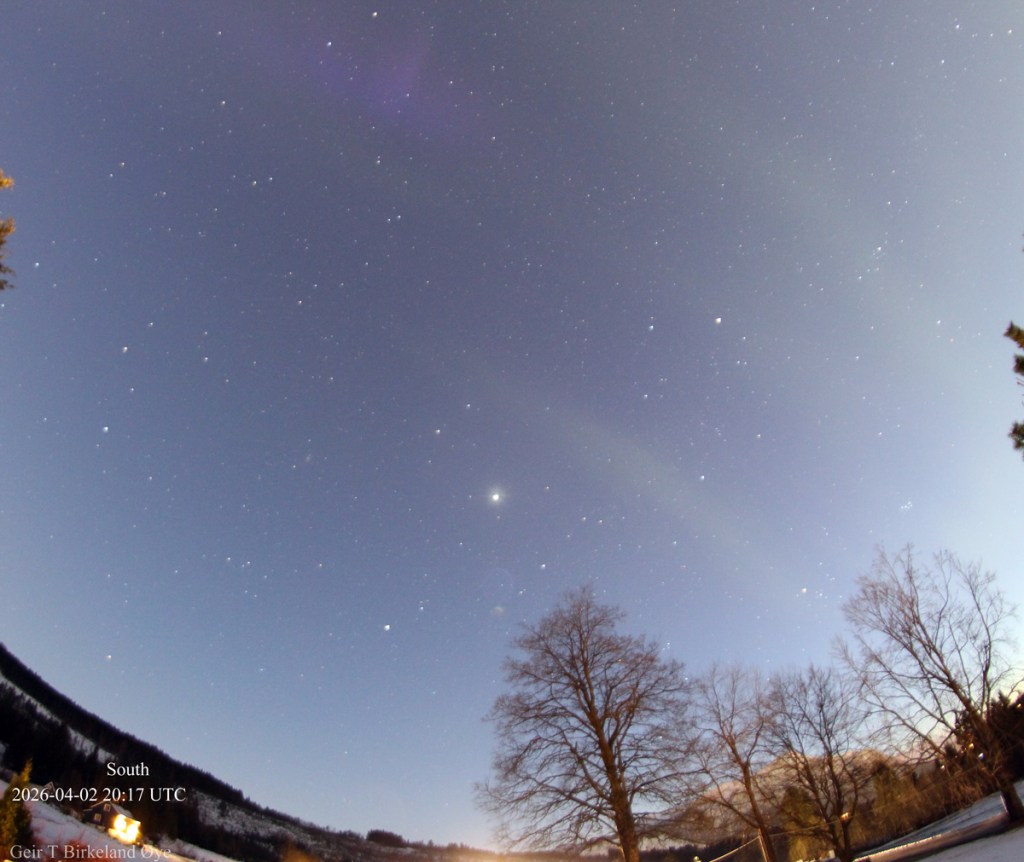
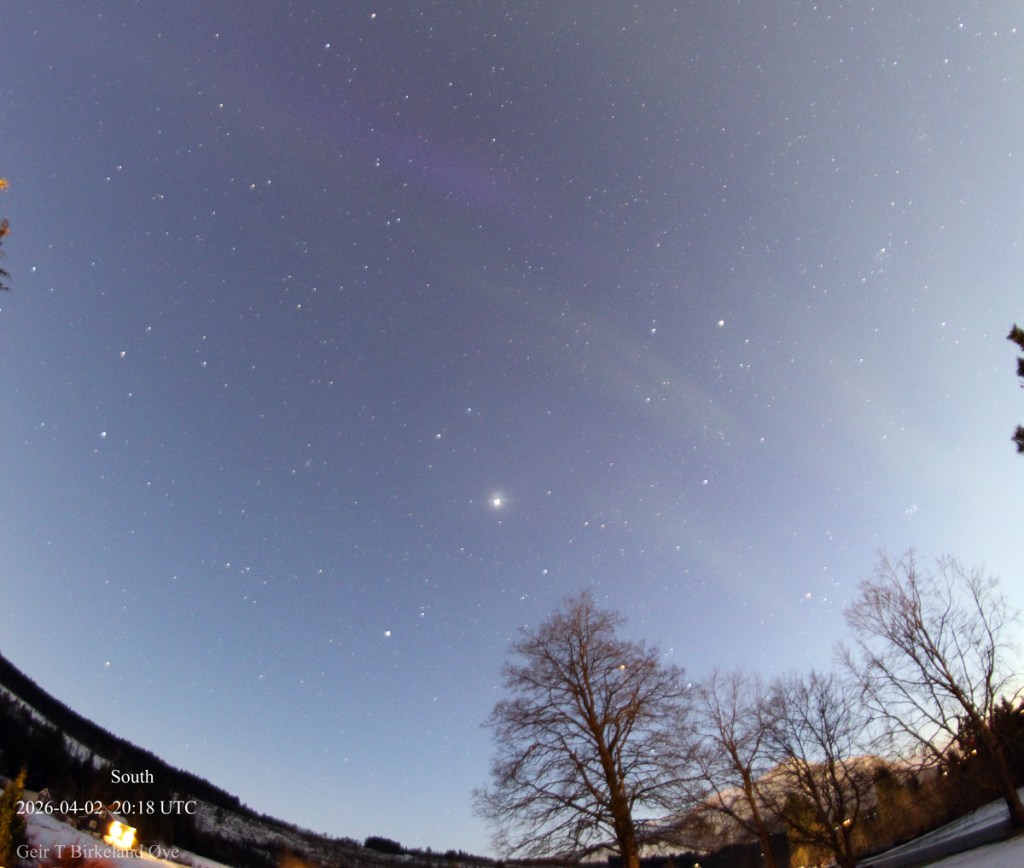
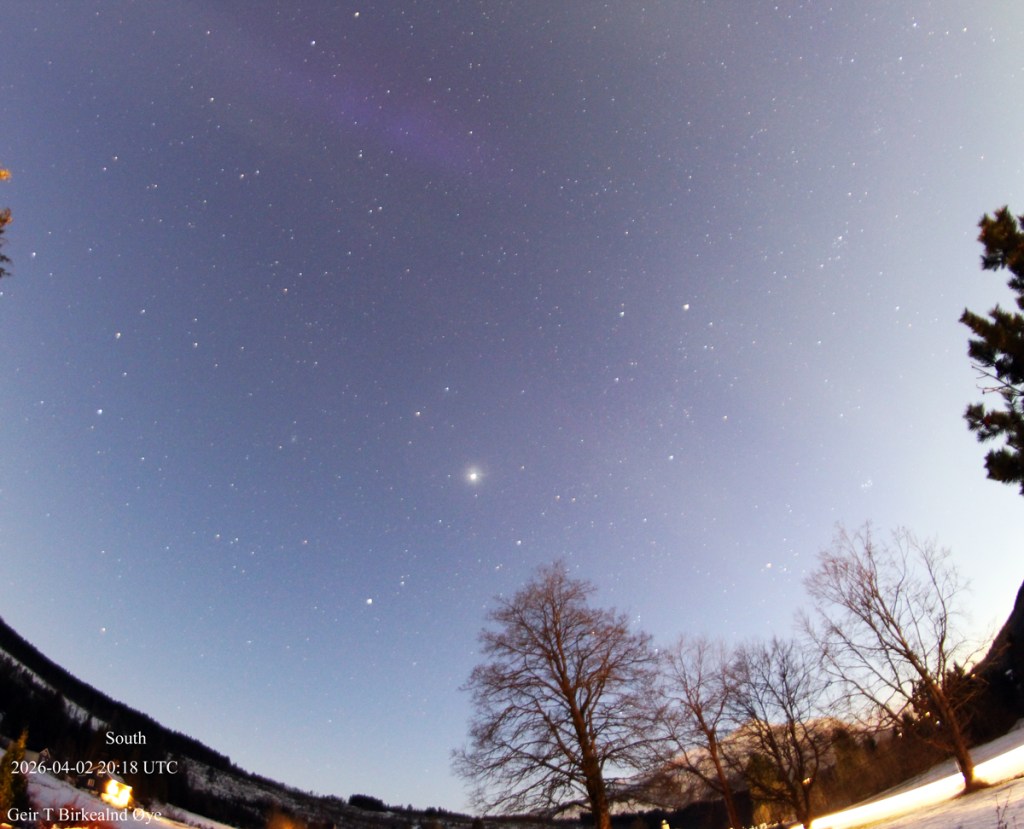
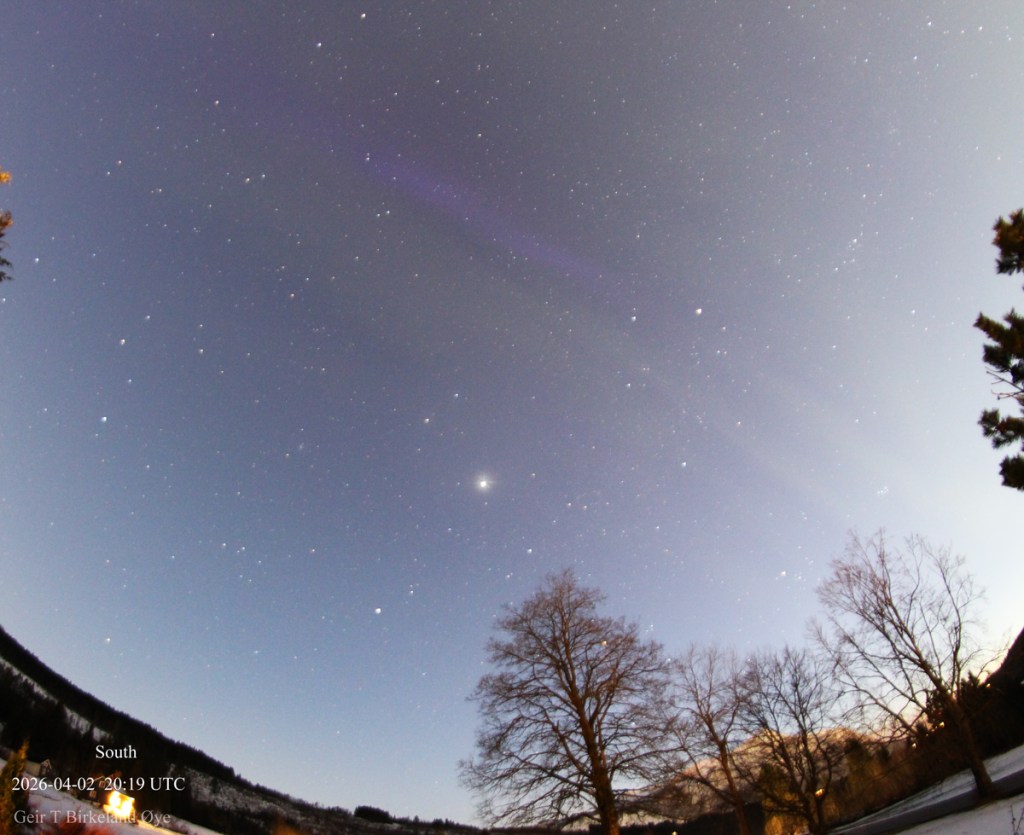
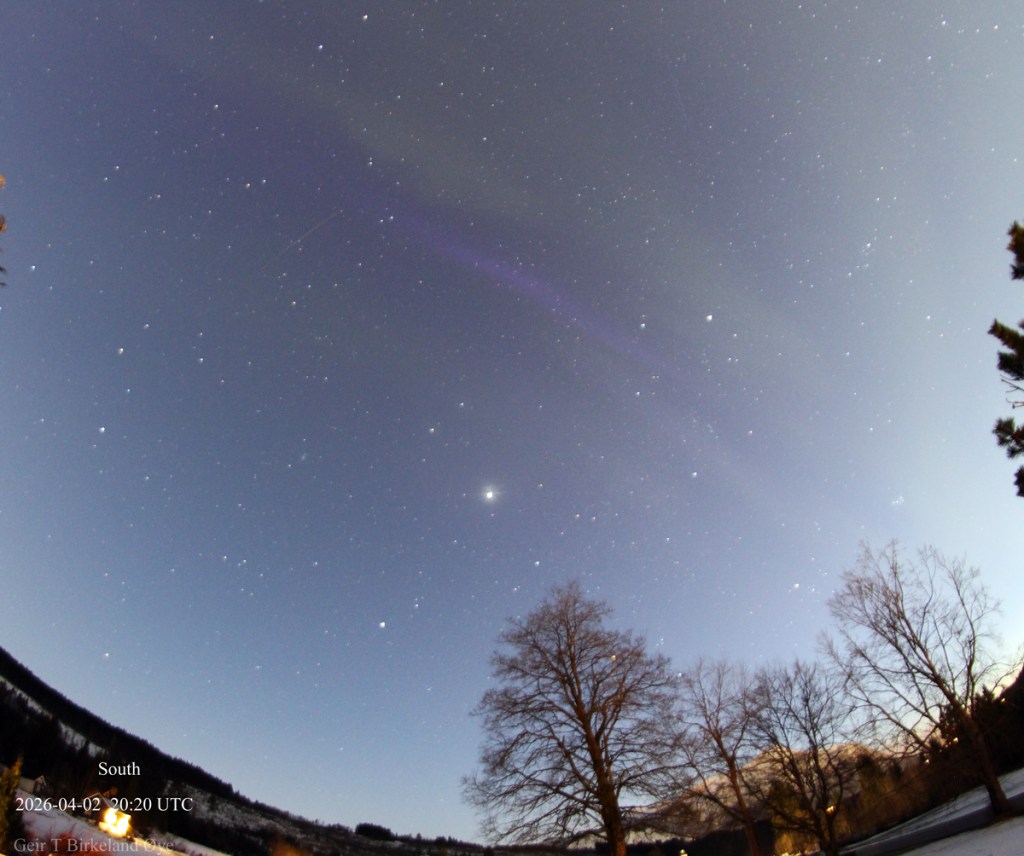
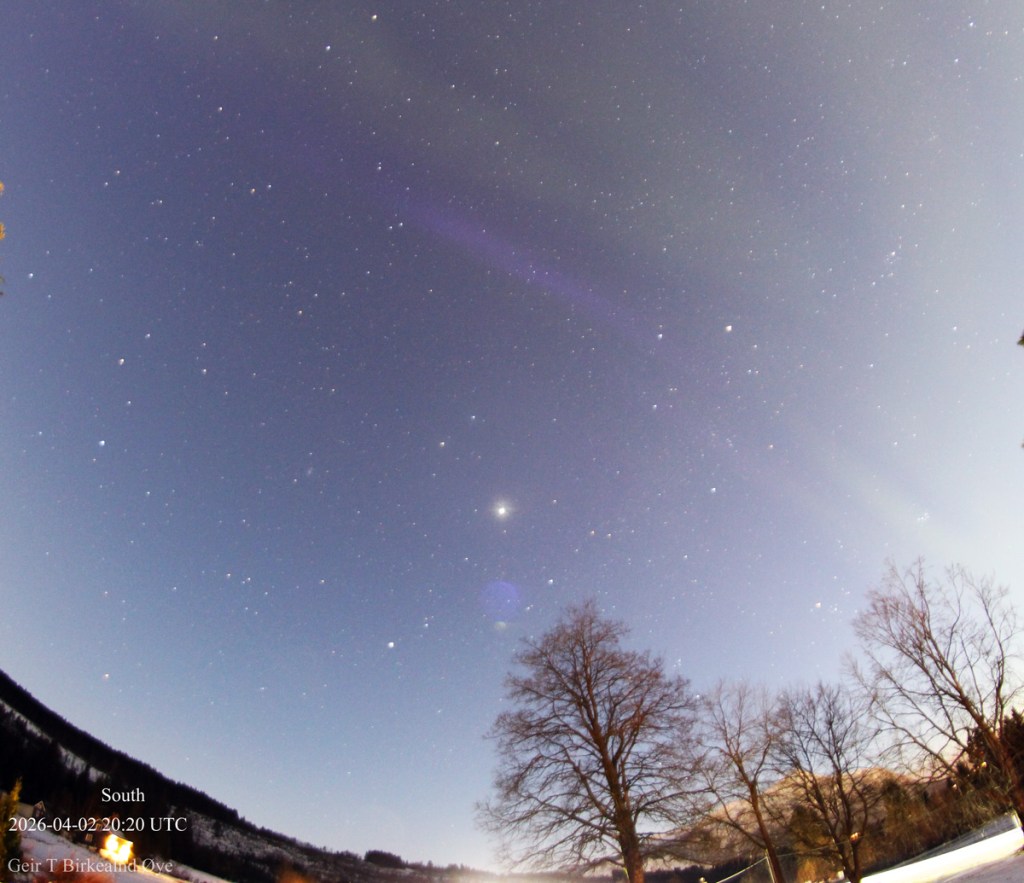
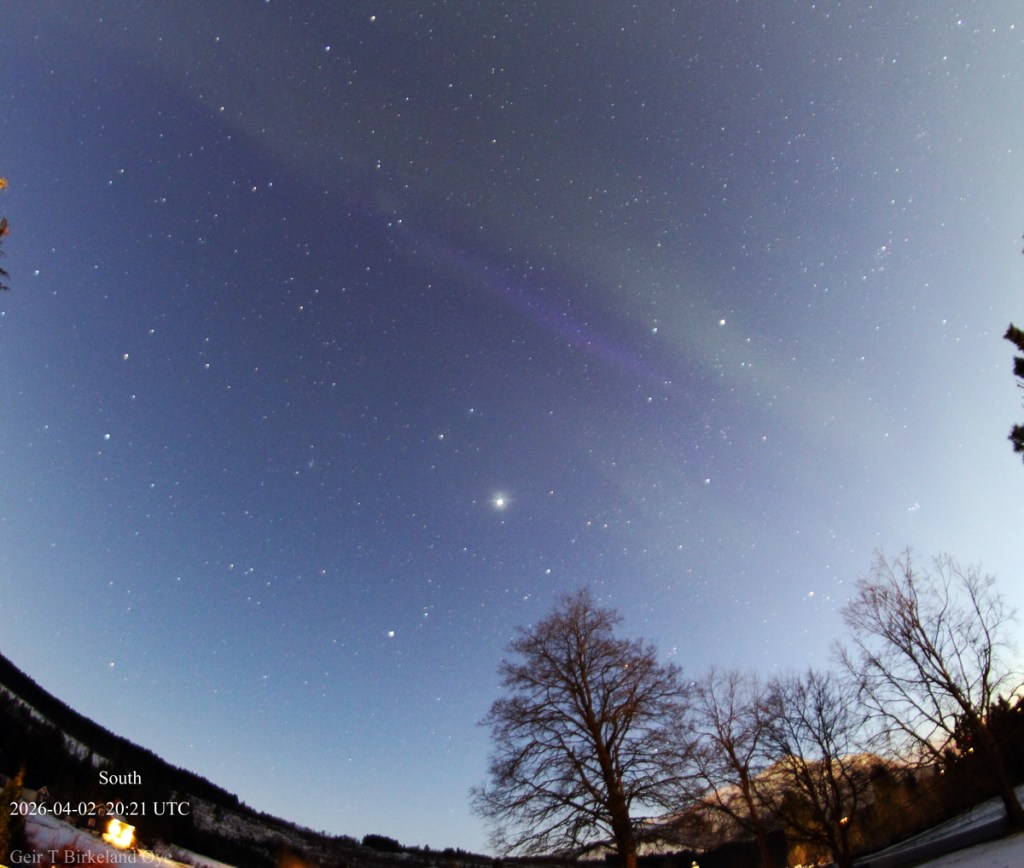
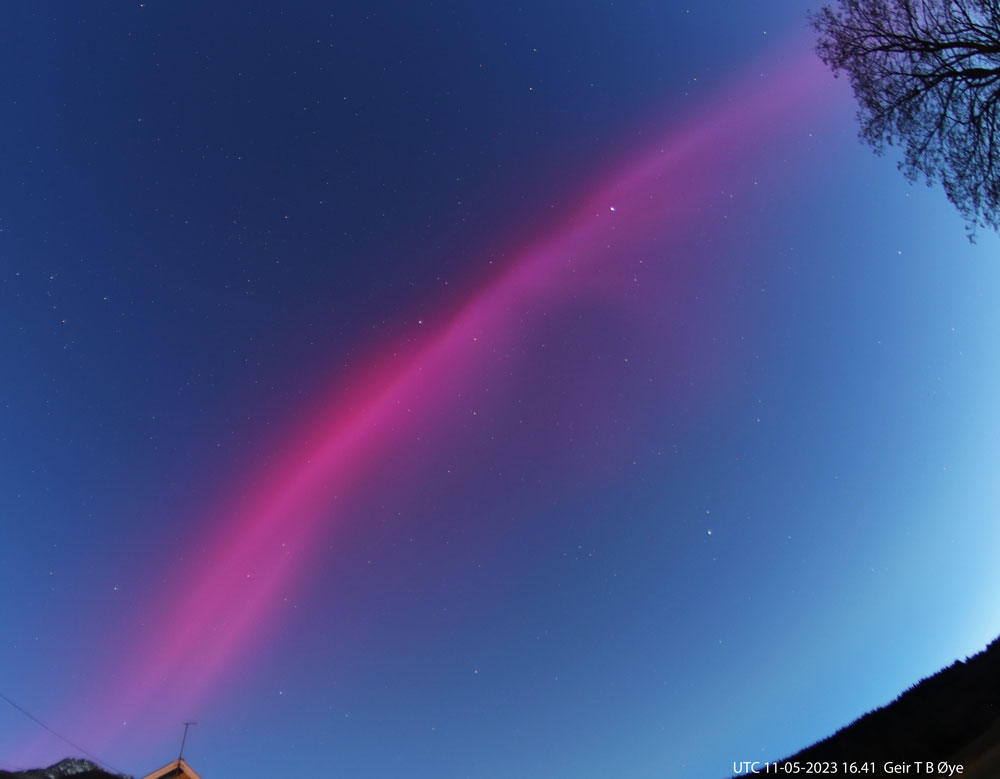
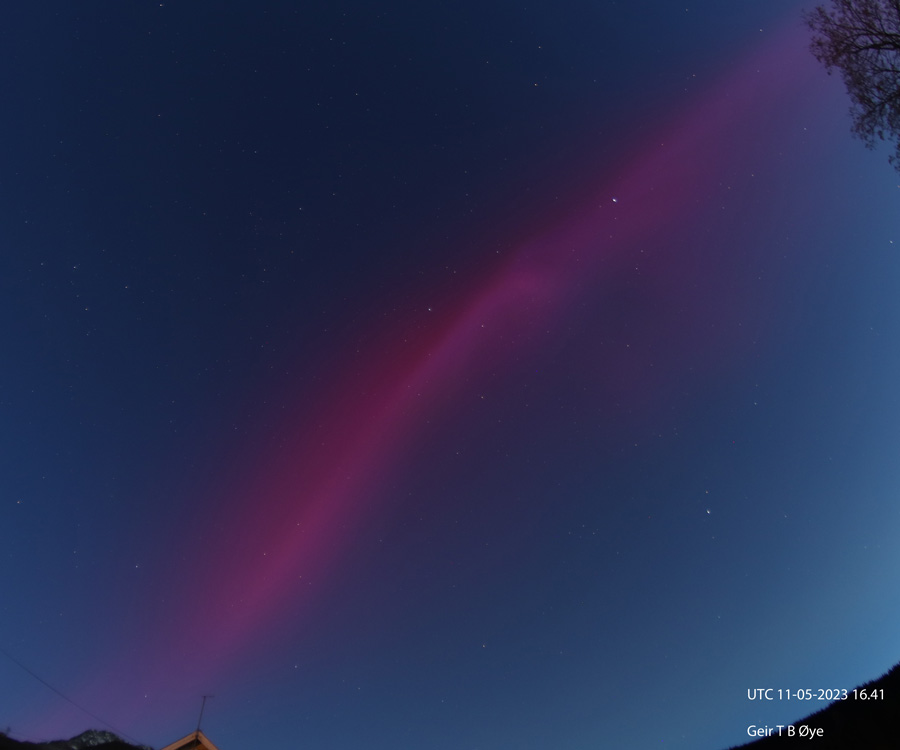
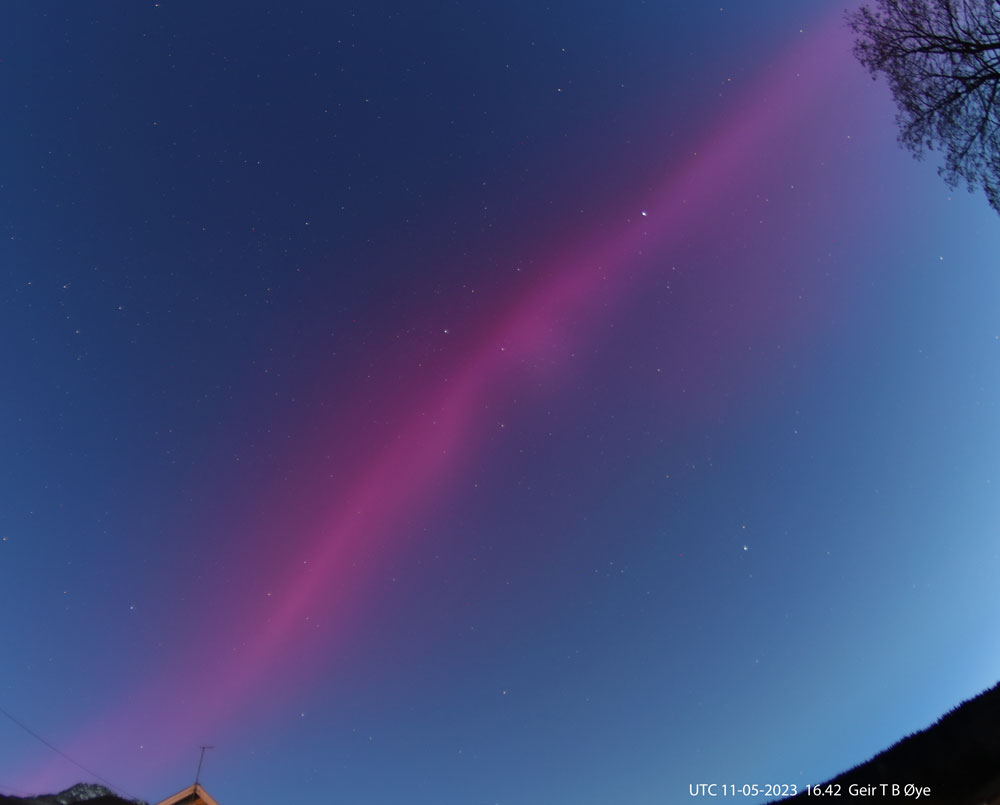
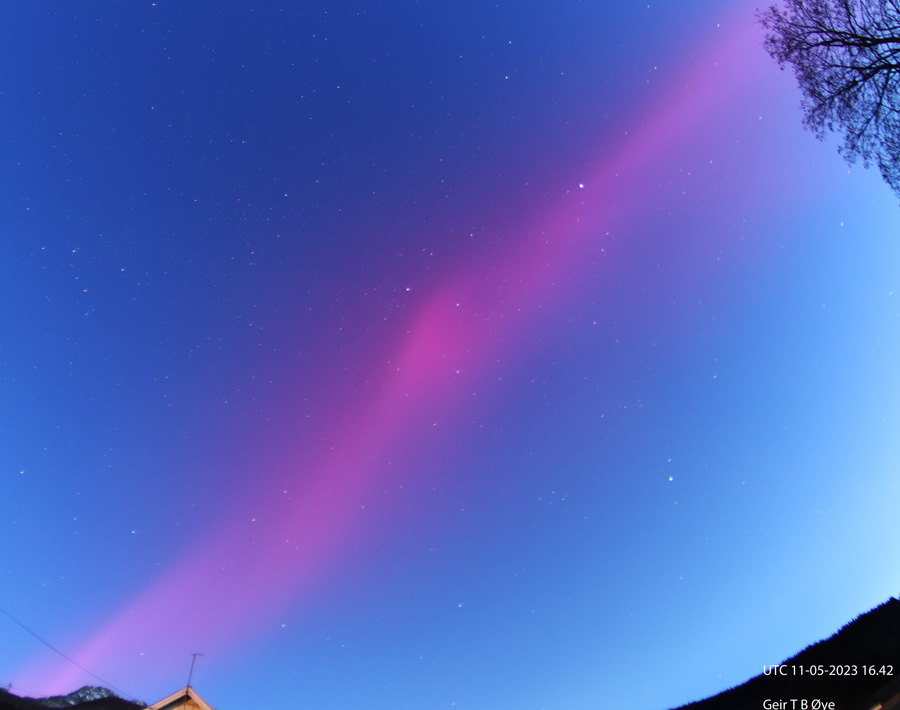
A very dynamic and short-lived STEVE (Strong Thermal Emission Velocity Enhancement) event captured from Ørsta, Norway.
I arrived at home after an approx 9 hour long drive, and had the camera set up quickly. Just a few minutes before the event took place. Not optimal conditions with a brigthly moonlit sky and clouds. The images with timestamp(s) shows how the phenomenon developed. Please, note image with timestamp 18:26 UTC looks like a SAR arc. The subauroral location, and mauve color profile, is typically STEVE, but the longivity was short.
The subauroral arc developed, peaked in intensity, and dissolved completely in a span of just 4 minutes (18:27 – 18:31 UTC). This rapid lifespan perfectly matches local magnetometer deflections from the region, which showed a sharp, short-lived magnetic disturbance exactly at this time.
The sequence clearly illustrates the incredible speed and volatile nature of the subauroral ion drifts (SAID) driving the phenomenon.
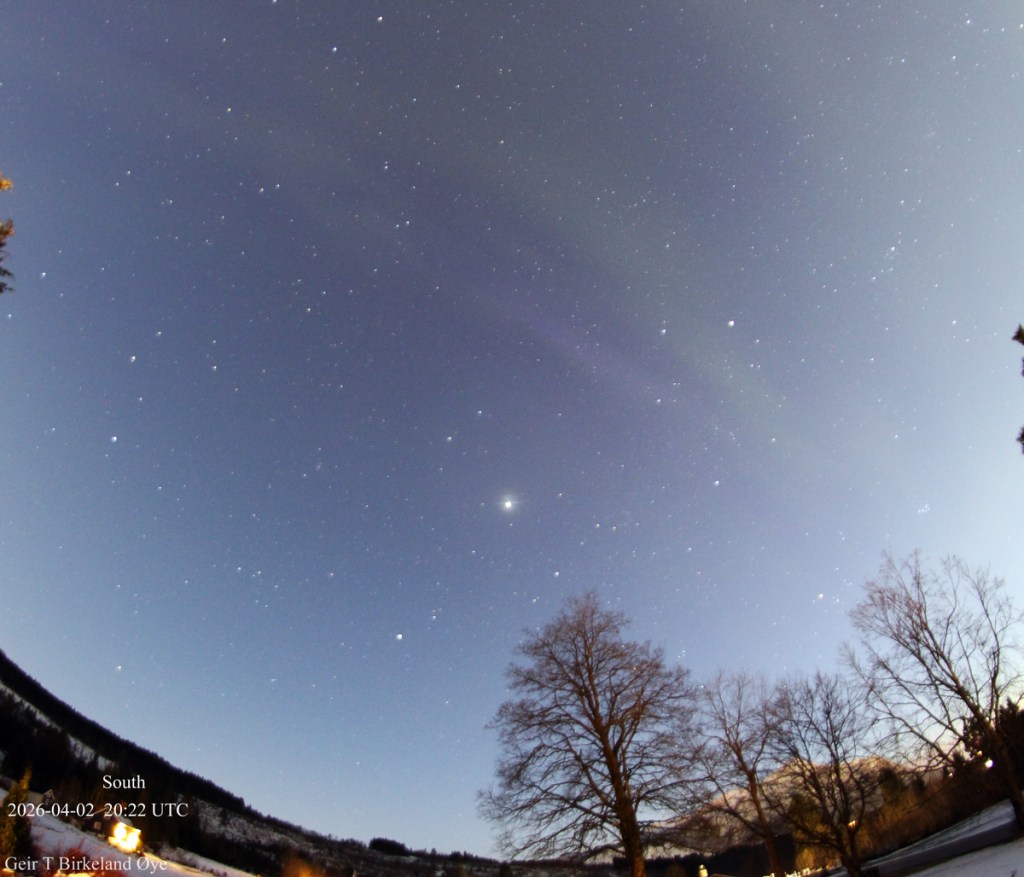
Time: 20:16–20:22 UTC Observation type: DSLR documentation of a transient subauroral STEVE‑like emission Observer: Geir T. Birkeland Øye Location: Ørsta, Norway
Instrument: Canon 650D, 8 mm fisheye lens, high‑resolution short‑exposure sequence
Summary
A transient subauroral optical emission consistent with the STEVE (Strong Thermal Emission Velocity Enhancement) phenomenon was observed south of the auroral oval on 2 April 2026. The event began as a compact purple/magenta subauroral blob around 20:16 UTC, which rapidly elongated into a narrow, well‑defined east–west arc. The emission persisted for approximately six minutes before dissipating.
Throughout the entire sequence, the structure displayed a stable purple–magenta continuum with no green (557.7 nm) or red (630.0 nm) oxygen‑line auroral features, and no curtain‑like or rayed morphology. This spectral appearance is characteristic of STEVE, which is known to produce broadband continuum emission rather than discrete auroral lines.
The full evolution—from initial blob to mature arc and final fading—was captured in a time‑stamped DSLR sequence.
Optical and morphological characteristics
Initial localized subauroral blob with purple/magenta emission
Rapid transition into a narrow, east–west oriented arc
No picket‑fence structures, no rayed curtains, and no oxygen‑line signatures
Emission remained smooth, featureless, and continuum‑dominated
Arc located equatorward of the main auroral oval, consistent with subauroral ion drift regions
This morphology aligns with documented STEVE events associated with SAID/SAPS channels.
Geomagnetic and solar‑wind context
Solar wind conditions on 2 April were already disturbed due to preceding coronal mass ejections (CMEs). Such conditions are favourable for the formation of subauroral ion drift channels, which can generate STEVE‑type emissions.
Key contextual points:
Disturbed solar wind from earlier CMEs
Enhanced geomagnetic activity at subauroral latitudes
Conditions supportive of fast, localized ionospheric flow channels
STEVE events are commonly short‑lived under such transient SAID/SAPS regimes
The brief duration (6 minutes) is fully consistent with known STEVE behaviour.
Interpretation
The event is best classified as a STEVE‑type subauroral emission, based on:
Subauroral location
Purple/magenta continuum emission
Absence of discrete auroral lines
Rapid blob‑to‑arc evolution
Occurrence during disturbed geomagnetic conditions
The high‑resolution, time‑stamped imagery provides a complete record of the event, including the rarely documented initial blob phase, making this a scientifically valuable observation.
Norsk
STEVE‑liknande subauroral emisjon – 2. april 2026
Ei kortvarig subauroral lysfenomen vart observert sør for nordlysovaen i Ørsta mellom 20:16 og 20:22 UTC. Hendinga starta som ein kompakt lilla/magenta “blob”, som raskt strekte seg ut til ein tydeleg aust–vest‑gåande STEVE‑struktur.
Emisjonen hadde gjennom heile forløpet ein jamn lilla/magenta kontinuerleg spektral karakter, utan grøne eller raude oksygenliner og utan gardin‑ eller strålestrukturar. Dette er typisk for STEVE, som ikkje er eit tradisjonelt nordlys, men eit optisk uttrykk for raske subaurorale ionedriftar (SAID/SAPS).
Solvindforholda var forstyrra av tidlegare CME‑ar, noko som gav gode vilkår for slike fenomen. Den korte varigheita er i tråd med kjende STEVE‑observasjonar.
Hendinga er klassifisert som ei STEVE‑type subauroral emisjon, og bileta dokumenterer heile utviklinga frå første blob til bortfall.
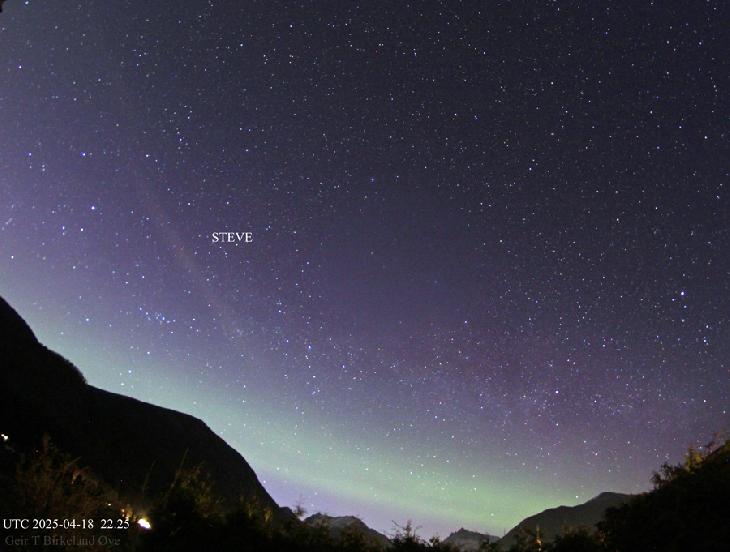
There was a STEVE in the sky on April 18, 2025. It was observed from UTC 22.17 – 22.41. A rather faint display, in a bright sky. The phenomenon was only observed photographically. Photo details: Canon 650D, Samyang 8 mm fisheye-lens.
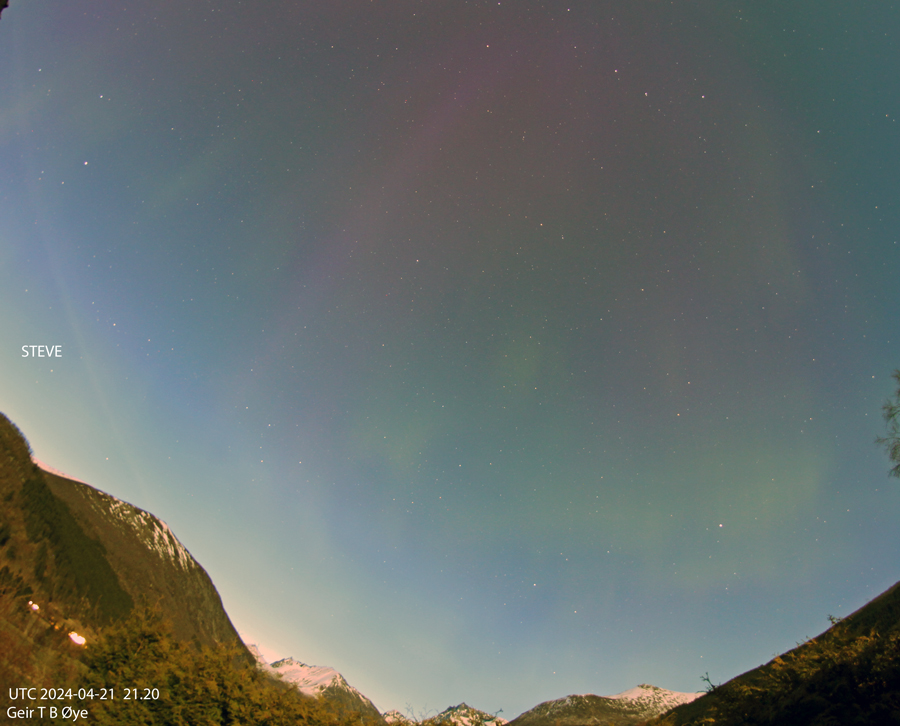
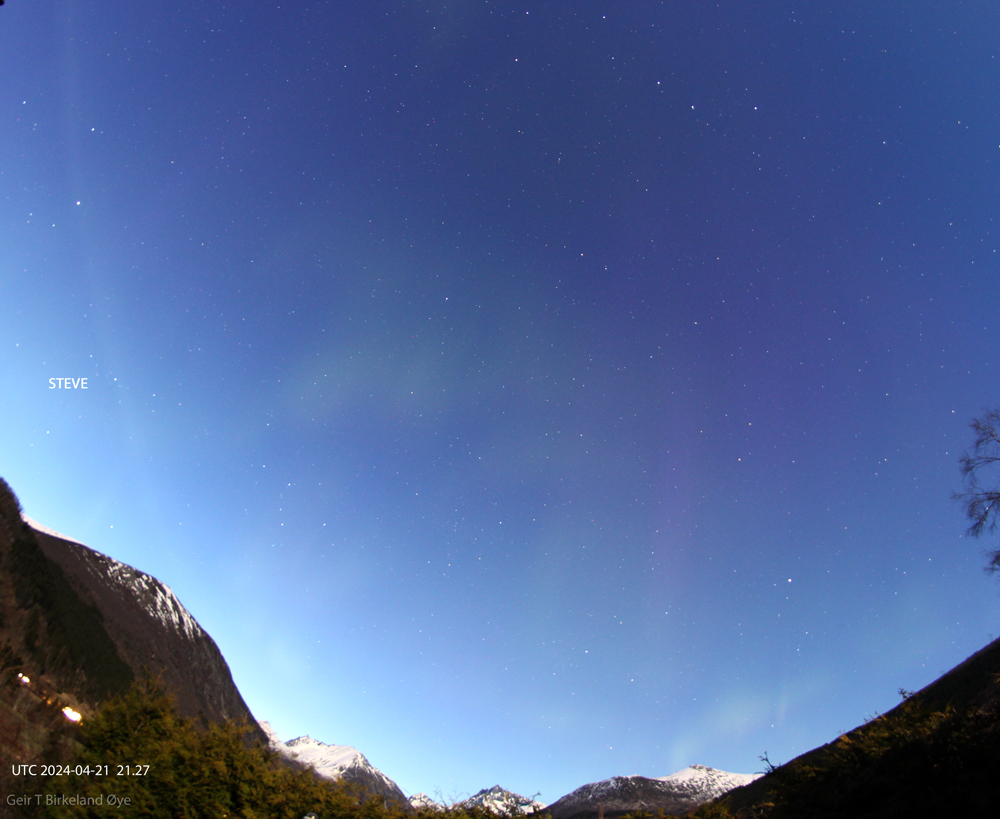
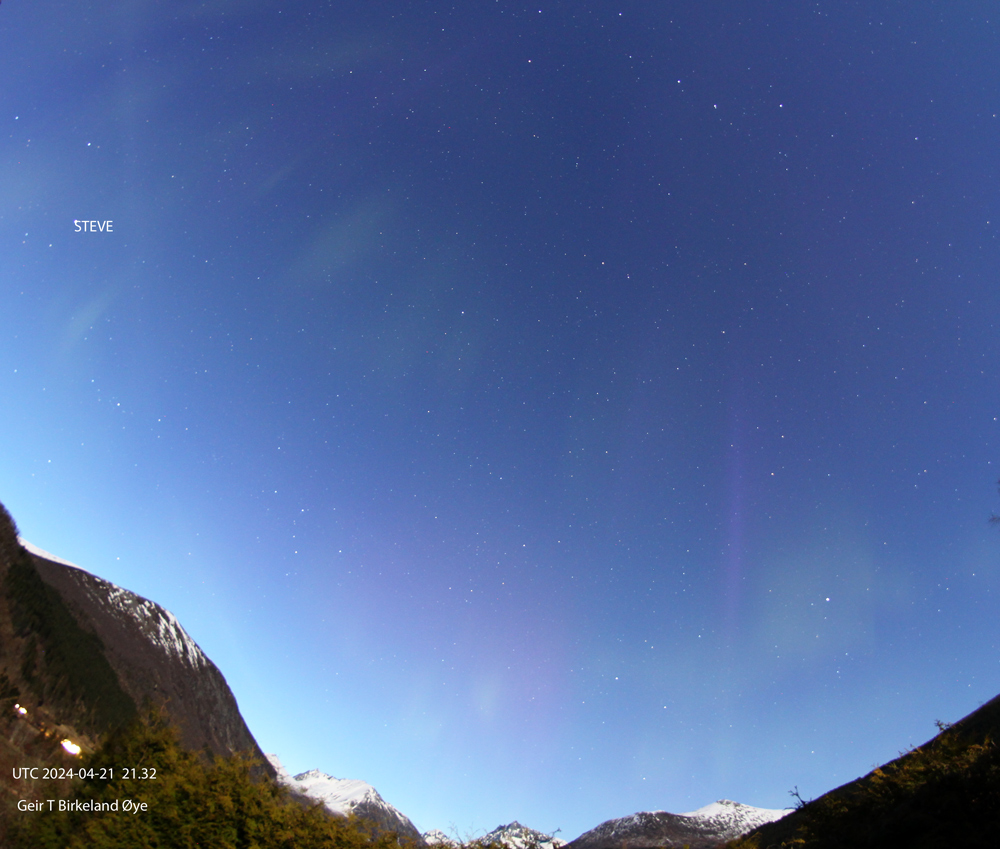
There was a brief instance of auroral activity on April 21. Not easily seen or photographed because of a bright sky. Interestingly, the contrail like phenomenon STEVE was observed from about UTC 21.02 to 21.34.
STEVE over the mountain. The faint mauve color was captured by an allsky camera (AMS135). Taken at the same time as the DSLR photos below.
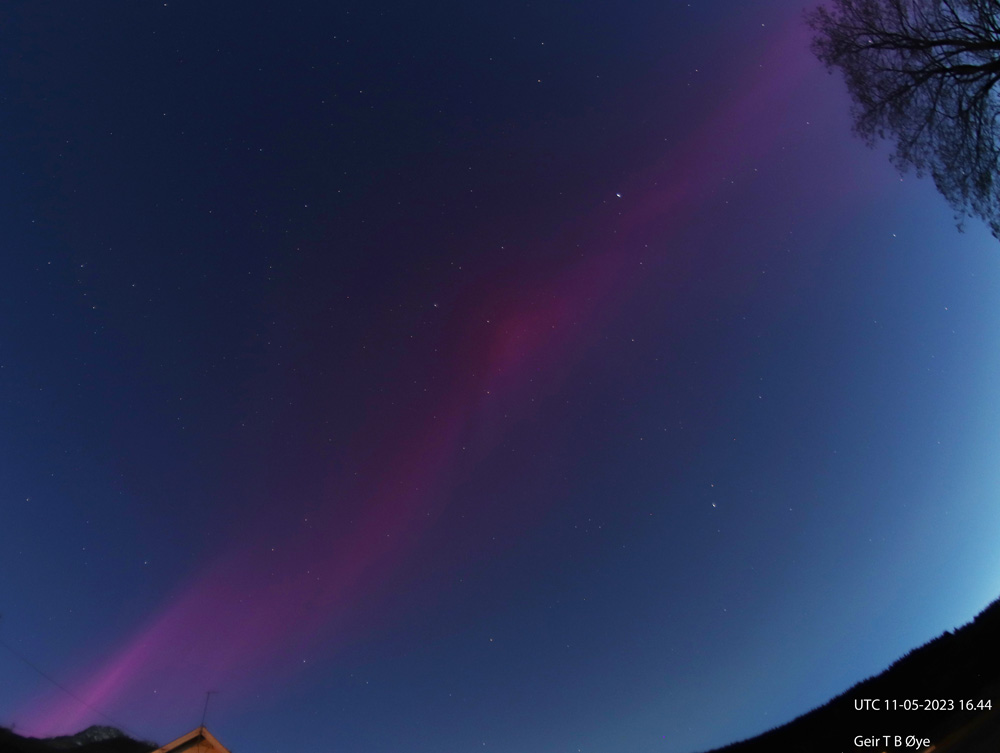
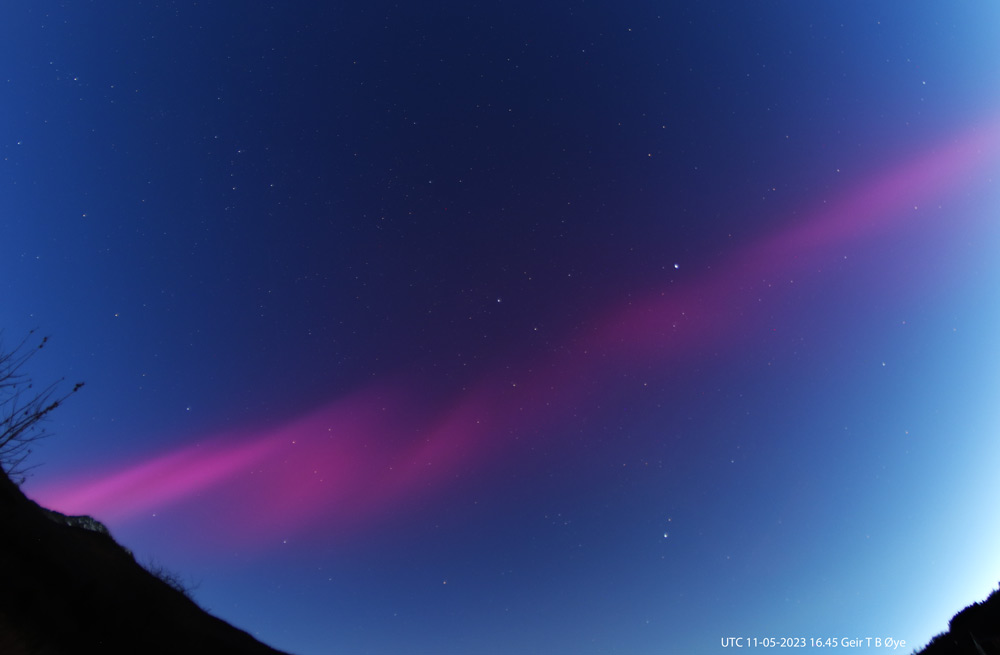
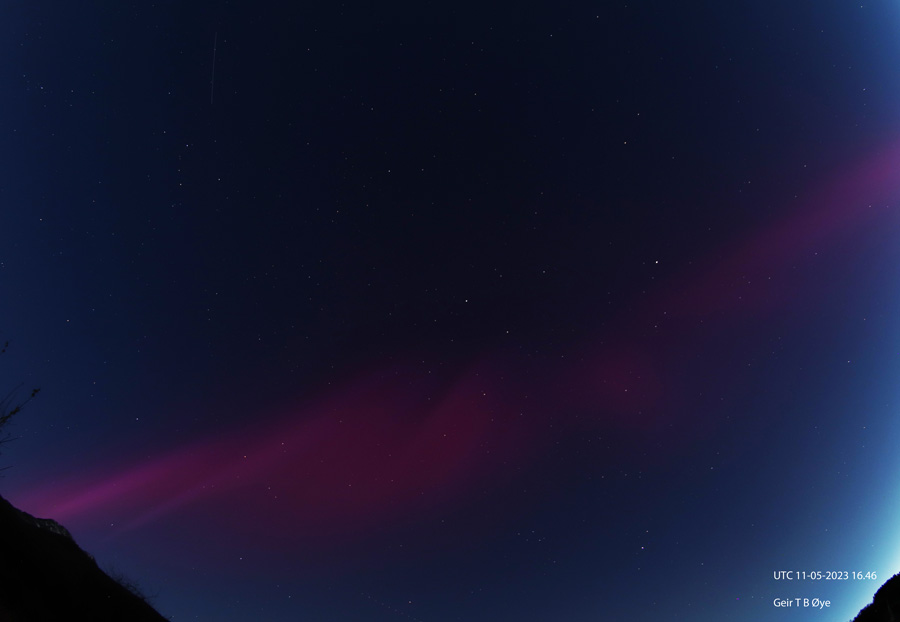
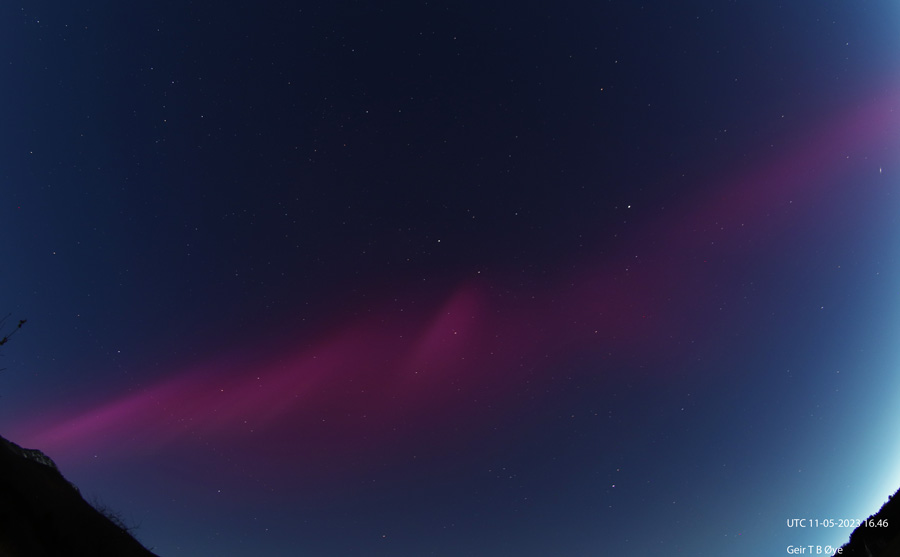
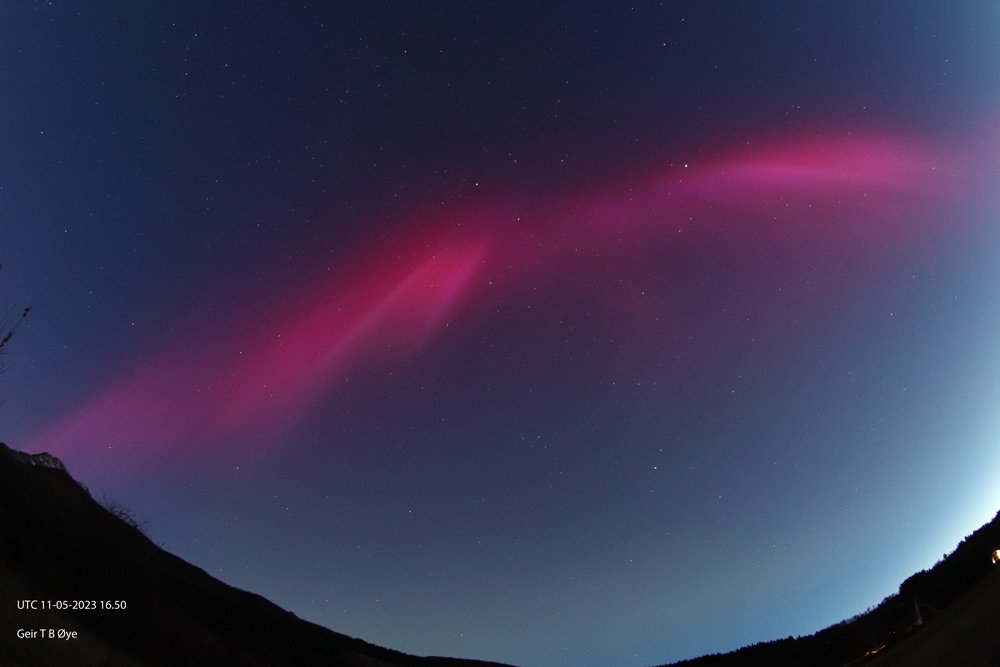
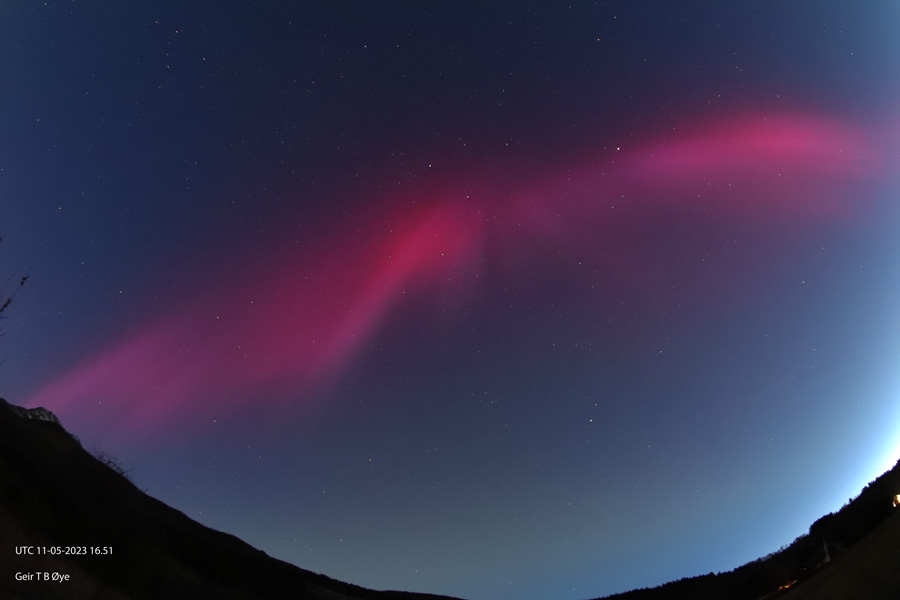
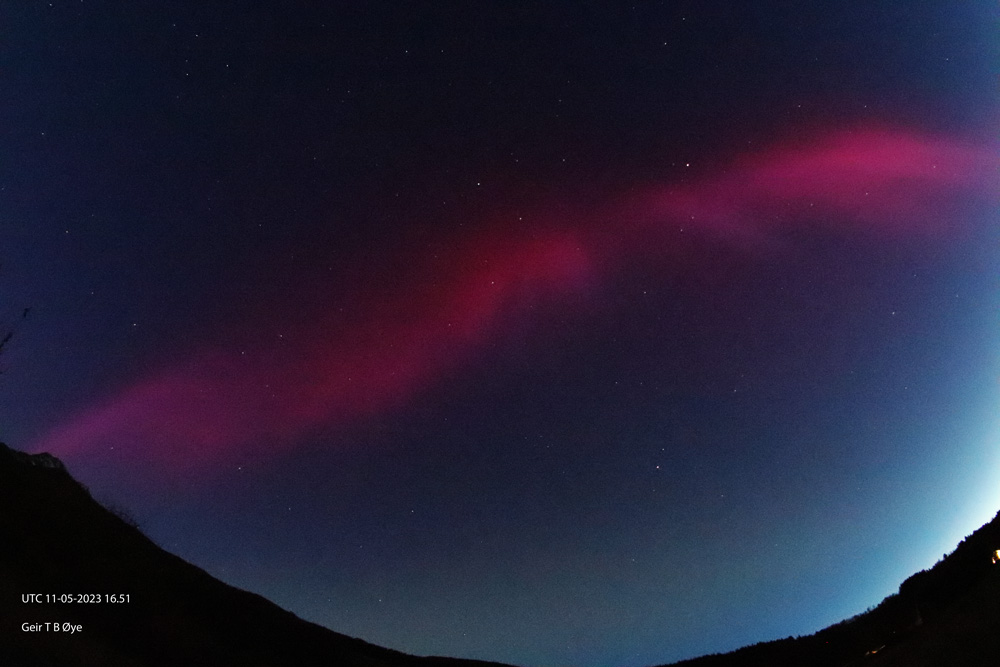
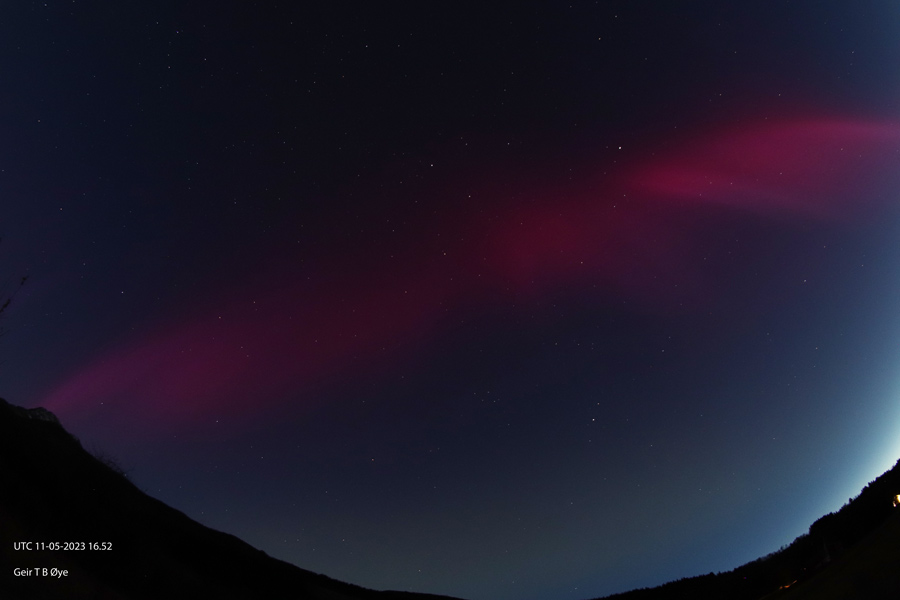
Red Arc and STEVE-Like Feature Observed— November 5, 2023
Auroral Observation Report by Geir T. Birkeland Øye
Location: Ørsta, Norway (approx. 62.2°N, 6.1°E)
Time of Observation: 16:40 – 17.08 UTC
Published: November 6, 2023.
Contact: gtboye@outlook.com
Event Summary
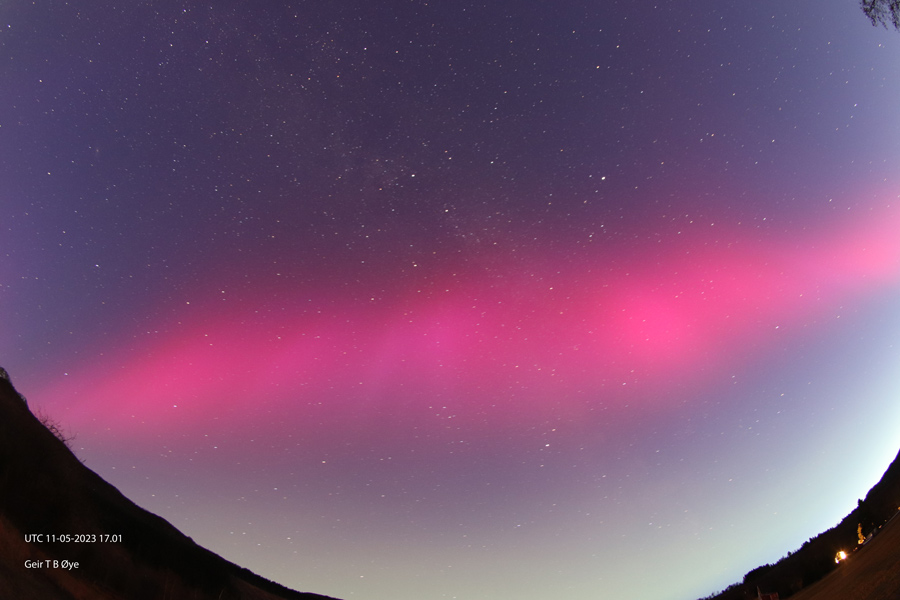
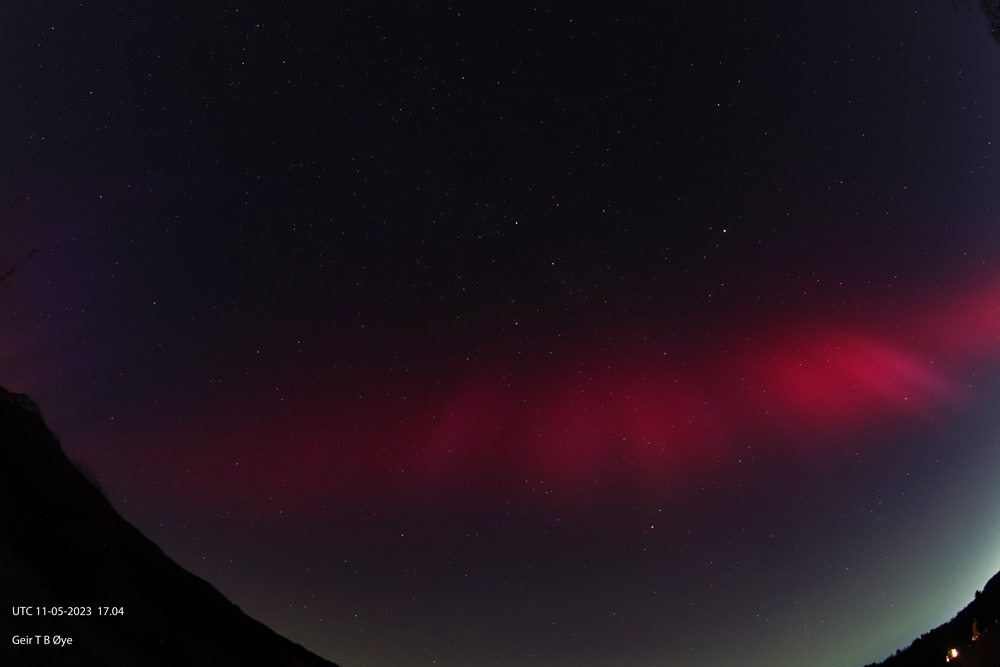
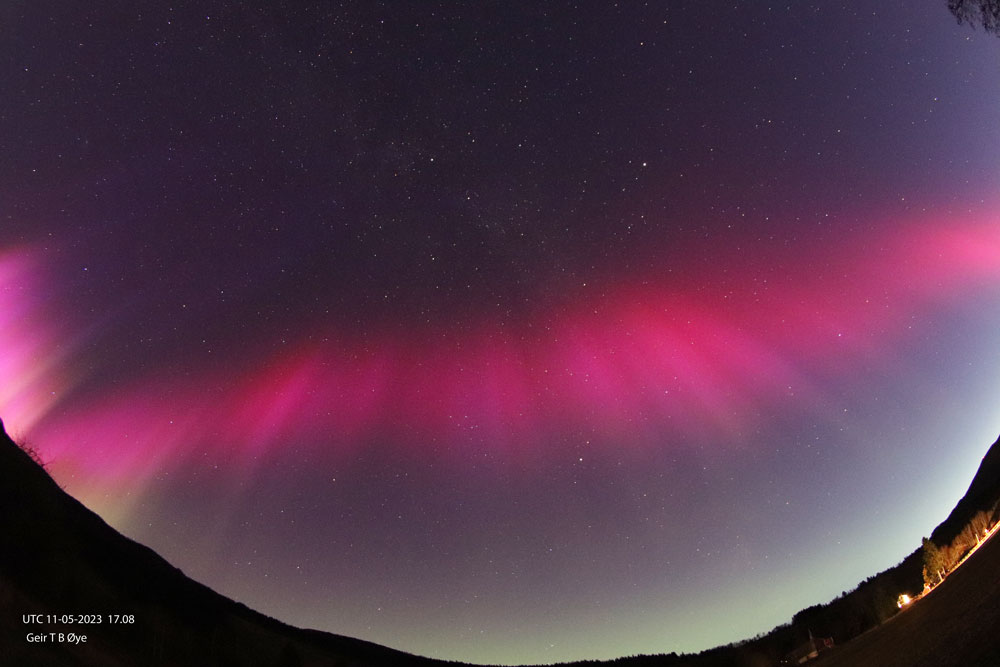
On November 5, 2023, a rare, structured deep red arc was documented overhead in Ørsta, Norway. The arc appeared poleward of the main auroral oval, lacked a green auroral base, and remained stable shortly before a significant substorm began. A simultaneous observation by Michael Theusner near the Svartisen Glacier confirmed the phenomenon from a separate location, supporting its spatial extent and rarity.
Geophysical Environment
Timeline of Geophysical Parameters — November 5, 2023
Time (UTC) Kp Index Bz (nT) Solar Wind Speed (km/s) Notes
16:40-17:08 — ~-12 ~510 — Structured red arc oberved overhead
18:00 4 –10 ~515 Calm conditions before storm onset
20:00 5 –18 ~525 Bz increasingly southward
21:00 6 –24 ~535 Substorm conditions intensifying
22:00 7+ –27 ~540 Full storm development
23:00 6 –15 ~525 Geomagnetic activity subsiding
Sources: NOAA SWPC, SpaceWeatherLive, The Watchers storm reports
NOTE: Although global indices suggested calm geomagnetic conditions around 18:00 UTC (Kp = 4), strong auroral activity was already observed from Ørsta at 17:09 UTC. This highlights how local observations often precede broader geophysical indicators, especially during dynamic storm transitions.
Phenomenon Description
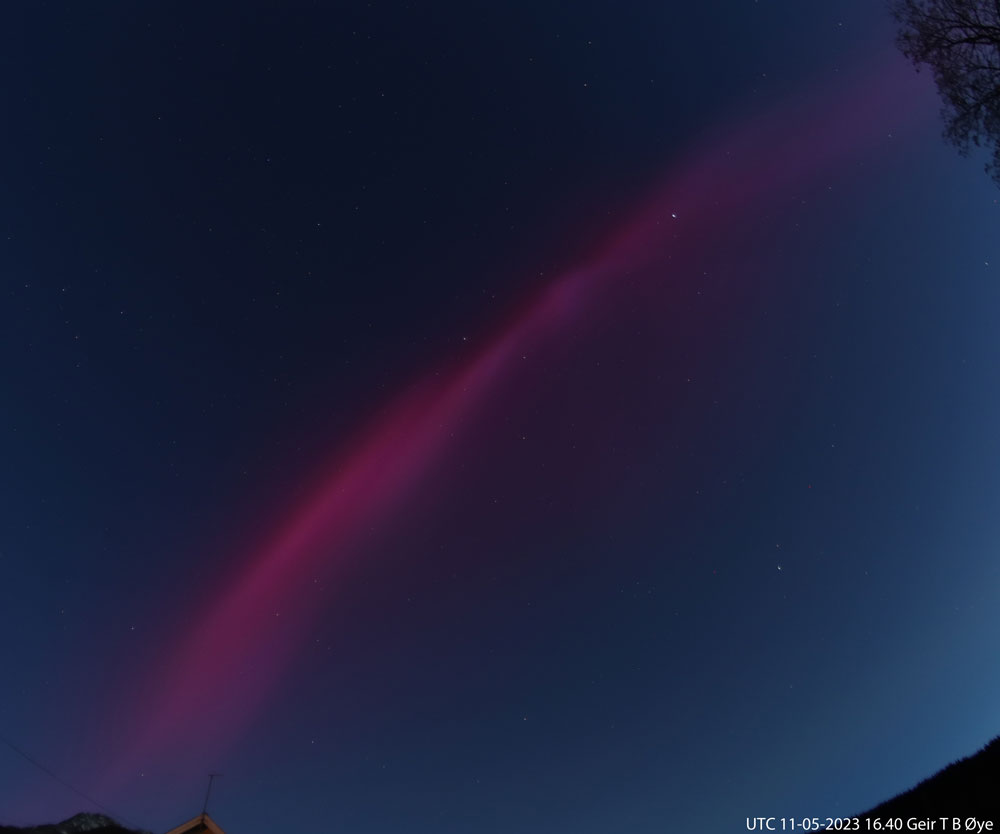
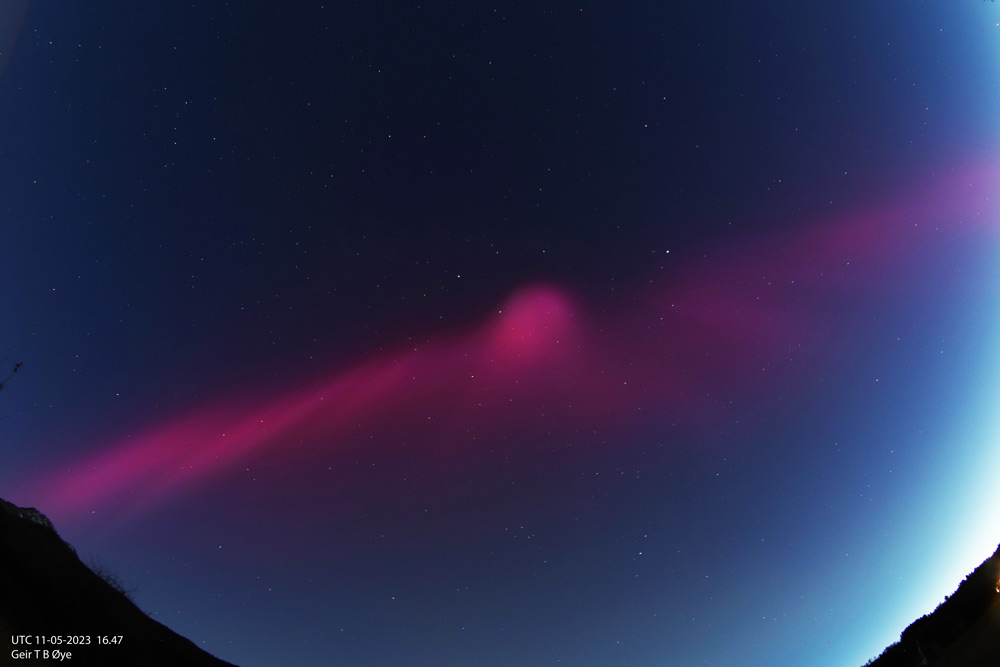
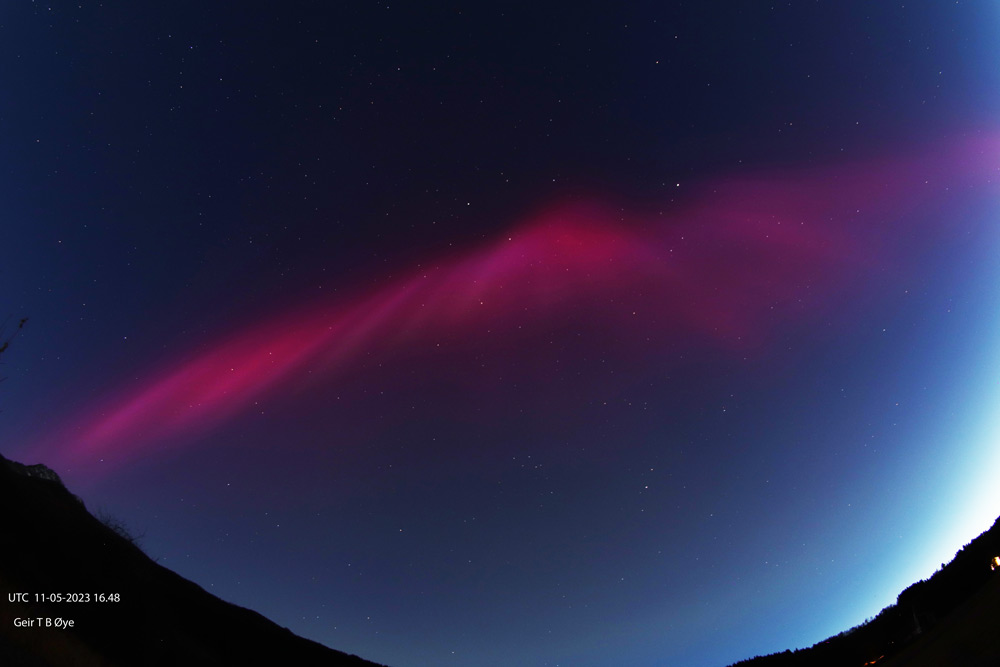
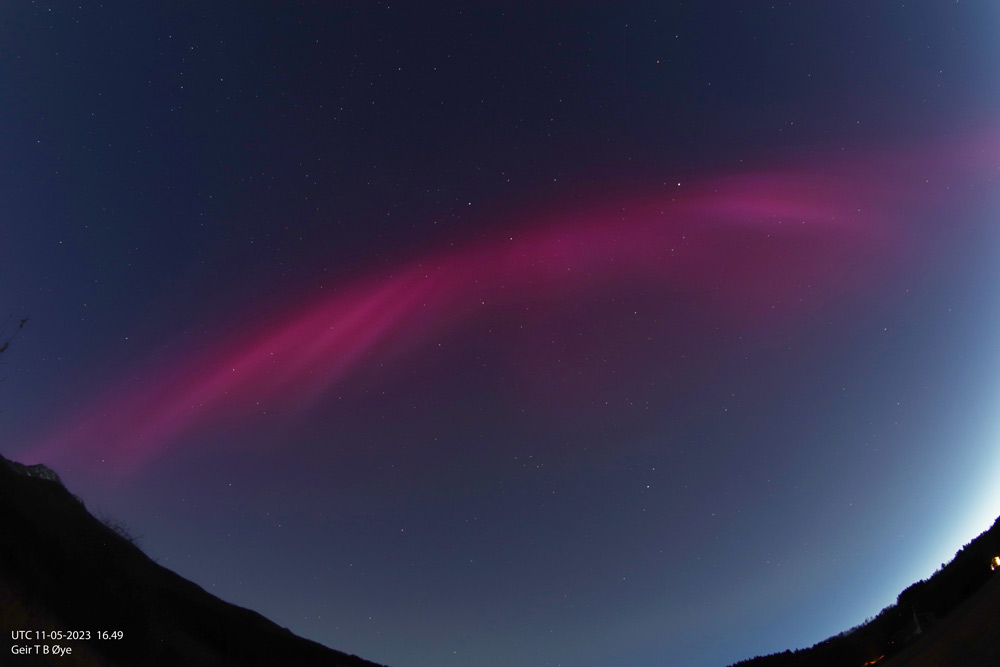
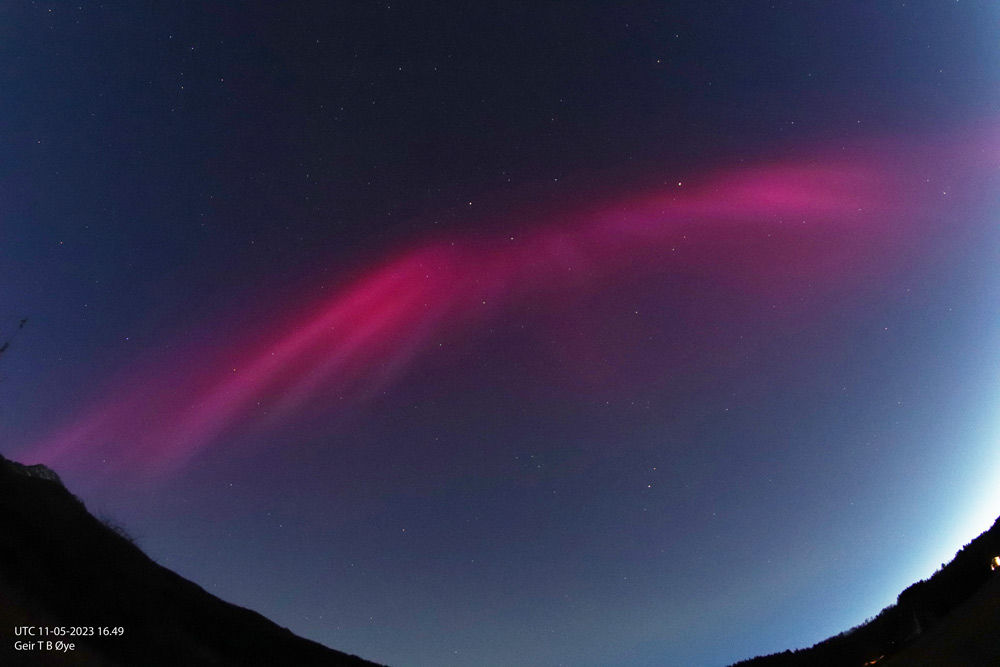
– Structure: Deep red arc, stable and smooth, faint vertical textures
— Color 630 nm + 636.4 nm. (emission like SAR arcs)
– Altitude Estimate: Presumably high, based on lack of green emission
– Duration: Several minutes before dynamic auroral onset
– Comparison: Matches Carl Størmer’s “feeble homogeneous arcs of great altitude”
Historical Reference
Carl Størmer documented rare red arcs appearing poleward and without green aurora, often at altitudes over 200 km. This observation may represent a modern analogue and support his early hypotheses about detached high-altitude auroral structures.
Interpretive Possibilities
– STEVE-like phenomenon: Visual similarity with unusual placement
– Not SAR: SAR arcs typically occur equatorward, inconsistent with this arc’s location
Acknowledgments
Thanks to Michael Hunnekuhl for insightful interpretation of arc orientation and structure, and to Michael Theusner for independent observation near Svartisen Glacier, which confirmed the arc’s regional appearance.
Collaboration Invitation
I welcome discussion and collaboration with scientists and aurora observers interested in high-altitude auroral structures. All images and metadata are available upon request.
Contact: gtboye@outlook.com
Image Documentation
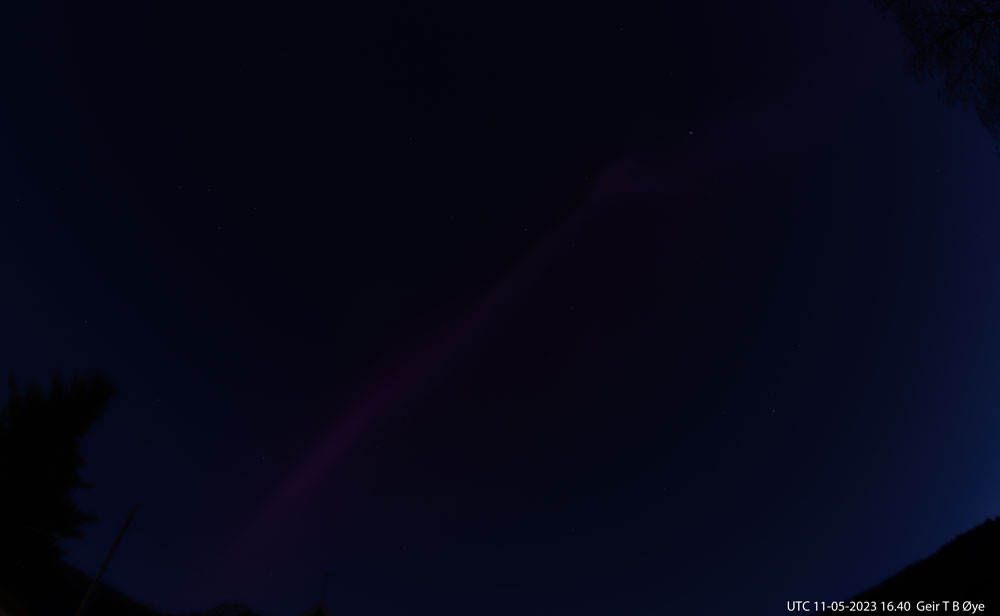
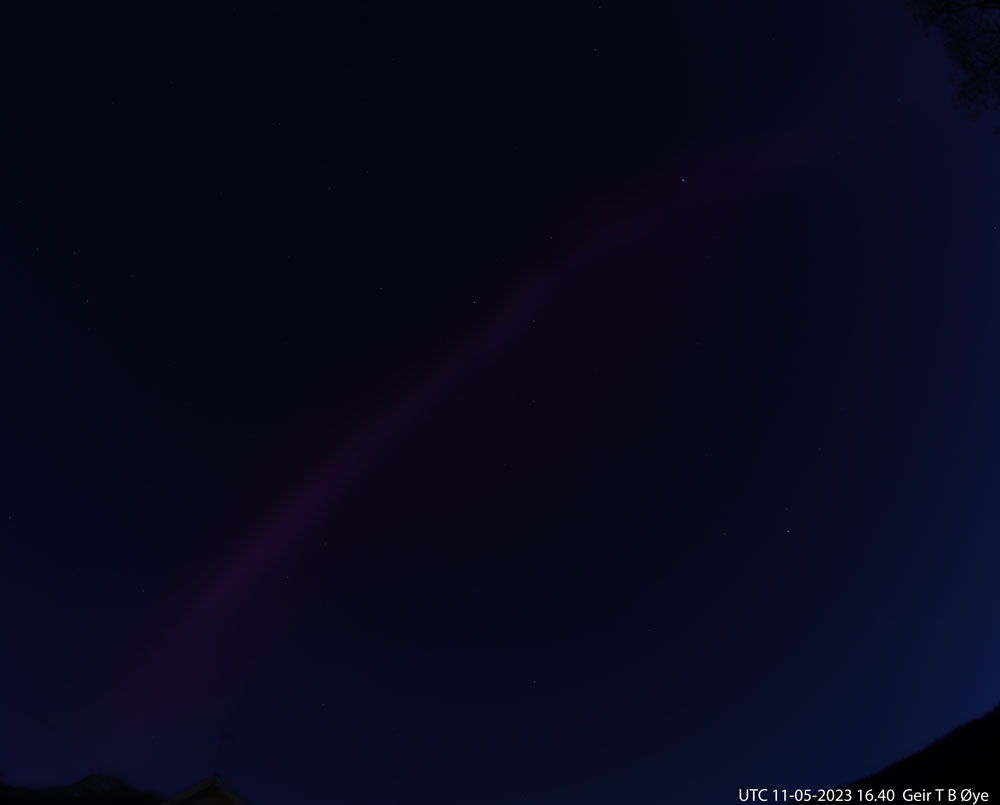
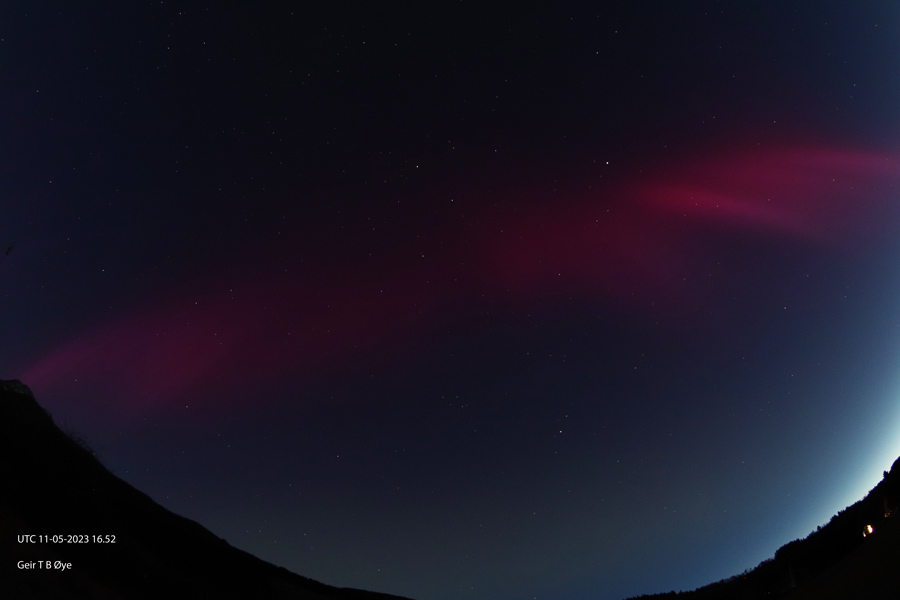
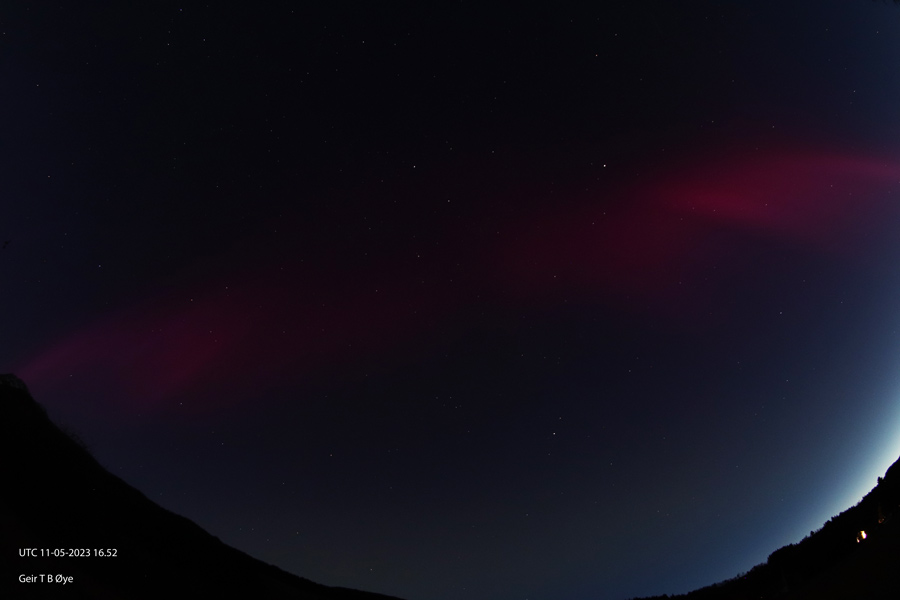
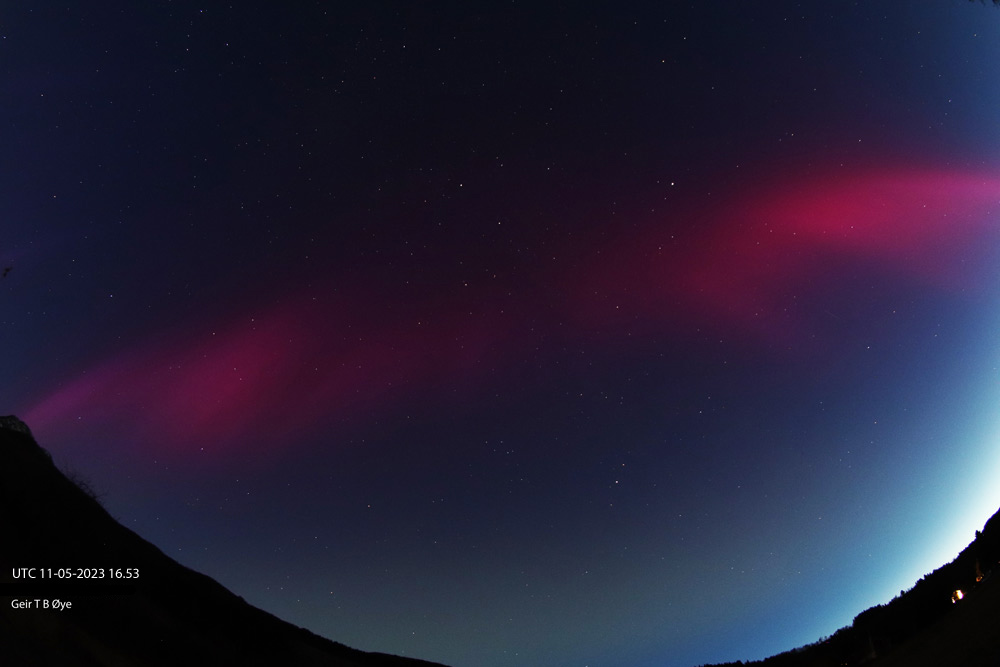
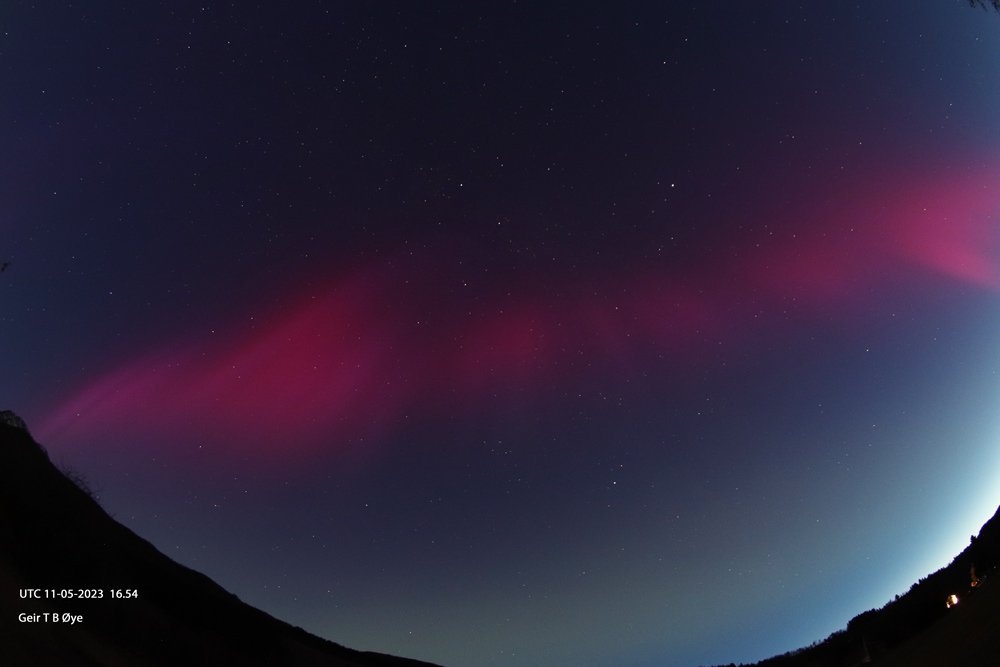
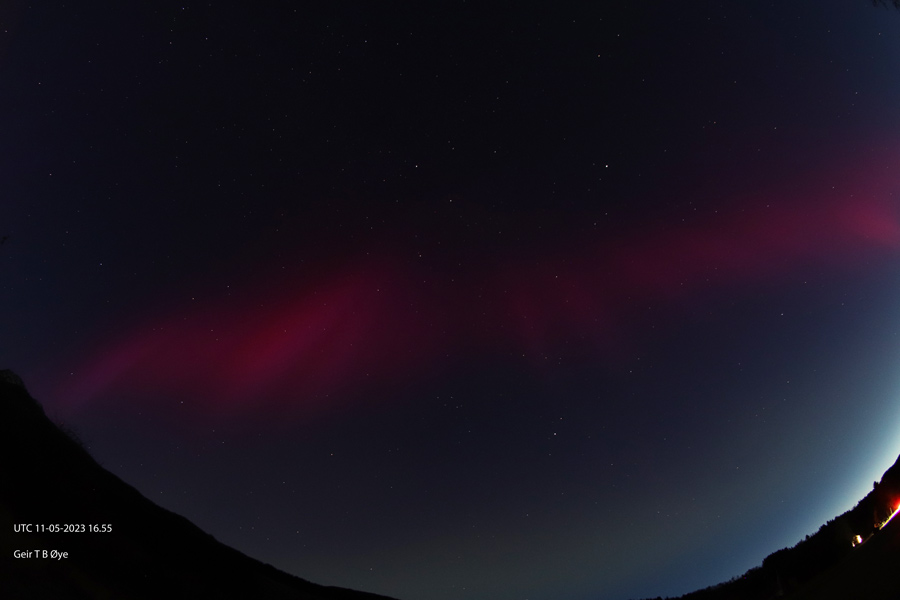
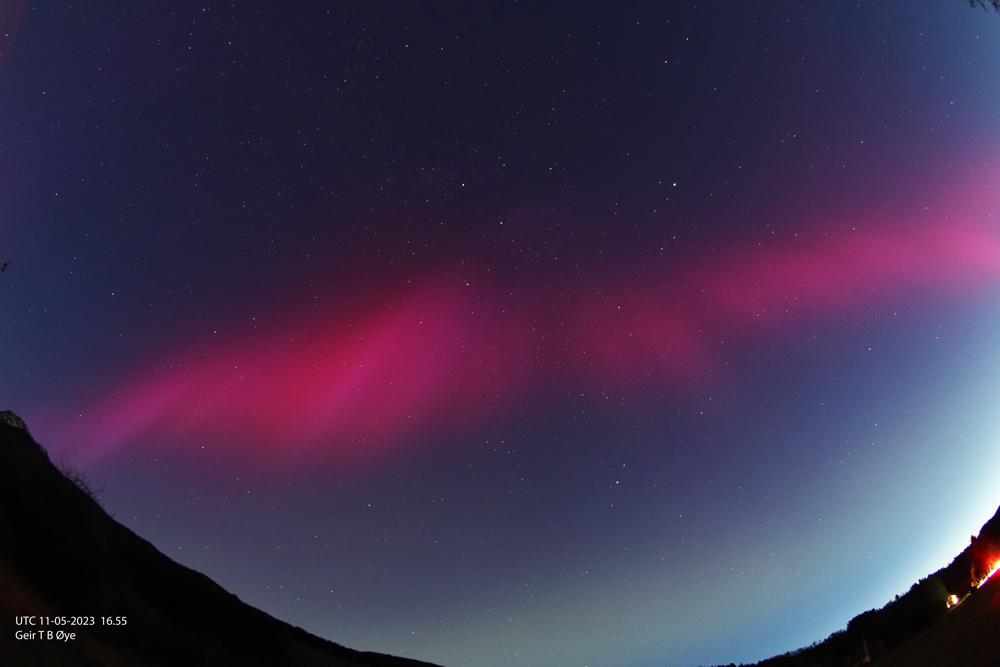
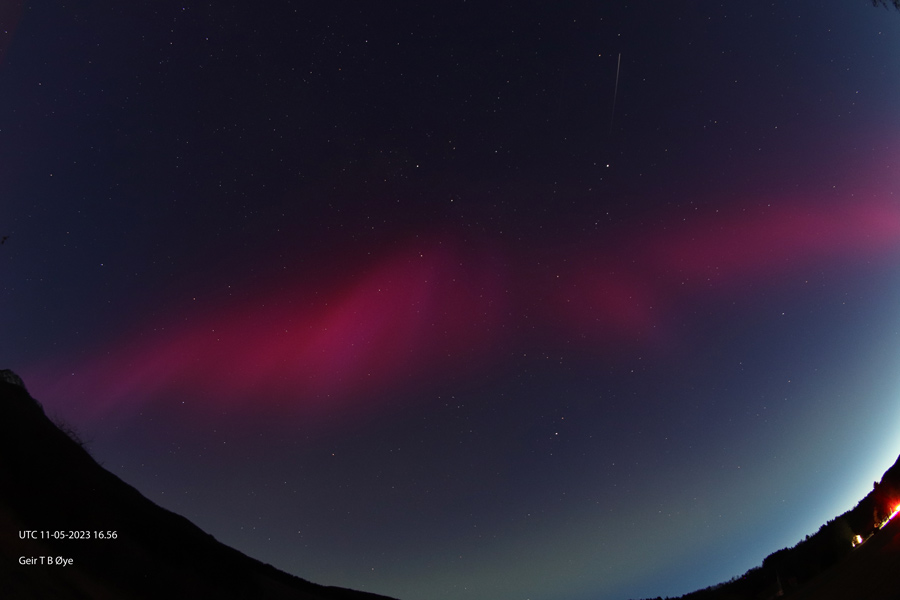
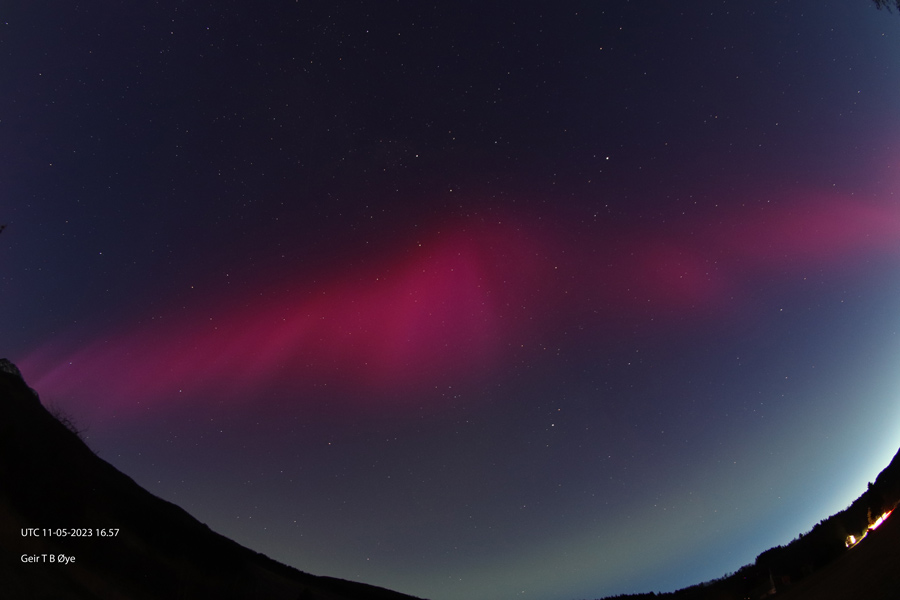
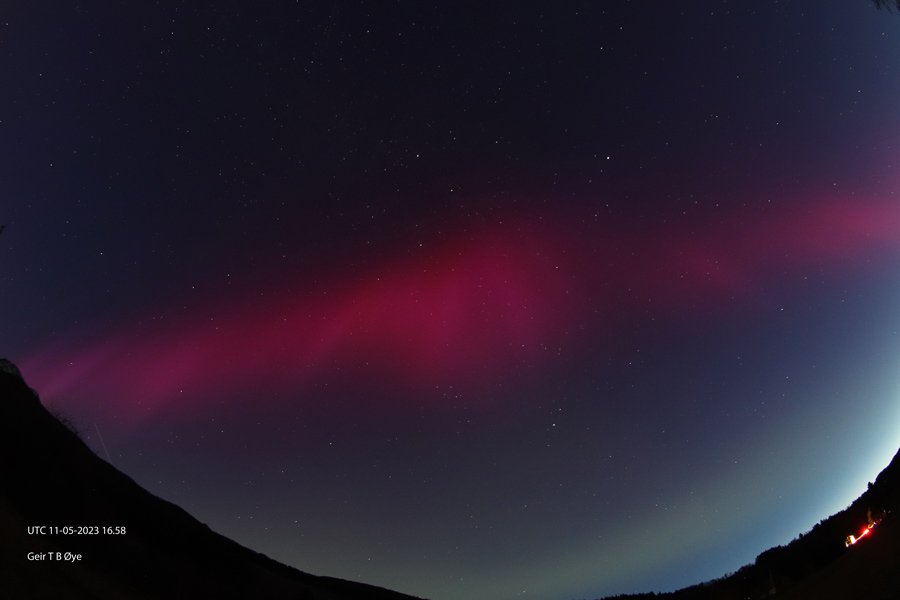
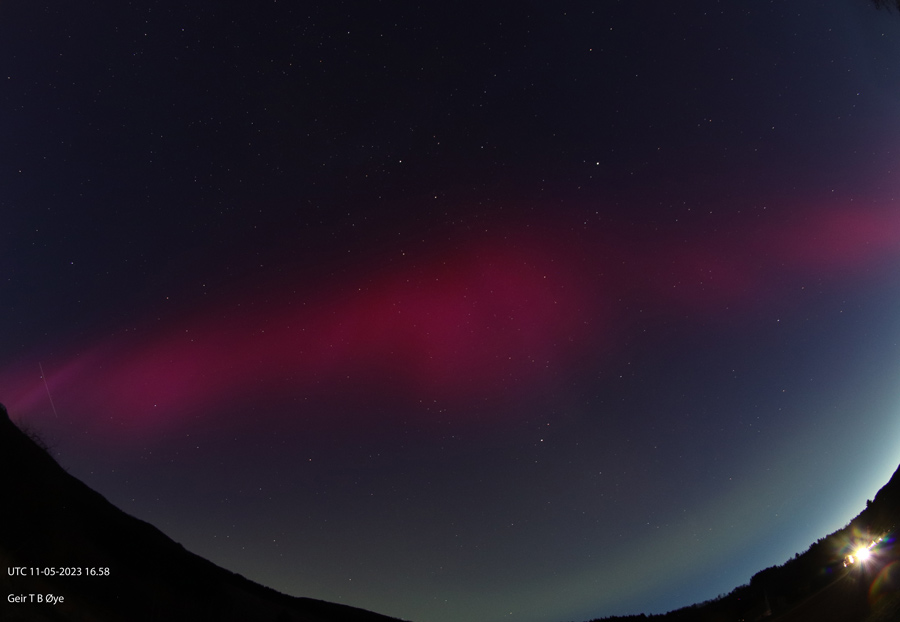
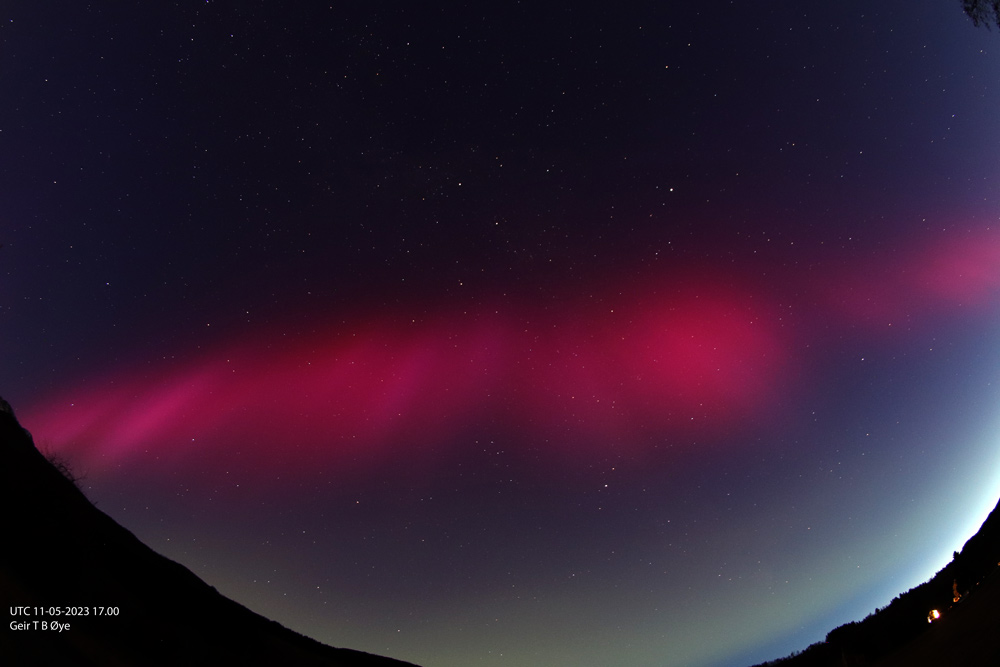
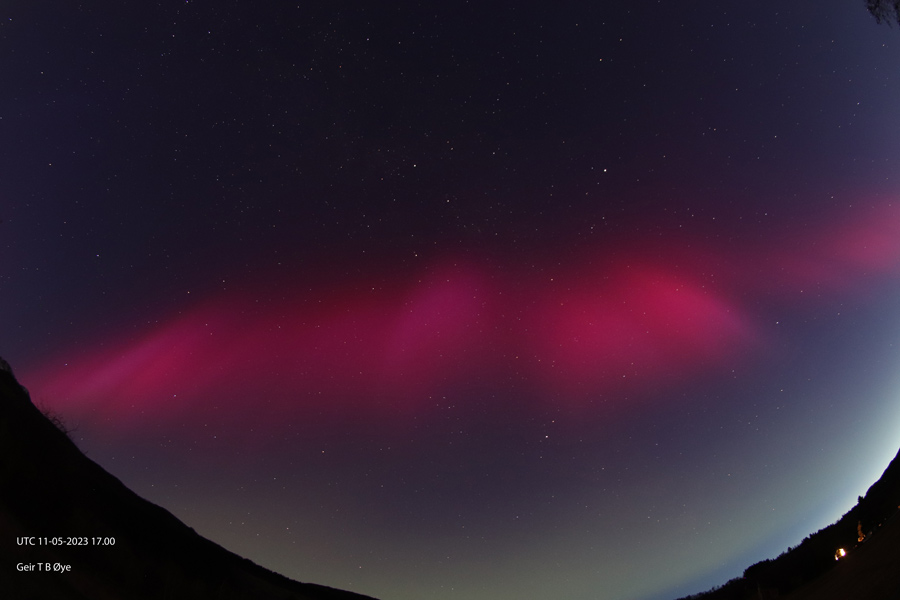
The pictures below are taken from UTC 16.40 to 17.08 on November 5, 2023. I noticed an east-west oriented band stretching over the sky. The following pictures were taken using a fisheye-lens from Ørsta, Norway. Photo details: Meke fisheye-lens, Canon 800D.
– Images captured by the author (Geir T. Birkeland Øye)
– UTC timestamps embedded for scientific verification
– Camera specs: ISO 1600, various exposure times (depending on the brightness of the sky).
– Orientation: Facing south (fisheye-lens view).
– Visuals show a detached, homogeneous red arc without green auroral emission below
Scientific Outreach Summary
This structured red arc was observed from Ørsta, Norway between 16:40 and 17:08 UTC on November 5, 2023 — roughly 90 minutes before global geomagnetic indicators reached storm levels.
The arc appeared smooth, horizontally aligned, and visually detached from dynamic auroral curtains later in the evening. These traits point toward a subauroral optical phenomenon, potentially linked to STEVE or SAR arcs, often driven by ionospheric friction or ring current particle interactions.
Notably, strong auroral activity was already underway locally from 17:09 UTC, despite Kp remaining at moderate levels (~4) and global indices still suggesting calm conditions. This highlights how ground-based observations often precede global model recognition, reinforcing the value of high-resolution visual documentation.
Full geophysical context and time-stamped images are provided above. External collaboration and feedback are welcome