Transient STEVE‑like emission – 2 April 2026
STEVE‑type subauroral emission
2 April 2026 — Ørsta, Norway
Time: 20:16–20:22 UTC
Observation type: DSLR documentation of a transient subauroral STEVE‑like emission
Observer: Geir T. Birkeland Øye
Location: Ørsta, Norway
Instrument: Canon 650D, 8 mm fisheye lens, high‑resolution short‑exposure sequence
Summary
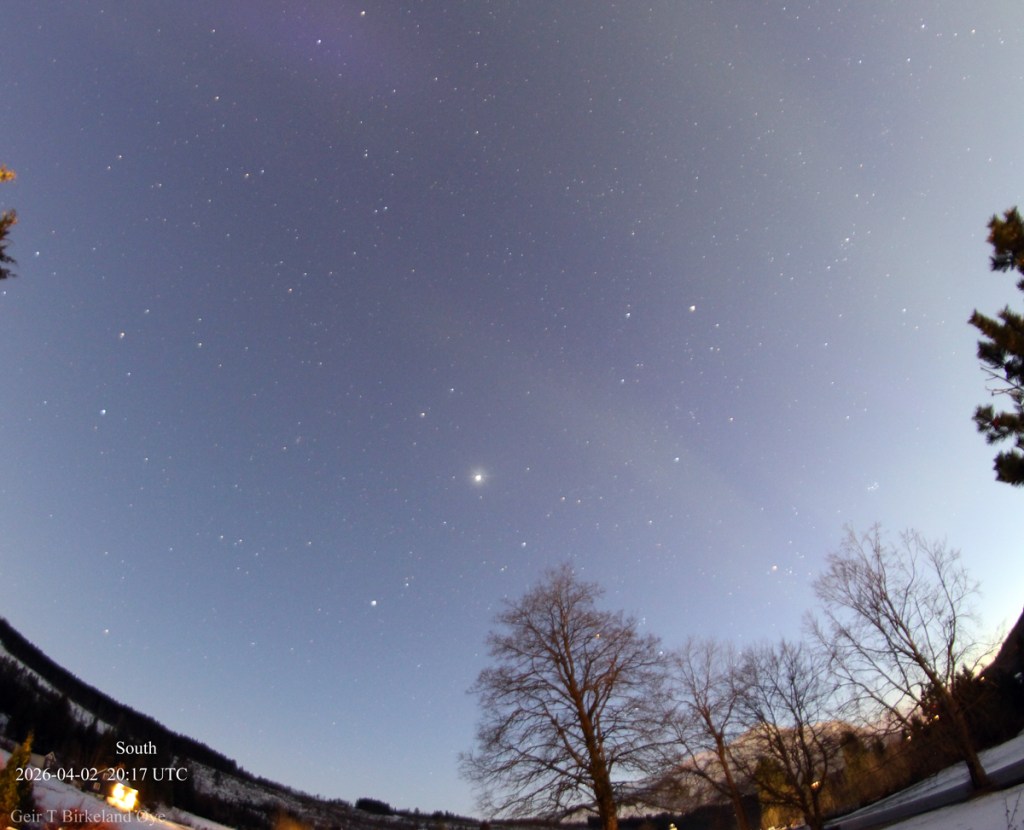
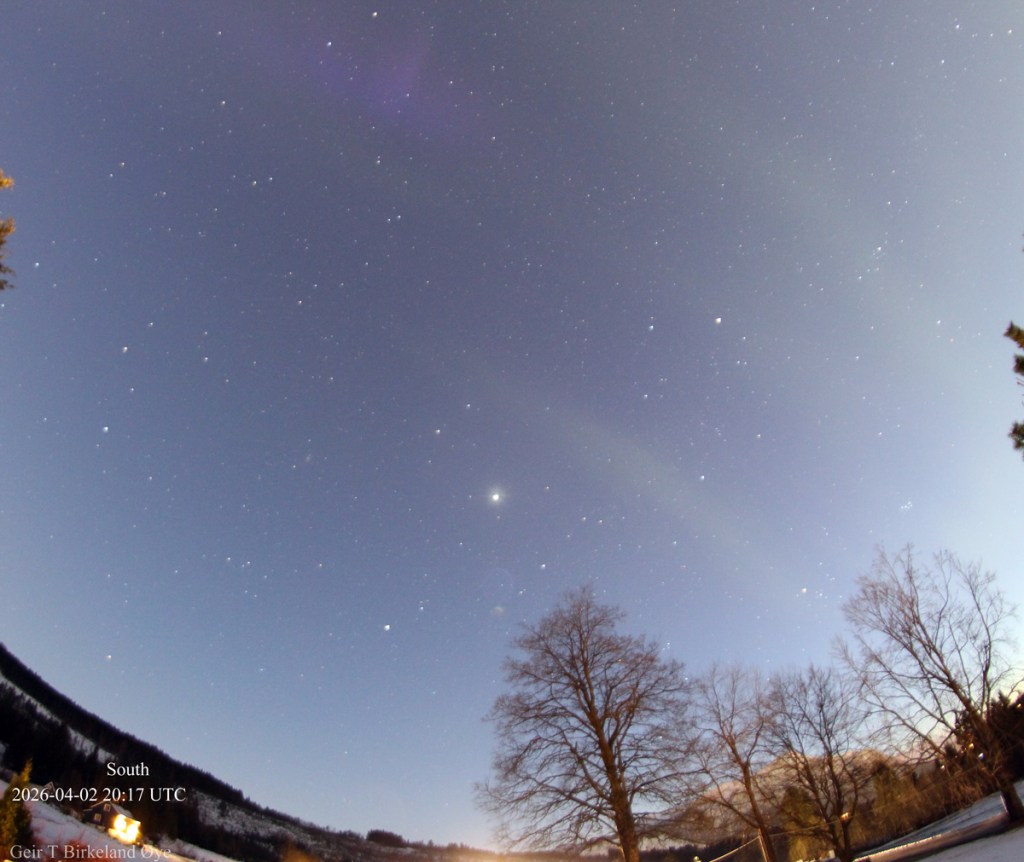
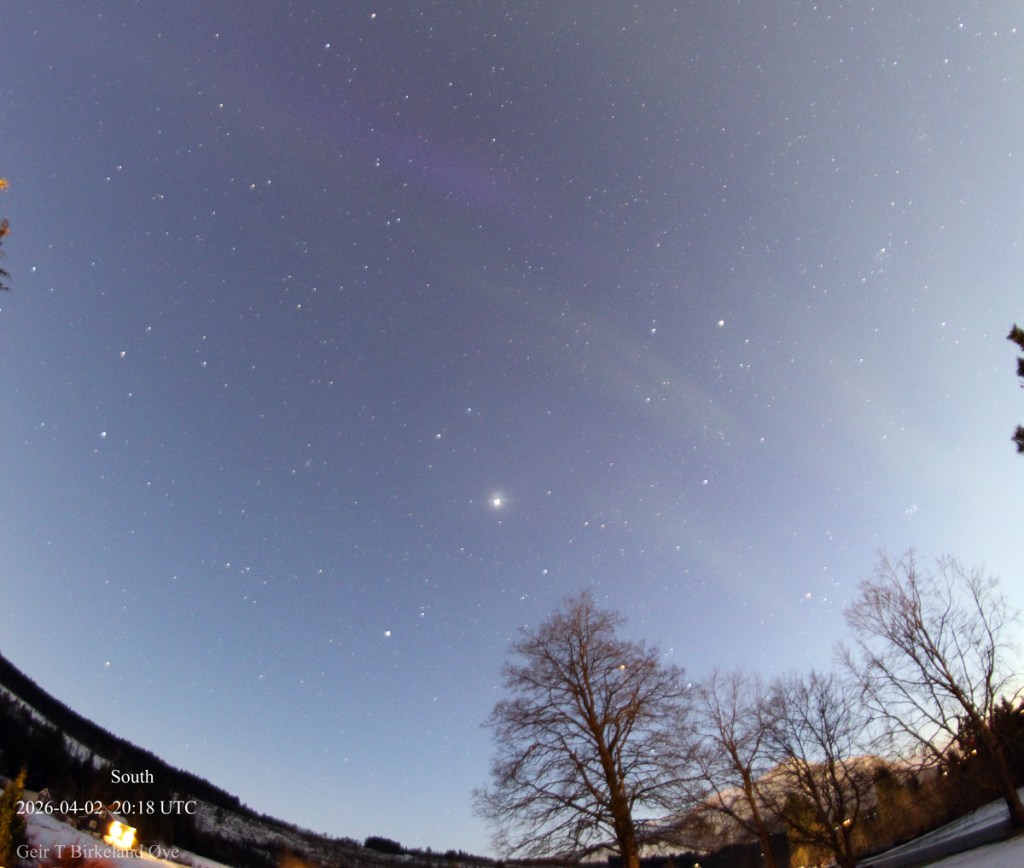
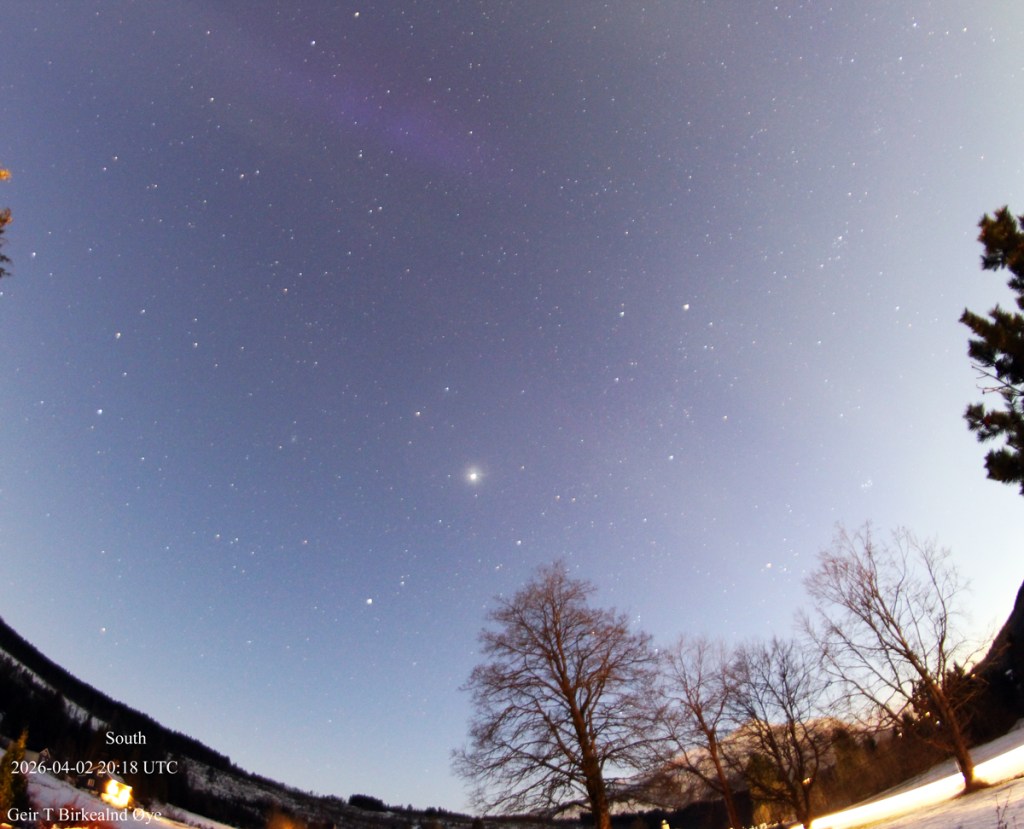
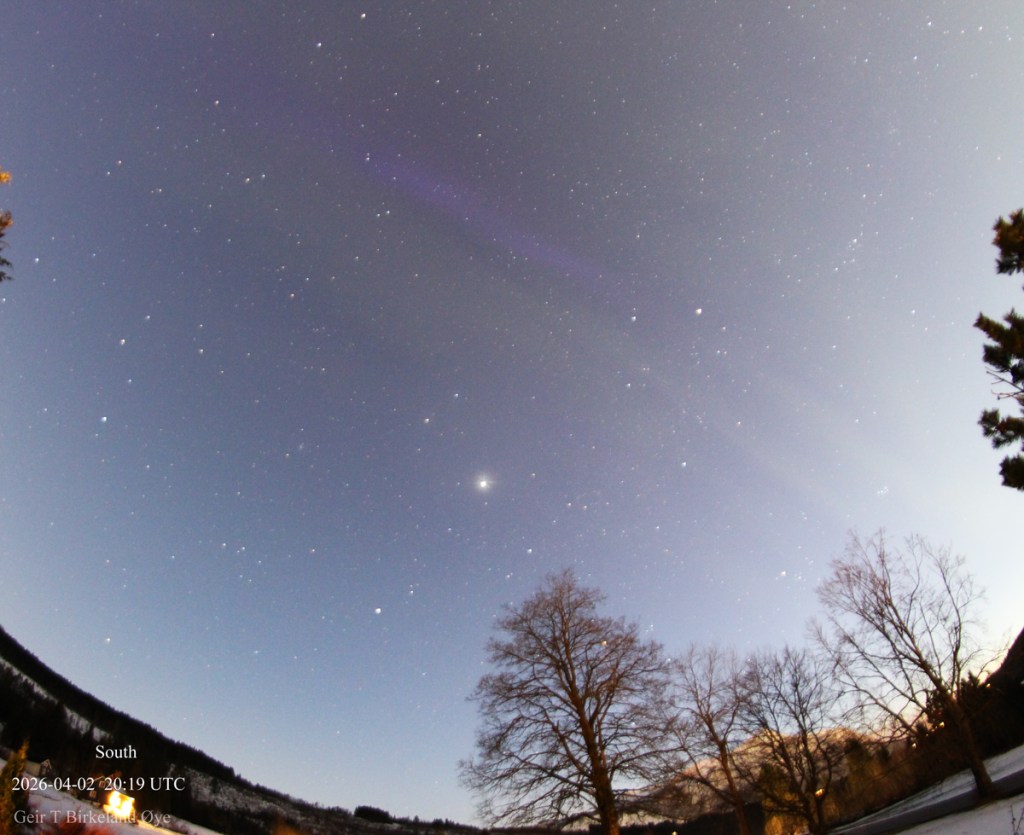
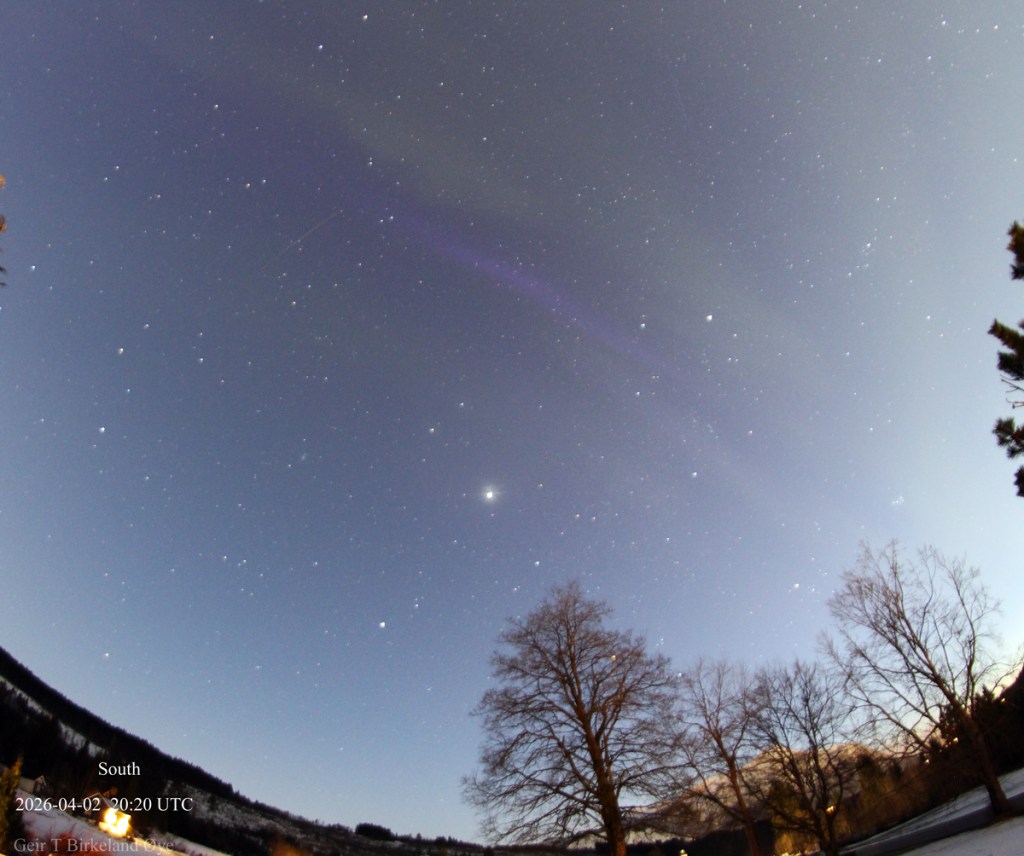
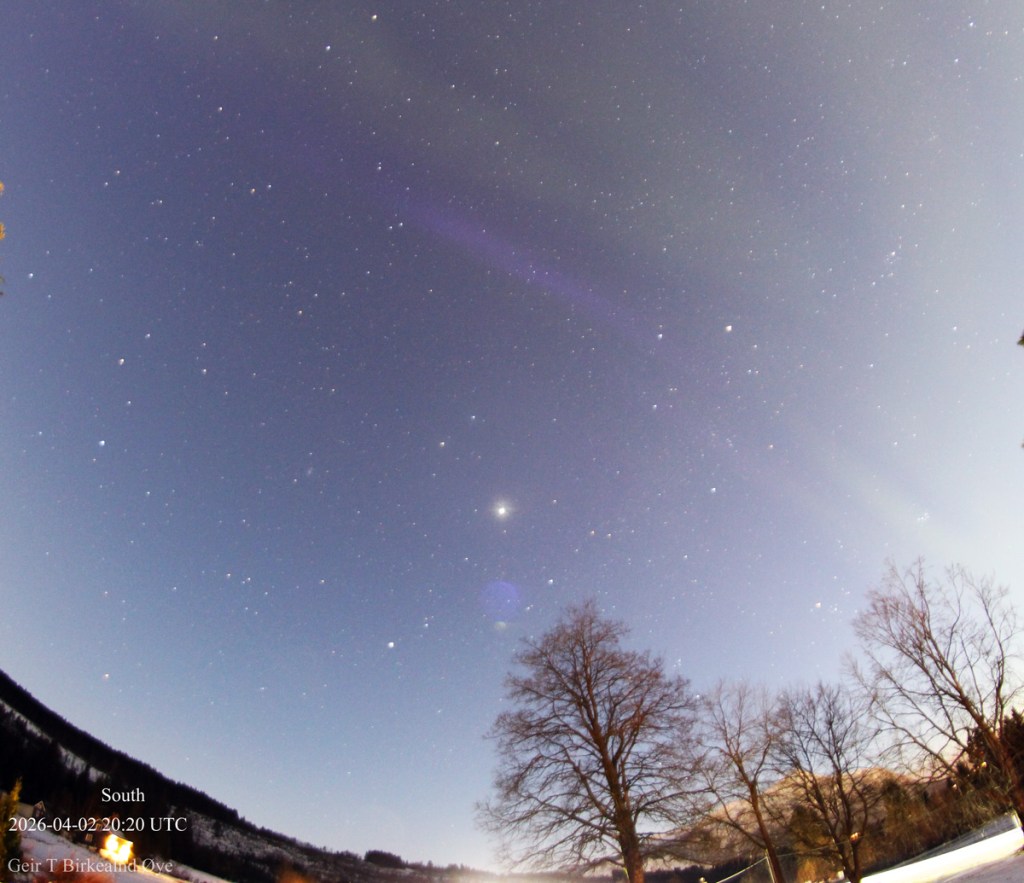
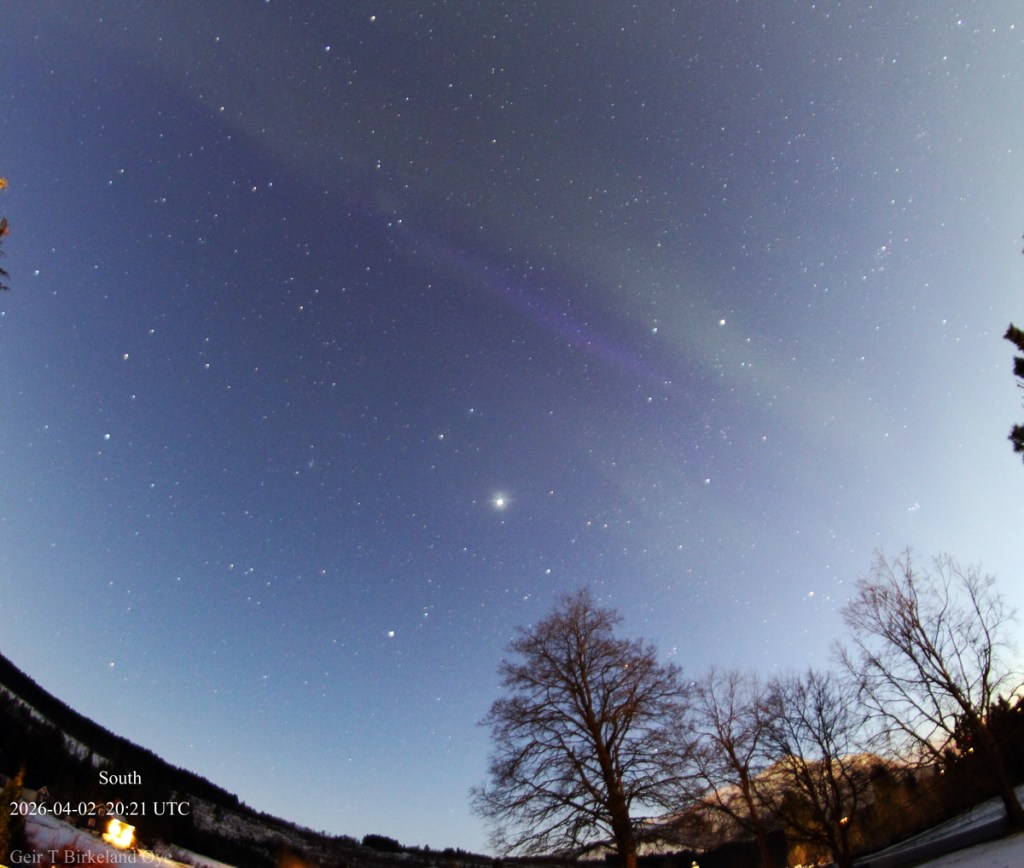
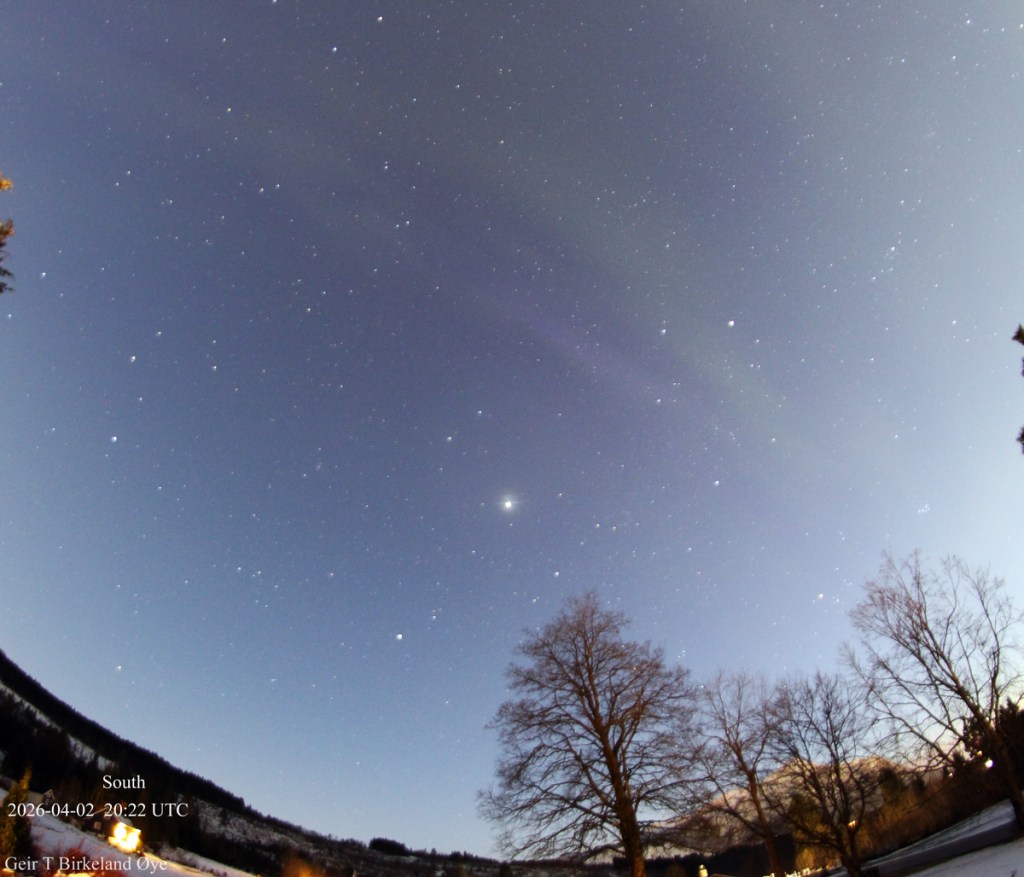
A transient subauroral optical emission consistent with the STEVE (Strong Thermal Emission Velocity Enhancement) phenomenon was observed south of the auroral oval on 2 April 2026. The event began as a compact purple/magenta subauroral blob around 20:16 UTC, which rapidly elongated into a narrow, well‑defined east–west arc. The emission persisted for approximately six minutes before dissipating.
Throughout the entire sequence, the structure displayed a stable purple–magenta continuum with no green (557.7 nm) or red (630.0 nm) oxygen‑line auroral features, and no curtain‑like or rayed morphology. This spectral appearance is characteristic of STEVE, which is known to produce broadband continuum emission rather than discrete auroral lines.
The full evolution—from initial blob to mature arc and final fading—was captured in a time‑stamped DSLR sequence.
Optical and morphological characteristics
- Initial localized subauroral blob with purple/magenta emission
- Rapid transition into a narrow, east–west oriented arc
- No picket‑fence structures, no rayed curtains, and no oxygen‑line signatures
- Emission remained smooth, featureless, and continuum‑dominated
- Arc located equatorward of the main auroral oval, consistent with subauroral ion drift regions
This morphology aligns with documented STEVE events associated with SAID/SAPS channels.
Geomagnetic and solar‑wind context
Solar wind conditions on 2 April were already disturbed due to preceding coronal mass ejections (CMEs). Such conditions are favourable for the formation of subauroral ion drift channels, which can generate STEVE‑type emissions.
Key contextual points:
- Disturbed solar wind from earlier CMEs
- Enhanced geomagnetic activity at subauroral latitudes
- Conditions supportive of fast, localized ionospheric flow channels
- STEVE events are commonly short‑lived under such transient SAID/SAPS regimes
The brief duration (6 minutes) is fully consistent with known STEVE behaviour.
Interpretation
The event is best classified as a STEVE‑type subauroral emission, based on:
- Subauroral location
- Purple/magenta continuum emission
- Absence of discrete auroral lines
- Rapid blob‑to‑arc evolution
- Occurrence during disturbed geomagnetic conditions
The high‑resolution, time‑stamped imagery provides a complete record of the event, including the rarely documented initial blob phase, making this a scientifically valuable observation.
Norsk
STEVE‑liknande subauroral emisjon – 2. april 2026
Ei kortvarig subauroral lysfenomen vart observert sør for nordlysovaen i Ørsta mellom 20:16 og 20:22 UTC. Hendinga starta som ein kompakt lilla/magenta “blob”, som raskt strekte seg ut til ein tydeleg aust–vest‑gåande STEVE‑struktur.
Emisjonen hadde gjennom heile forløpet ein jamn lilla/magenta kontinuerleg spektral karakter, utan grøne eller raude oksygenliner og utan gardin‑ eller strålestrukturar. Dette er typisk for STEVE, som ikkje er eit tradisjonelt nordlys, men eit optisk uttrykk for raske subaurorale ionedriftar (SAID/SAPS).
Solvindforholda var forstyrra av tidlegare CME‑ar, noko som gav gode vilkår for slike fenomen. Den korte varigheita er i tråd med kjende STEVE‑observasjonar.
Hendinga er klassifisert som ei STEVE‑type subauroral emisjon, og bileta dokumenterer heile utviklinga frå første blob til bortfall.
 Color and Light On And Beyond The Earth