On November 13, 2026, at 19:10:43 UTC, my DSLR camera, located in Ørsta, Norway, captured a bright sporadic meteor followed by a faint, reddish persistent train in consecutive one-minute exposures from 19:11 to 19:13 UTC. Despite drifting thin clouds and challenging sky conditions, the red-orange afterglow—consistent with chemiluminescent emission from meteor-trail chemistry—can be seen drifting against the background stars in the cropped follow-up frames. DSLR images cannot identify the emitting species.
Details: Canon EOS 650D, 8 mm fisheye lens, ISO 1600.
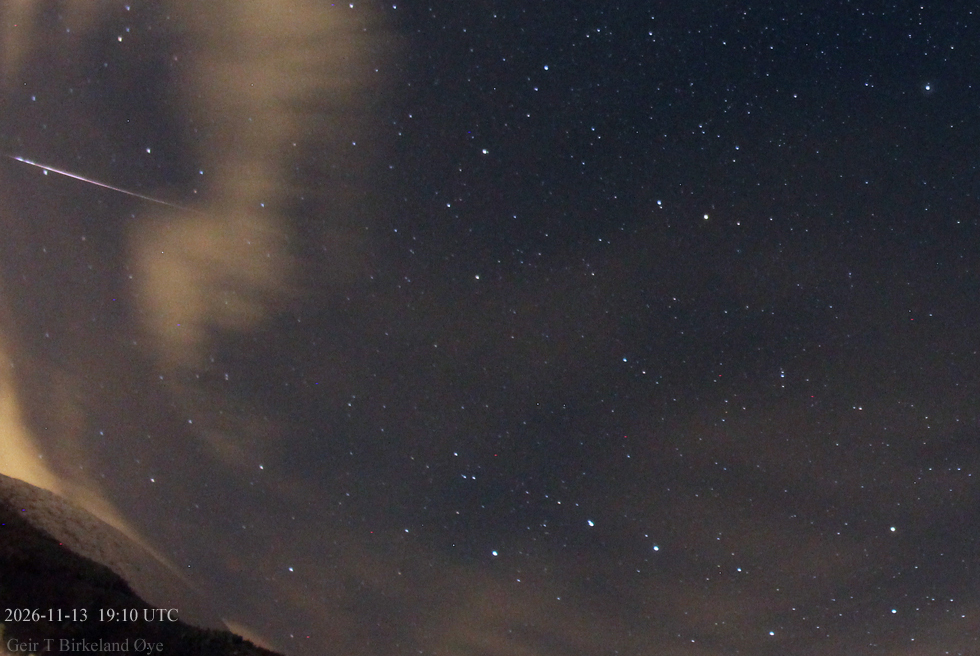
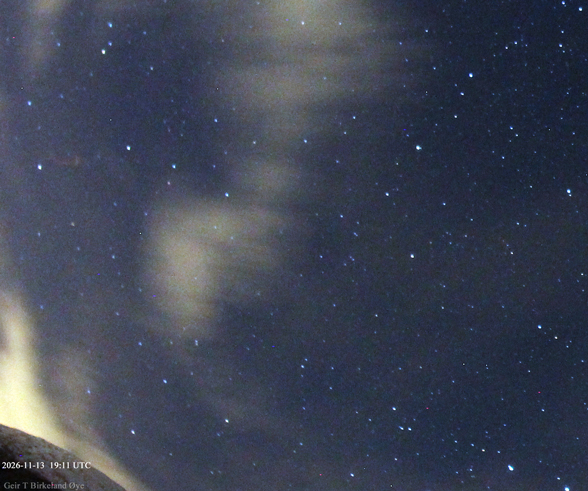
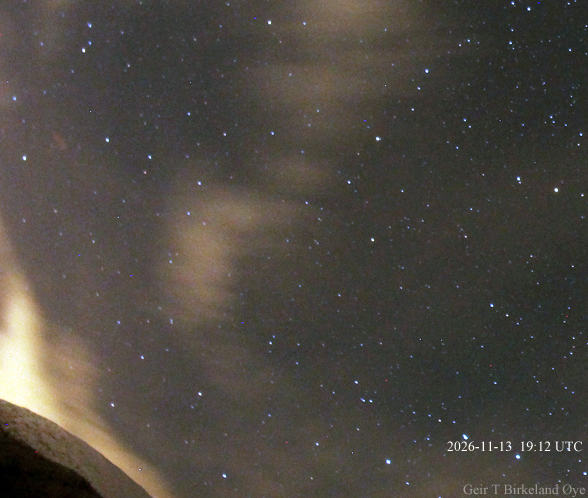
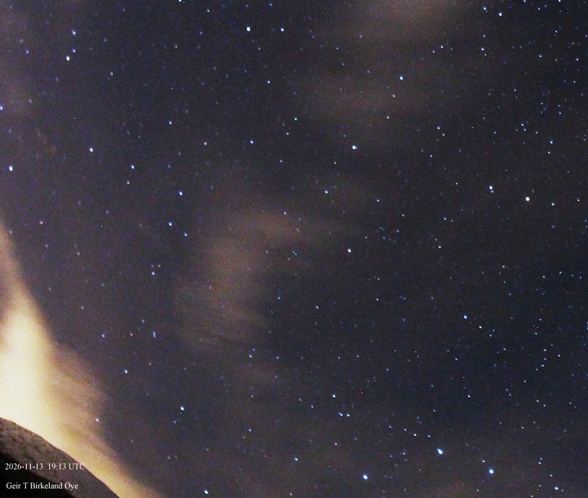
The meteor was simultaneously recorded by my AllSky7 station (AMS 135) and four other stations in the Norwegian Meteor Network (Norsk meteornettverk). According to the network’s triangulation data, the meteoroid entered the atmosphere at 59.4 km/s and disintegrated between 113.4 km and 77.0 km altitude over the coast near Måløy.
Link to report: Norsk meteornettverk
A rough mesospheric wind and orbital analysis (with substantial uncertainty)
Based on the Norwegian Meteor Network’s triangulation data, the meteoroid was on a hyperbolic, retrograde orbit (e = 1.056, i = 114.0°, perihelion distance q = 0.223 AU). It entered the atmosphere at 59.4 km/s and disintegrated between 113.4 km and 77.0 km altitude, at an approximate line-of-sight distance of 190 km from Ørsta.
By tracking the apparent angular drift of the persistent train against the background stars between 19:10 and 19:13 UTC, I estimate that its bright core moved roughly 3.3°–3.8° northwestward. If the distance to the observed part of the train was about 190 km, this corresponds to an apparent displacement of approximately 11–12.5 km over three minutes, or roughly 60–70 m/s in the plane of the sky. This is only a rough estimate: perspective and uncertainty in the distance affect the calculation. The train’s changing, wavy appearance may be consistent with wind shear, but the images alone cannot establish the wind profile.

