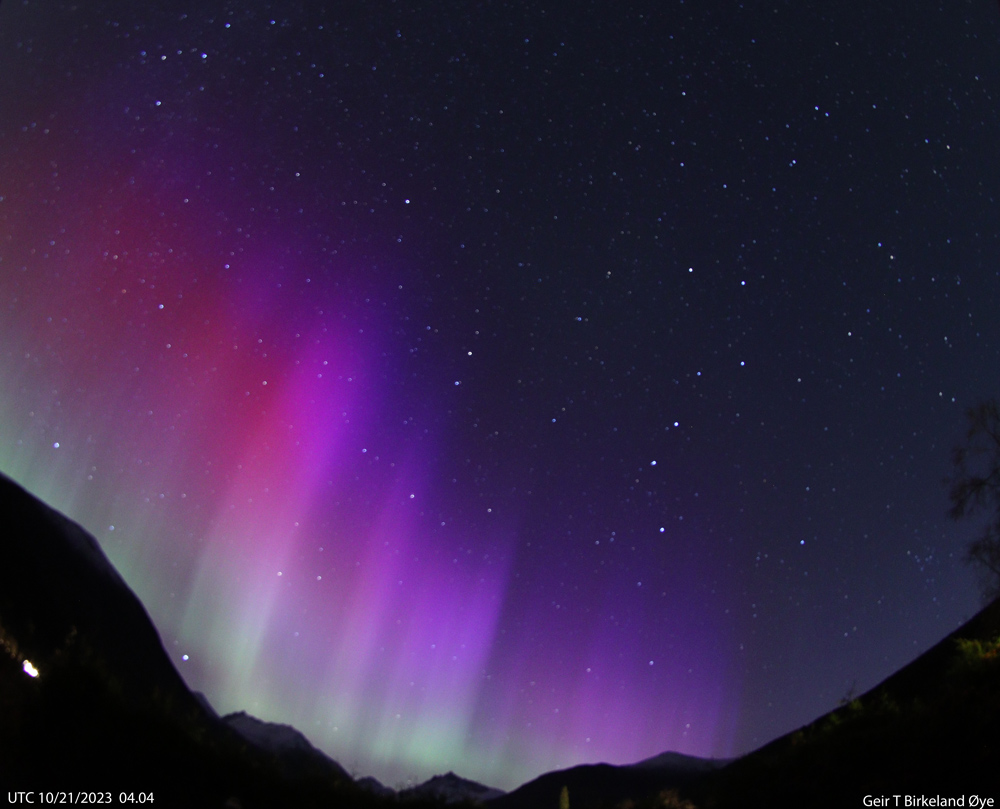
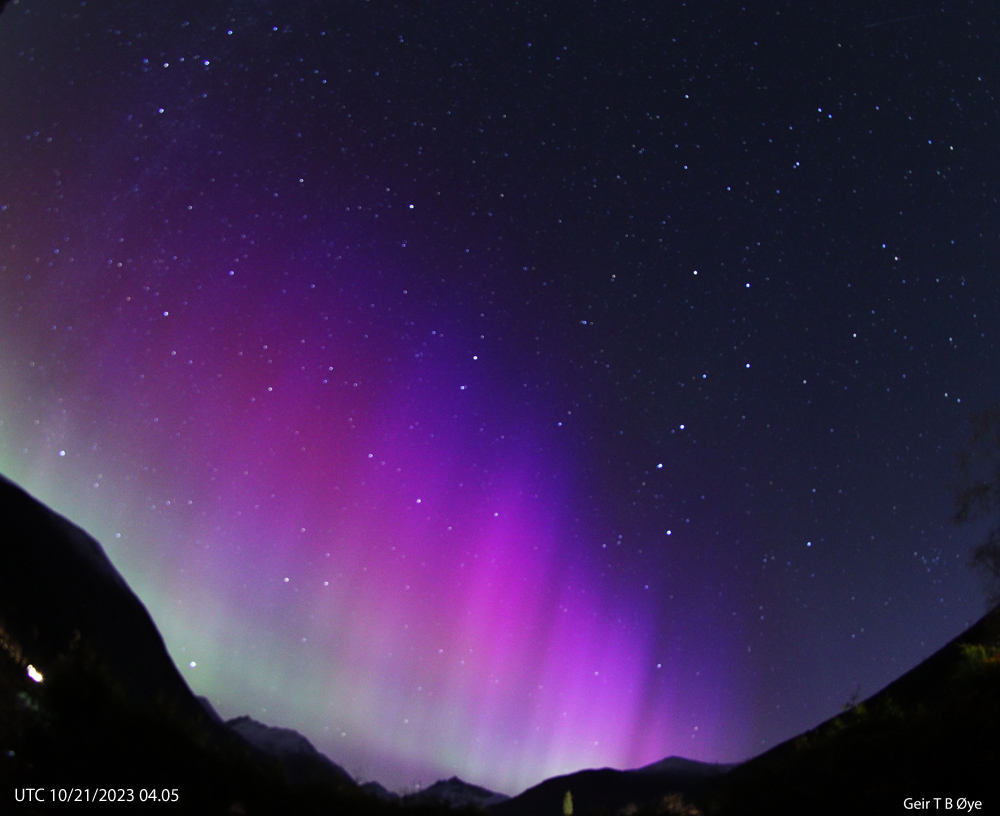
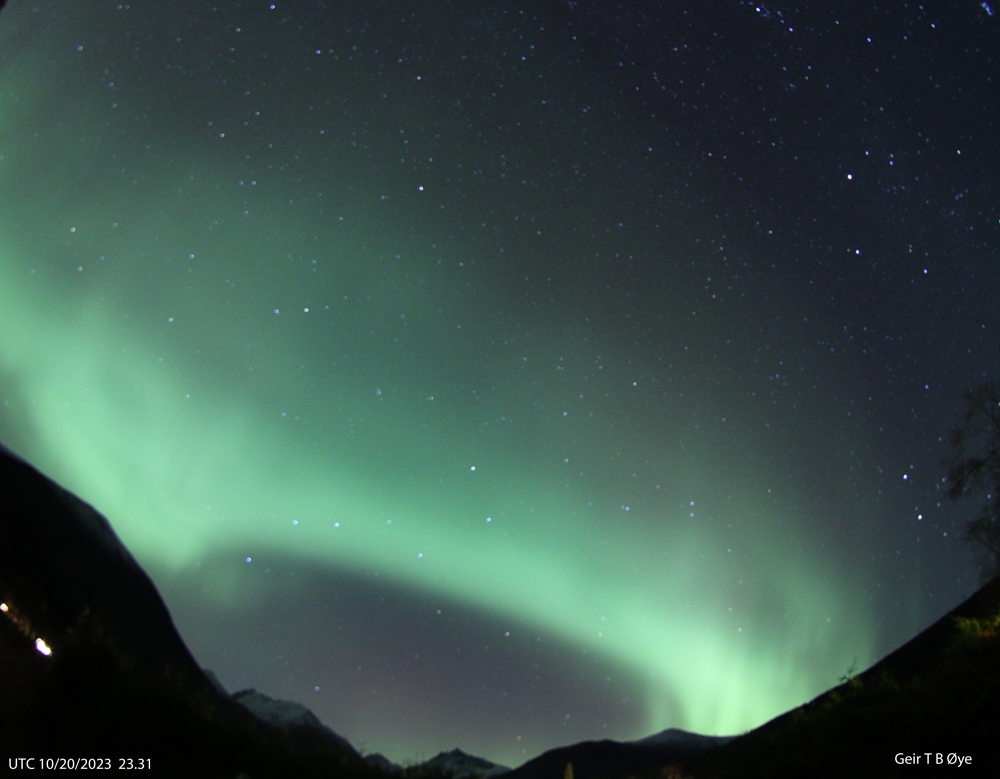
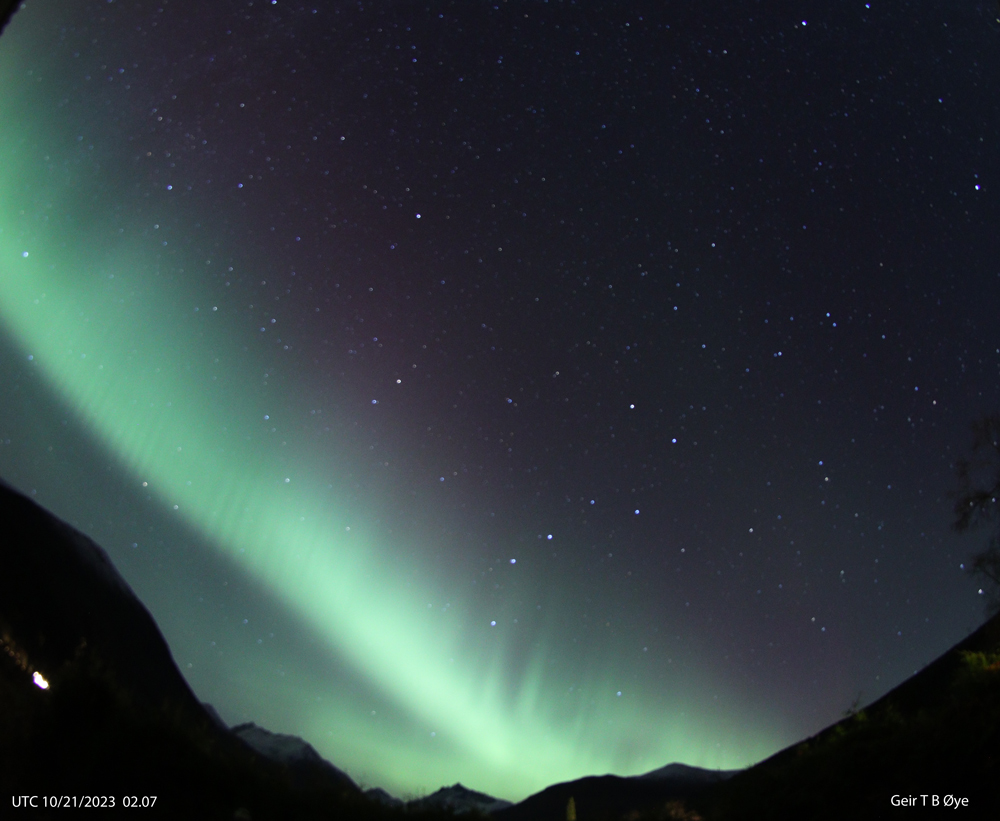
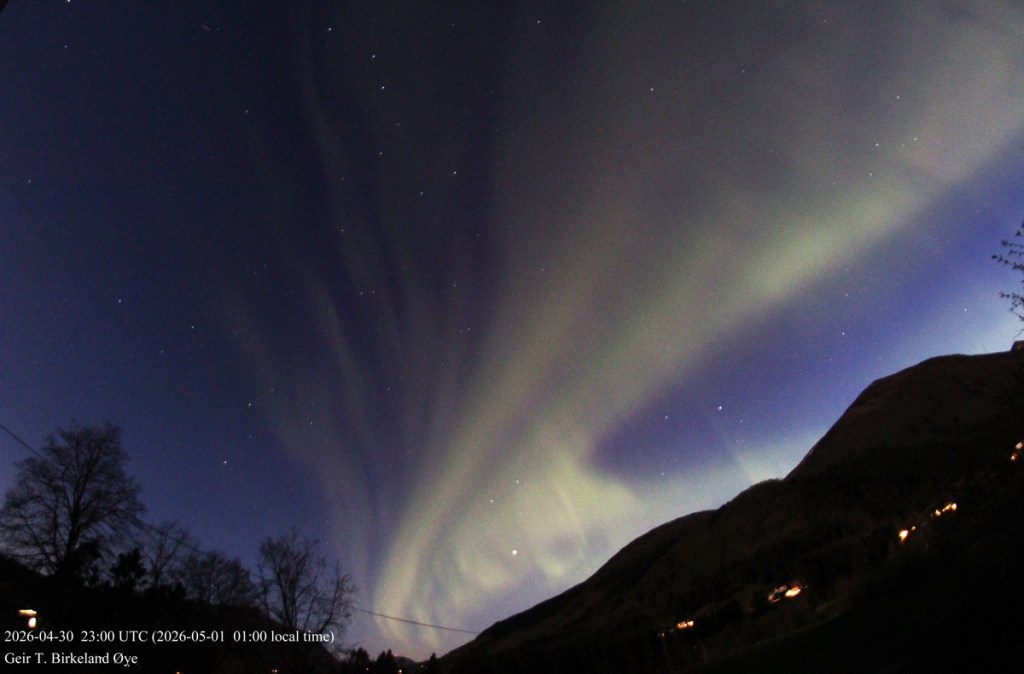
This STEVE event on May 1, 2026 consisted of two distinct phases: an earlier 23:10 UTC exposure showing faint picket fence low above the treeline, followed by a later 23:15–23:16 UTC phase where STEVE appeared alone. The images below document both phases.
Phase 1 — 23:10 UTC (STEVE with faint picket fence)
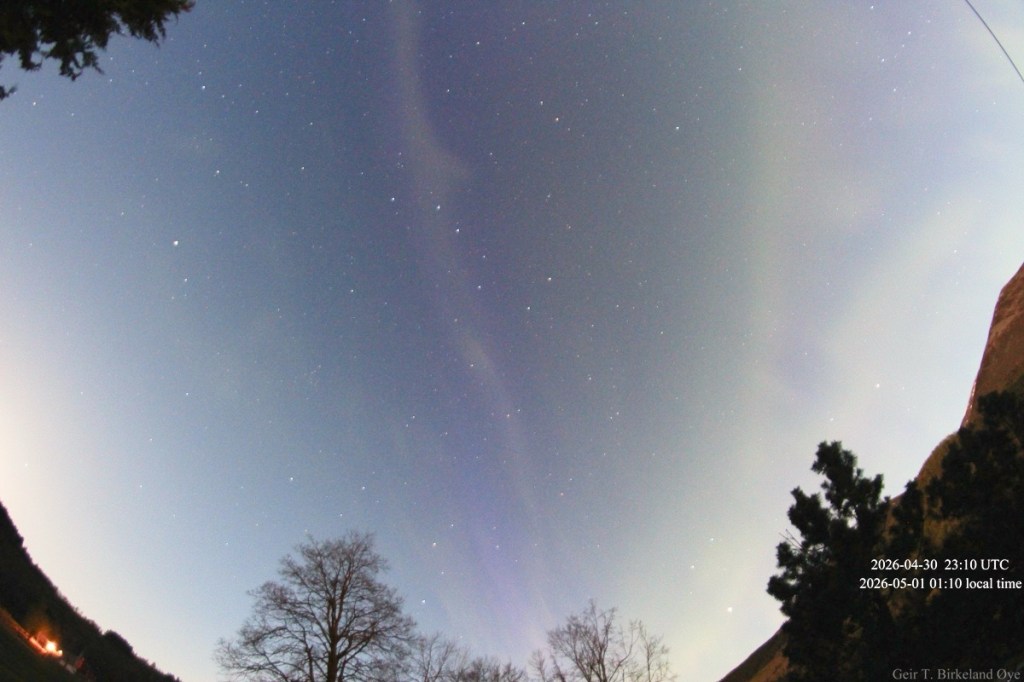
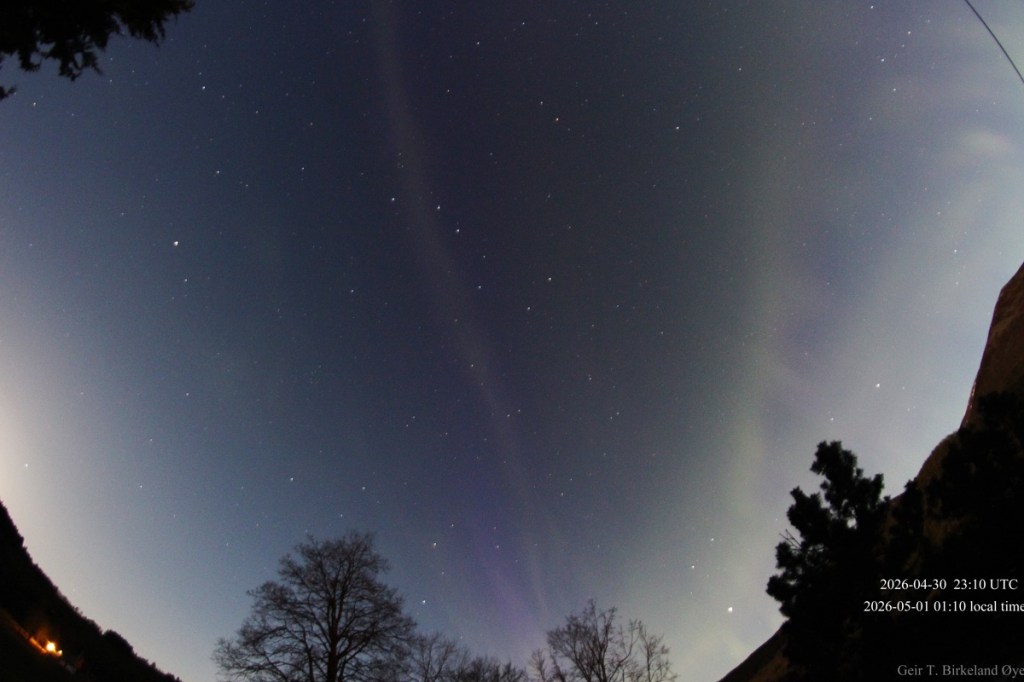
A narrow subauroral arc appeared over Follestaddalen around 23:10 UTC, following a clear separation from the auroral oval. The structure, timing, and behaviour were consistent with a STEVE‑like event. Although the characteristic mauve colour was difficult to see visually due to bright moonlight and a generally bright sky, the camera sequence revealed a narrow, uniform arc crossing directly through zenith.
The viewing geometry is important for interpreting the green structures beneath the arc. Because the STEVE arc passed overhead, the green, vertically structured band (“probable picket fence”) was seen directly from below. This foreshortens the vertical columns and causes them to appear broad, diffuse, and partially overlapping, rather than as the sharp, well‑separated spikes typically seen when picket fence is observed closer to the horizon. The sequence shows a faint but vertically modulated green band near the crossing point, consistent with a weak or developing picket‑fence structure.
This was a short‑lived late‑season event, lasting only a few minutes before fading into the brightening spring sky.
Summary of the May 1, 2026 STEVE Event
The event unfolded in two stages. At 23:10 UTC, a narrow SAID structure appeared above the treeline with faint picket‑fence elements. As the SAID band shifted slightly, the true STEVE arc — a thin mauve N₂⁺ line — became visible behind it, revealing the layered geometry of the system.
By 23:15–23:16 UTC, SAID had weakened into a diffuse green subauroral band, while STEVE remained as a narrow, isolated arc. No picket fence was present in this later phase.
A clean transition was observed:
23:10 — STEVE + faint PF + narrow SAID
23:15–23:16 — STEVE alone + diffuse green band
Please see the entire sequence below.
Image Sequence
Phase 2 — STEVE alone
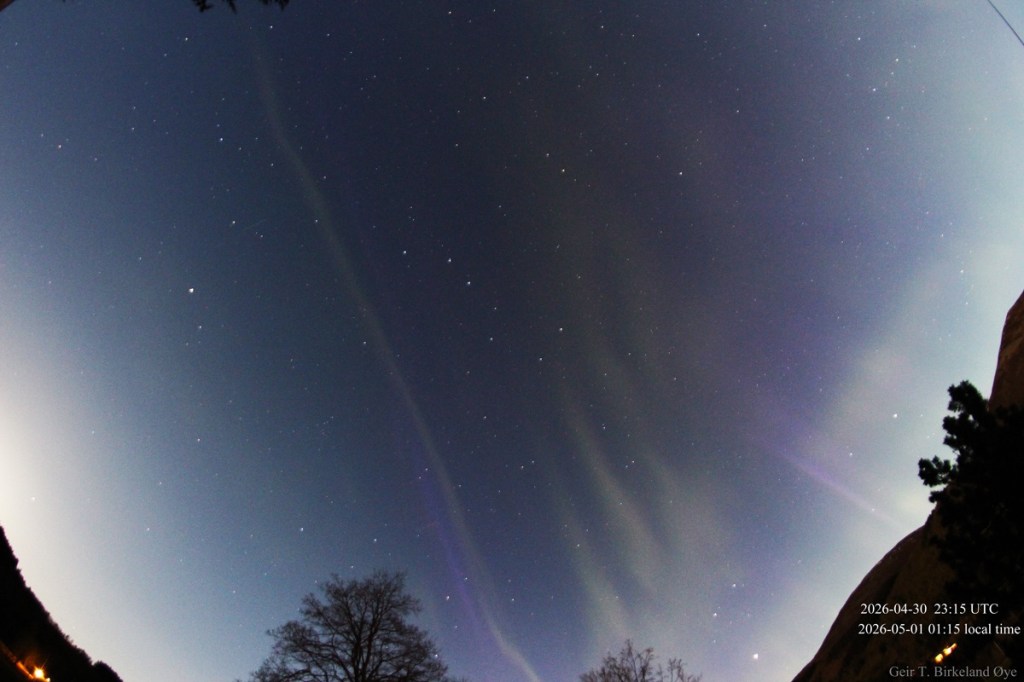
In this later phase (23:15–23:16), STEVE appears alone in the images; the green diffuse emission below the band is not picket fence.
The difference between the two frames may explain why some external pages interpreted the later image as containing picket fence.
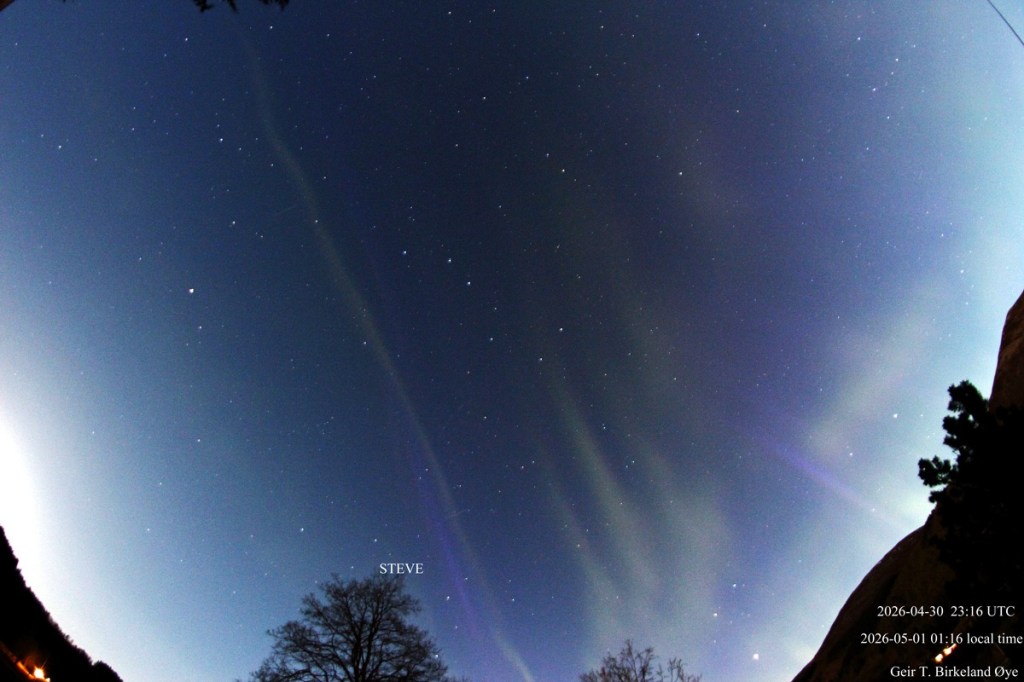
This is a weak subauroral green emission layer that often appears with STEVE, but is physically separate from the STEVE mechanism. However, the diffuse green band beneath STEVE is produced by the same particle‑injection process that creates picket fence, but it is not picket fence itself. When the injections are weak or continuous, the pillars disappear and the emission becomes a smooth green arc.
The green diffuse emission
The green diffuse emission below the STEVE band is not picket fence.
This is a weak subauroral green emission layer caused by low‑level particle precipitation north of the SAID/STEVE region.
It often appears together with STEVE in images, but it is physically separate from the STEVE mechanism and does not form vertical structures.
Phase summary
Phase 1 (23:10): Clear picket fence north of the STEVE region.
Phase 2 (23:15–23:16): STEVE without PF; weak green diffuse emission appears below the band at 23:16.
Color profile
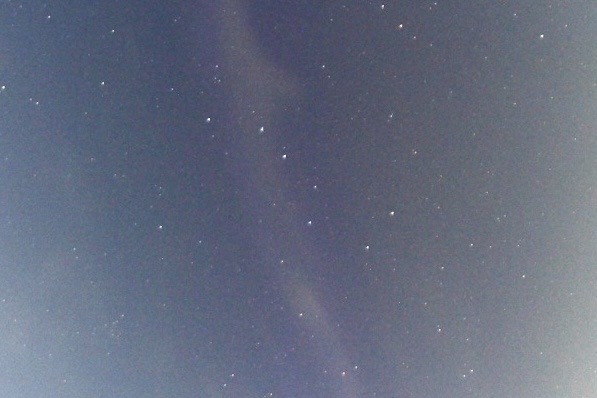
The color profile at 23:10 UTC captures the STEVE arc at its peak, when the mauve band was widest and most intense near zenith. The profile shows dominant N₂⁺ emission with minimal green contamination, consistent with a fully developed SAID channel during the brightest phase of the event. A faint mauve halo surrounds the central structure, reflecting strong N₂⁺ excitation in the core of the arc.
Post‑peak profile showing dominant N₂⁺ emission as the SAID channel weakens. No 5577 Å contribution is present inside the mauve band.
Scientific summary
- STEVE observed between 23:10–23:16 UTC
- Faint picket fence present only at 23:10 UTC
- No picket fence visible in the 23:15–23:16 UTC phase
- Green diffuse emission present in both frames
- Geometry consistent with low‑altitude subauroral structures
Equipment: Canon EOS 650D with an 8 mm fisheye lens, ISO 1600, and varying exposure times depending on sky brightness.
______________________________________________
STEVE – eit smalt, lilla lysband i den øvre atmosfæren
STEVE (Strong Thermal Emission Velocity Enhancement) er eit sjeldent himmelfenomen som ser ut som eit smalt, lilla eller rosa lysband som ligg sør for den vanlege nordlyssona. Det er ikkje klassisk nordlys, men eit subauroralt fenomen som oppstår når ionar i den øvre atmosfæren blir skyvde ekstremt raskt sidelengs av sterke elektriske felt.
Kvar skjer STEVE?
STEVE oppstår i F‑regionen av ionosfæren, rundt 200–300 km over bakken – mykje høgare enn det grøne nordlyset.
Kva lagar lyset?
Lyset kjem frå oppvarma ionisert nitrogen (N₂⁺) som gløder i ein mauve/lilla farge.
Dette skjer når:
- iondrift og temperatur aukar kraftig
- elektriske felt pressar ionar sidelengs
- den subaurorale ionosfæren blir ekstremt varm
STEVE er altså eit varme‑ og hastighetsfenomen, ikkje eit partikkel‑bombardement som vanleg aurora.
Korleis ser STEVE ut?
- smalt og langstrekt
- lilla/rosa glød
- ligg alltid sør for aurora
- varer ofte 5–30 minutt
- ingen vertikale strålar eller bølgjer
Det ser ut som eit lysande, rett band som skjærer gjennom himmelen.
STEVE – a narrow, purple light band in the upper atmosphere
STEVE (Strong Thermal Emission Velocity Enhancement) is a rare sky phenomenon that appears as a narrow purple or pink arc south of the normal auroral zone. It is not traditional aurora, but a subauroral glow created when ions in the upper atmosphere are pushed sideways at extreme speeds by strong electric fields.
Where does STEVE occur?
STEVE forms in the F‑region of the ionosphere, around 200–300 km altitude — much higher than the green aurora.
What produces the light?
The glow comes from heated ionized nitrogen (N₂⁺) emitting mauve/purple light.
It appears when:
- ion drift becomes extremely fast
- strong electric fields build up
- the subauroral ionosphere heats dramatically
STEVE is therefore a heat‑and‑velocity phenomenon, not particle precipitation like normal aurora.
How does STEVE look?
- narrow and elongated
- purple/pink glow
- always south of the aurora
- lasts 5–30 minutes
- no vertical rays or wave structures
It looks like a straight, glowing ribbon across the sky.